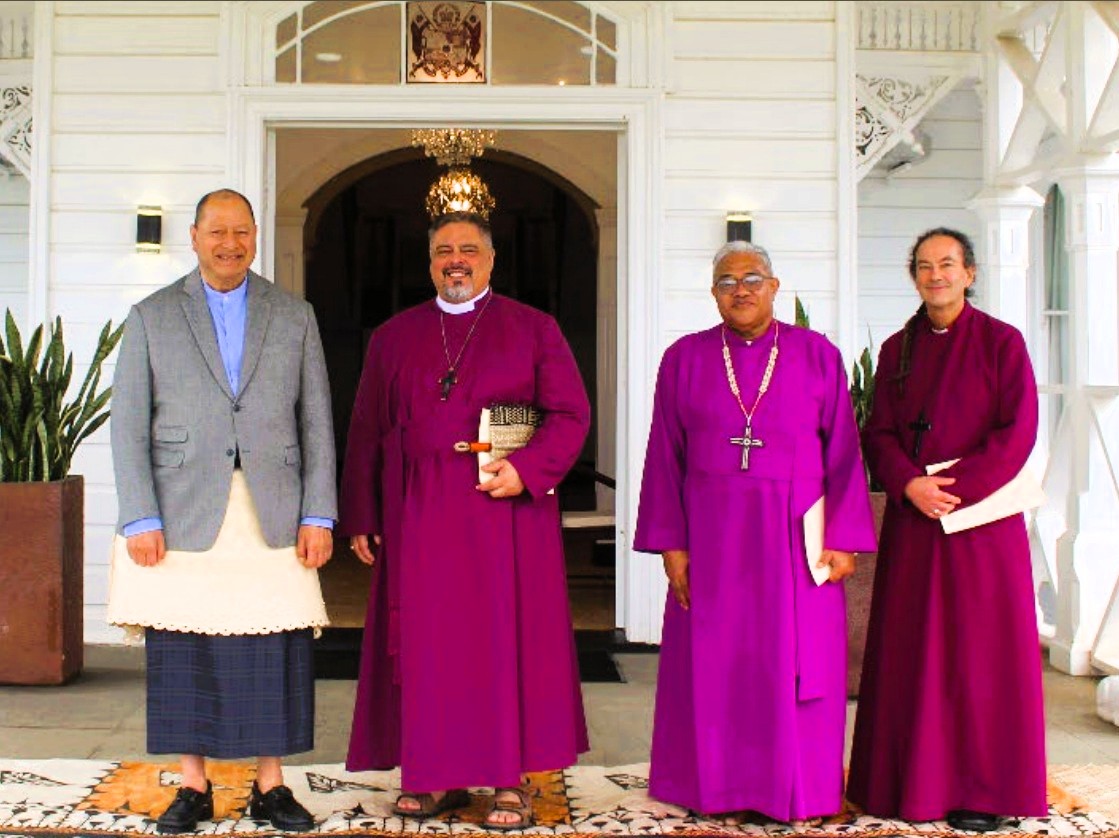
King Tupou VI has used the Tongan concept of Maeakafa to call for unity and shared leadership as the Anglican Church gathers in Tonga for its 67th General Synod.
Welcoming participants of Te Hīnota Whānui in Nukuʻalofa, the King reflected on Maeakafa, a nickname associated with King Tupou I because of his practice of weaving sennit coconut rope.
For King Tupou VI, the image of sennit offered a lesson in the strength that comes from bringing individual strands together.
A single strand may be weak, but when strands are carefully woven together they form something stronger and more resilient.
The King used the image to reflect on the Anglican Church’s three Tikanga leadership and its wider mission across Aotearoa, New Zealand and Polynesia.
He encouraged the Church to carry the same spirit of being woven together as it continues its work, emphasising unity, partnership and shared responsibility.
The reference to Maeakafa also placed the Synod within a distinctly Tongan understanding of leadership. Rather than strength being found in one strand alone, the metaphor points to the value of relationships and the contribution of each part to the strength of the whole.
King Tupou VI also reflected on the longstanding relationship between the Anglican Church and Tonga, particularly through education and traditional leadership.
The 67th General Synod was held in Tonga from 15 to 21 August as part of the Church’s wider gathering across the Pacific. The King acknowledged the three Tikanga leaders and wished participants God’s blessing as they deliberate on the Church’s continuing work.
The message of Maeakafa was ultimately a reminder that unity is not the loss of individual strands, but the strength created when they are woven together.