Your support helps us to tell the story
From reproductive rights to climate change to Big Tech, The Independent is on the ground when the story is developing. Whether it’s investigating the financials of Elon Musk’s pro-Trump PAC or producing our latest documentary, ‘The A Word’, which shines a light on the American women fighting for reproductive rights, we know how important it is to parse out the facts from the messaging.
At such a critical moment in US history, we need reporters on the ground. Your donation allows us to keep sending journalists to speak to both sides of the story.
The Independent is trusted by Americans across the entire political spectrum. And unlike many other quality news outlets, we choose not to lock Americans out of our reporting and analysis with paywalls. We believe quality journalism should be available to everyone, paid for by those who can afford it.
Your support makes all the difference.Read more
As prolonged extreme heat dries up rivers across Europe, the remains of a steam tugboat from the early 1900s have become the latest historic artefact to emerge.
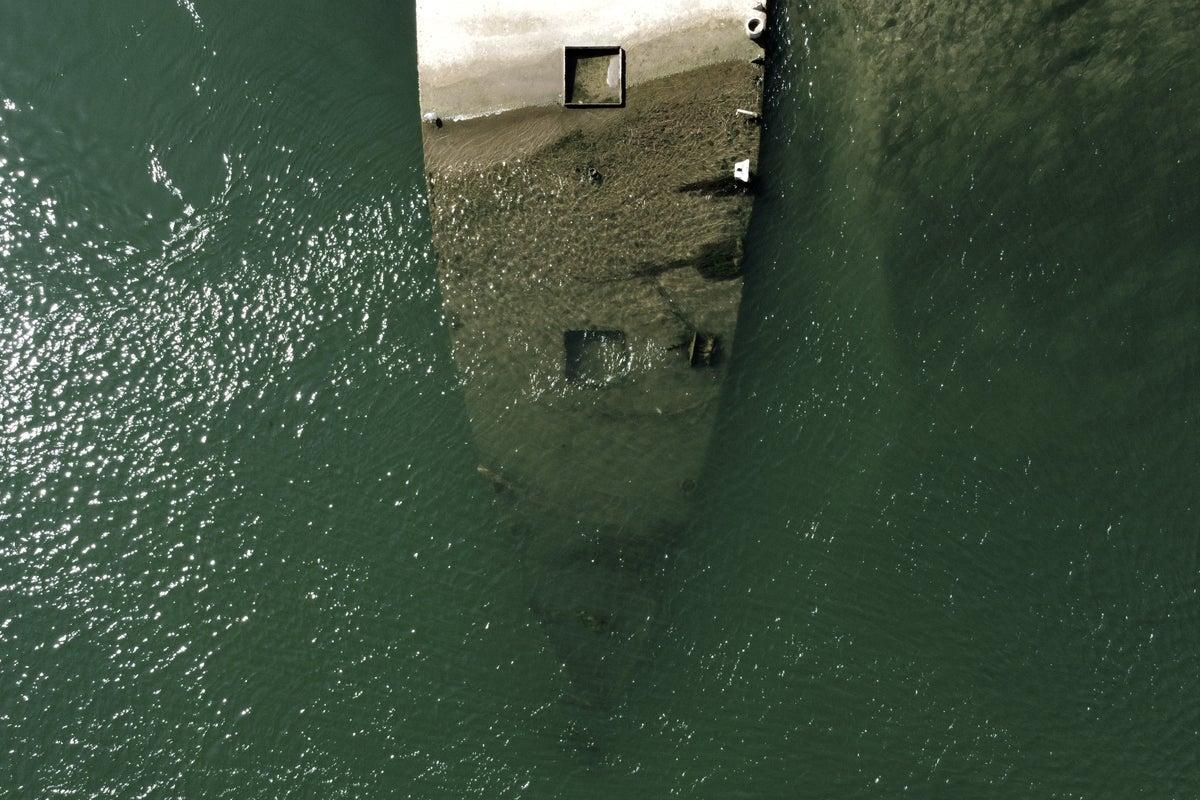
The corroded hull, a vessel once known as the Slovenian, re-emerged earlier this month from the Sava River near Sremska Mitrovica, Serbia, 70 kilometres (45 miles) northwest of Belgrade.
Although parts have broken the surface previously, residents say the wreck has never been so fully exposed.
“It’s been several years since it was last seen, so there is quite an interest,” said historian Andrija Popovic, who is the head of the town museum.
“It’s truly something you don’t see every day,” he added.
Local Serbian media have nicknamed the boat “Sava’s Titanic”.
Stanislav Kozenko stands on the wreckage of the old steam boat (AP)
A range of relics, including military vessels, mammoth bones and ancient structural remains, have surfaced from falling waters along the Danube, Rhine and other waterways.
The intense drought has also disrupted trade, power generation and local water supplies.
Record-low water on the Danube has severely affected nuclear power plants in Hungary and Romania while bringing shipping to a halt along Europe’s second-largest river.
Meanwhile, months of dry weather have ruined crops from Bosnia to the Netherlands and led to water shortages extending into the Alps.
The Slovenian was made in 1913 and was initially named Vag (AP)
The Slovenian survived two World Wars
According to Mr Popovic, the Slovenian was made in 1913 in a shipyard in Budapest, Hungary, which was then part of the Austro-Hungarian empire.
It measured roughly 54 metres (177 feet) in length and was initially named Vag, which is Hungarian for Slovakia’s longest river, Vah. With a steam engine, the boat pulled heavy cargo between Budapest and other towns along the Danube.
During the Second World War, the boat largely paused its routes, Mr Popovic added.
As the war ended and the Austro-Hungarian empire was dismantled, the boat’s ownership switched to the newly formed Kingdom of Serbs, Croats and Slovenians – which would later become Yugoslavia – as part of war reparations, he said.
The Slovenian has been exposed by falling river levels (AP)
“This is when it was renamed the Slovenian,” Mr Popovic said, adding that it is a mystery “why this name was chosen”.
Then, during World War II, the Slovenian – and its new country – came under Nazi German occupation. After Yugoslav anti-fascist forces liberated Belgrade in 1944, they used the boat to transfer the wounded and equipment while pushing German troops further west, Mr Popovic said.
The boat was carrying wounded fighters when it hit a German mine in late April 1945, Mr Popovic said.
“It sank and has stayed in the same place since that day.”
The Danube gives up its ghosts
The Slovenian is not the only relic that has emerged from Europe’s drying rivers.
Parts of the Slovenian have been exposed before, but never so much (AP)
On Serbia’s eastern border with Romania, rusty remains of German ships are sticking out from the slumped Danube waters.
Some still laden with weapons, the ships belonged to Nazi Germany’s Black Sea fleet that was deliberately sunk near the end of the war as German troops retreated from Romania and Soviet forces advanced deeper into Europe.
In Italy, the worst drought in 70 years has exposed the piers of an ancient bridge over the Tiber River once used by Roman emperors but which fell into disrepair by the third century.
As the Danube waters shrank in Bulgaria, researchers were thrilled to find and recover a jawbone, tusks, a shoulder blade, ribs and other bone fragments belonging to an extinct woolly mammoth, buried deep in the sand.
Climate change hits Europe hard
Europe is the world’s fastest-warming continent, with temperatures increasing twice as fast as the global average since the 1980s, according to the European Union’s Copernicus Climate Change Service.
Zoran Lovric, a local fisherman, stands near a sunken German warship from the Second World War, exposed due to low Danube River levels near Prahovo, Serbia (Reuters)
Half of the European Union and the United Kingdom was experiencing drought by late July 2026, according to the EU’s European Drought Observatory, with 9 per cent of the territory at the most severe “alert” level.
Scientists warn that climate change is exacerbating the frequency and intensity of heat and dryness.
Serbian hydrology expert Dejan Vladikovic said that the current drought is the combination of a lack of winter snow and a very dry spring.
“What awaits us in the future … is that such situations will be more frequent,” he said. “We are entering periods when this will, unfortunately, become a new normalcy.”
Even the mountains are suffering. In the Slovenian Alps, lodges that depend on rainwater have restricted the use of water for climbers and hikers, including for showers and toilets.
The Triglav Lodge, Slovenia’s highest-altitude guest hut at an elevation of 2,515 metres (8,251 feet), is using paper plates this summer to save water on dishes.