…new 2026–2030 strategy puts technology, value for money at centre of public auditing
BY EPN REPORTER
MBABANE – Artificial Intelligence (AI) and digital transformation are set to play a bigger role in how Eswatini’s public finances are scrutinised as the Office of the Auditor-General (OAG) moves to modernise auditing and strengthen accountability across Government.
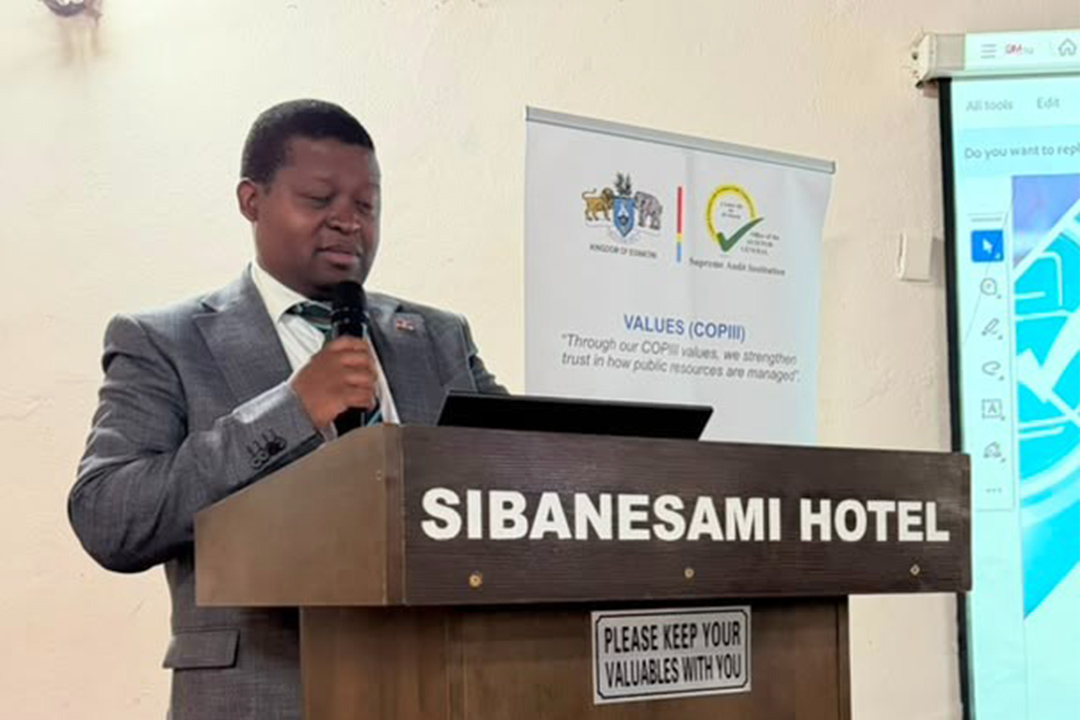
Auditor-General Timothy Matsebula has challenged officers within his institution to embrace emerging technologies, warning that the environment in which auditors operate is changing rapidly and demanding new skills, fresh thinking and greater adaptability.
Matsebula was addressing more than 80 officers from the OAG’s audit and corporate services divisions during the staff launch of the institution’s Strategic Plan 2026–2030 at SibaneSami Hotel.
The plan signals an ambitious transformation of the Auditor-General’s Office over the next five years, with digital transformation, stronger institutional independence, improved audit quality and greater public accountability among its major priorities.
For Matsebula, technology is no longer an optional extra in public auditing.
He said technological advancement was already transforming Government accounting systems and auditing processes, making it critical for officers to become versatile enough to work effectively in an increasingly digital environment.
“AI [is] changing the landscape of work and providing easier ways of doing,” Matsebula said, while noting that public expectations were also evolving and institutional accountability becoming increasingly complex.
Rather than seeing such changes only as challenges, the Auditor-General encouraged employees to view them as opportunities to become more innovative, impactful and relevant.
His message places Eswatini’s supreme audit institution firmly within the growing global conversation around how technology can improve oversight of public resources.
AUDITING BEYOND NUMBERS
However, Matsebula made it clear that modernisation would not simply be about introducing new technology.
At the centre of the new strategy is a push for auditors to look beyond financial statements and ask a question that directly affects ordinary EmaSwati: Did citizens receive value from the money Government spent?
He challenged staff to understand that their responsibility extends beyond producing audit reports and certifying accounts.
The real measure of successful auditing, he said, should include determining whether public money has translated into meaningful benefits for citizens.
“As you do your work, you derive answers to ‘was value received by the citizens in the use of public funds?’. With each budget appropriation what value does the budget bring to the citizens,” Matsebula said.
The approach could deepen scrutiny of public expenditure by placing greater attention on outcomes rather than simply whether money was spent according to procedure.
For ordinary citizens, this means auditing that increasingly asks whether budgets ultimately translate into better services and tangible public value.
FIVE-YEAR ROADMAP FOR STRONGER OVERSIGHT
The Strategic Plan 2026–2030 sets out a roadmap aimed at strengthening public sector accountability, transparency and good governance in Eswatini.
It was developed with financial and technical support from the INTOSAI Development Initiative (IDI) and the African Organisation of English-Speaking Supreme Audit Institutions (AFROSAI-E).
The strategy is built around four key outcomes.
These include strengthening the independence and legal framework of the Supreme Audit Institution, positioning the OAG as a model public institution, enhancing accountability and transparency through high-quality audits, and ensuring that the institution remains relevant to its stakeholders.
The outcomes are aligned with international auditing standards and best practices, including principles of the International Organisation of Supreme Audit Institutions (INTOSAI).
Integrity, innovation and collaboration, independence and objectivity, as well as professionalism, have been identified as the core values that will underpin implementation.
DIGITAL TRANSFORMATION AMONG FIVE PRIORITIES
The OAG has also identified five strategic priorities that will guide its transformation over the five-year period.
These are strengthening legal and institutional independence; improving the impact of audits and implementation of audit recommendations; institutionalising quality management and professional excellence; advancing digital transformation; and building a high-performing and ethical institution.
The inclusion of digital transformation is particularly significant as Government institutions increasingly migrate towards technology-driven systems.
A technologically capable Auditor-General’s Office would be better positioned to respond to increasingly sophisticated financial systems while strengthening oversight and accountability.
The strategy also places emphasis on ensuring that audit recommendations result in action – an important step towards ensuring that findings do not simply end with reports but contribute towards improved management of public resources.
STAFF FIRST TO RECEIVE STRATEGY
OAG employees became the first stakeholder group to receive the completed strategic plan.
The institution intends to subsequently present the strategy to other key stakeholders, including Parliament, Government entities that are audited, accountability institutions and professional partners.
The staff launch also included discussions on how employees would implement the strategy across the different priority areas.
This gives officers a direct role in translating the five-year blueprint from paper into practical changes in the institution’s daily operations.
Ultimately, the OAG says the strategy is intended to strengthen oversight, accountability and governance while building greater public trust.
Its long-term vision is to position the Auditor-General’s Office as a cornerstone of public trust and a catalyst for improved governance, accountability and service delivery for all citizens of Eswatini.
(Courtesy Pic)
Post Views: 110