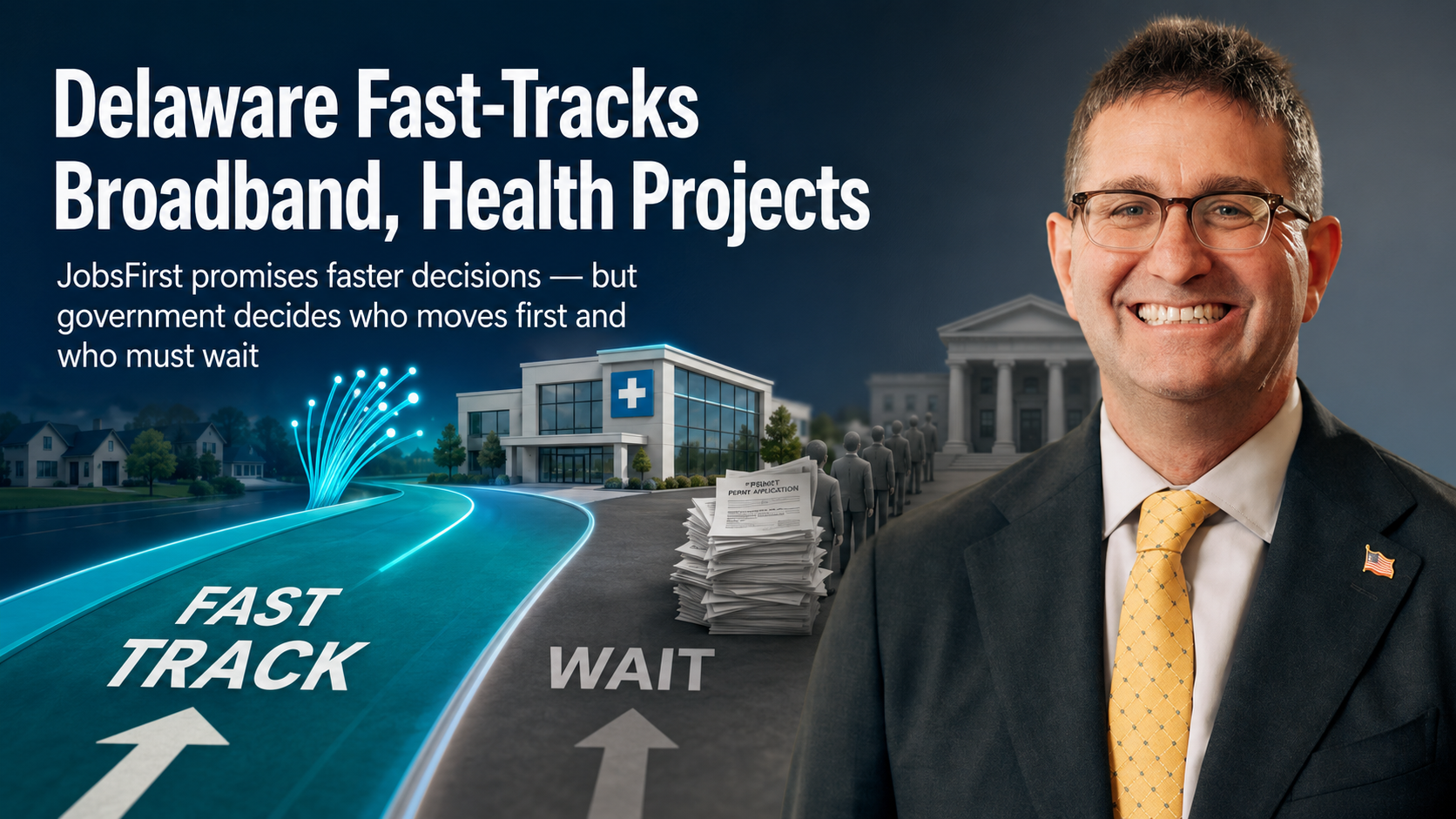
The accelerator does not simply improve permitting for every business, developer and organization. It creates a priority lane, with the Governor’s Office deciding which applicants receive expedited attention and which remain in the regular bureaucratic process. Image created with AI on 8/14
WILMINGTON, Del. — Delaware will fast-track three broadband and health care projects through a state permitting system designed to produce decisions within 120 business days, but the announcement is also raising a broader question: If state government can move quickly for selected applicants, why can’t it do so for everyone?
Gov. Matt Meyer announced Thursday that a rural broadband expansion and two ChristianaCare health campuses have been accepted into the JobsFirst Permitting Accelerator.
The program gives designated projects a single government contact, coordinates reviews across state agencies and creates a process for escalating unresolved problems. Reviews that might otherwise take 18 to 24 months are targeted for completion in about six months.
“JobsFirst is about tackling Delaware’s biggest challenges with urgency, not bureaucracy,” Meyer said. “Whether it’s expanding access to health care, closing the digital divide or building the infrastructure our communities need, Delawareans shouldn’t have to wait years for projects that people need now.”
That argument makes a strong case for faster permitting. It also highlights the unequal treatment built into the program.
The government chooses who moves first
The accelerator does not simply improve permitting for every business, developer and organization. It creates a priority lane, with the Governor’s Office deciding which applicants receive expedited attention and which remain in the regular bureaucratic process.
Executive Order 18 establishes eligibility categories covering housing, broadband, energy, water and sewer, and mixed-use development. However, meeting an eligibility definition does not guarantee admission. The order says the governor or the governor’s designee “may designate” a nominated project as a priority.
The state’s published process says the Governor’s Office considers eligibility, readiness and permitting constraints. It does not provide a public scoring system explaining how competing qualified projects are ranked or why one applicant moves ahead of another.
That distinction matters. Without clearly published selection standards, the accelerator gives state officials significant discretion over who receives a dedicated coordinator, enforced deadlines and direct access to an expedited review.
The administration’s announcement did not say how many projects applied, whether any were rejected or why these three were selected over other potentially eligible projects. It also did not identify the category under which the two ChristianaCare health campuses qualified. Health care is not listed among the program’s five initial project categories.
Projects promise public benefits
The projects themselves promise substantial public benefits.
Talkie Communications plans to install buried fiber within existing roadway rights-of-way, bringing gigabit-speed internet service to 1,448 unserved homes and businesses in Kent and Sussex counties. The project is supported by the Federal Communications Commission’s Rural Digital Opportunity Fund.
ChristianaCare’s planned Georgetown campus would combine a health center and neighborhood hospital. It would provide primary, specialty, behavioral health and outpatient services, along with an eight-bed emergency department and eight inpatient beds.
A similar campus planned for Camden would expand health care and community-based hospital capacity in Kent County.
Accelerating those projects does not mean environmental or public safety requirements will be waived. The administration says JobsFirst changes the speed and coordination of reviews, not the standards applicants must meet. The 120-business-day target also promises a decision, not necessarily an approval.
Those safeguards make the faster process easier to defend. But they also support extending it to other applicants.
Why shouldn’t every applicant receive faster service?
If agencies can review applications simultaneously instead of sequentially, provide applicants with a single checklist and hold employees accountable for missed deadlines, those practices should become the normal permitting system — not a special service reserved for projects selected by the executive branch.
There is also a question of agency capacity. Unless the state has added staff or eliminated unnecessary work, moving priority projects ahead could divert attention from businesses and organizations already waiting.
The administration has not disclosed whether the accelerator is reducing the overall permitting backlog or rearranging the order in which applications are processed.
Small businesses could be especially disadvantaged. Large institutions often have attorneys, engineers and government-relations professionals to help navigate state processes. Smaller applicants are more likely to need the coordination and accountability provided by JobsFirst, but they may be less likely to propose projects large enough to receive priority status.
Transparency should begin with selection
The state has created a public dashboard to track designated projects, participating agencies, required permits and approaching deadlines. That is a meaningful transparency measure once a project is accepted.
Transparency should also cover the selection process. The public should be able to see all applications, the standards used to evaluate them, the reasons projects were accepted or rejected, and whether giving one project priority caused delays for others.
The administration says JobsFirst is being introduced in stages and could eventually lead to a coordinated permitting system covering the full range of state approvals.
That should be the objective.
Everyone should have access to the fast lane
Broadband service and health care facilities should not remain trapped in government bureaucracy. Neither should a housing project, a new employer or a small Delaware business simply because the Governor’s Office did not put it in the priority lane.
The real measure of JobsFirst will not be whether government can move three selected projects faster. It will be whether Delaware uses what it learns to give every qualified applicant a clear, accountable and timely decision.
To Go Box
- Program: JobsFirst Permitting Accelerator
- New priority projects: Talkie Communications broadband expansion and ChristianaCare campuses in Georgetown and Camden
- Target: State permitting decisions within 120 business days after applications are complete
- Central question: Why aren’t the same coordination, deadlines and accountability available to every applicant?
- Track projects: JobsFirst Delaware dashboard
Delaware LIVE collaborates with a network of professional journalists to cover a diverse range of stories across various fields. Staff Writers include experienced journalists and young professionals. If you have questions, please feel free to contact [email protected] or our publisher, George D. Rotsch, at [email protected]