Industry veteran says the state’s review lacked the technical depth needed as electricity costs rise and Delaware remains dependent on imported power
DOVER, Del – Delaware’s Nuclear Energy Feasibility Task Force cannot approve a reactor, select a location or commit public money to a nuclear project. Its influence, however, could be significant.
The General Assembly created the task force to help determine whether small modular nuclear reactors could become part of Delaware’s long-term energy supply. Its findings could influence whether lawmakers authorize additional studies, investigate potential sites, revise state permitting laws or decide nuclear power is too costly or uncertain to pursue.
That makes the quality of the task force’s work important.
Kenneth J. Reuter Jr., a task force participant and longtime energy industry executive, contends the panel did not conduct the structured, technically intensive review necessary to support such a consequential decision.
In an Aug. 14 assessment, Reuter said the task force did not hear directly from willing nuclear manufacturers, adequately investigate possible Delaware sites or divide its work among specialized teams.
His criticism does not establish that the task force’s conclusions are wrong. It does raise questions about whether state policymakers have enough information to make decisions that could affect Delaware’s electricity supply, consumer costs and economic competitiveness for decades.
Panel assigned to study nuclear potential
The General Assembly created the Delaware Nuclear Energy Feasibility Task Force in 2025 to examine whether small modular reactors, commonly known as SMRs, could be developed in the state.
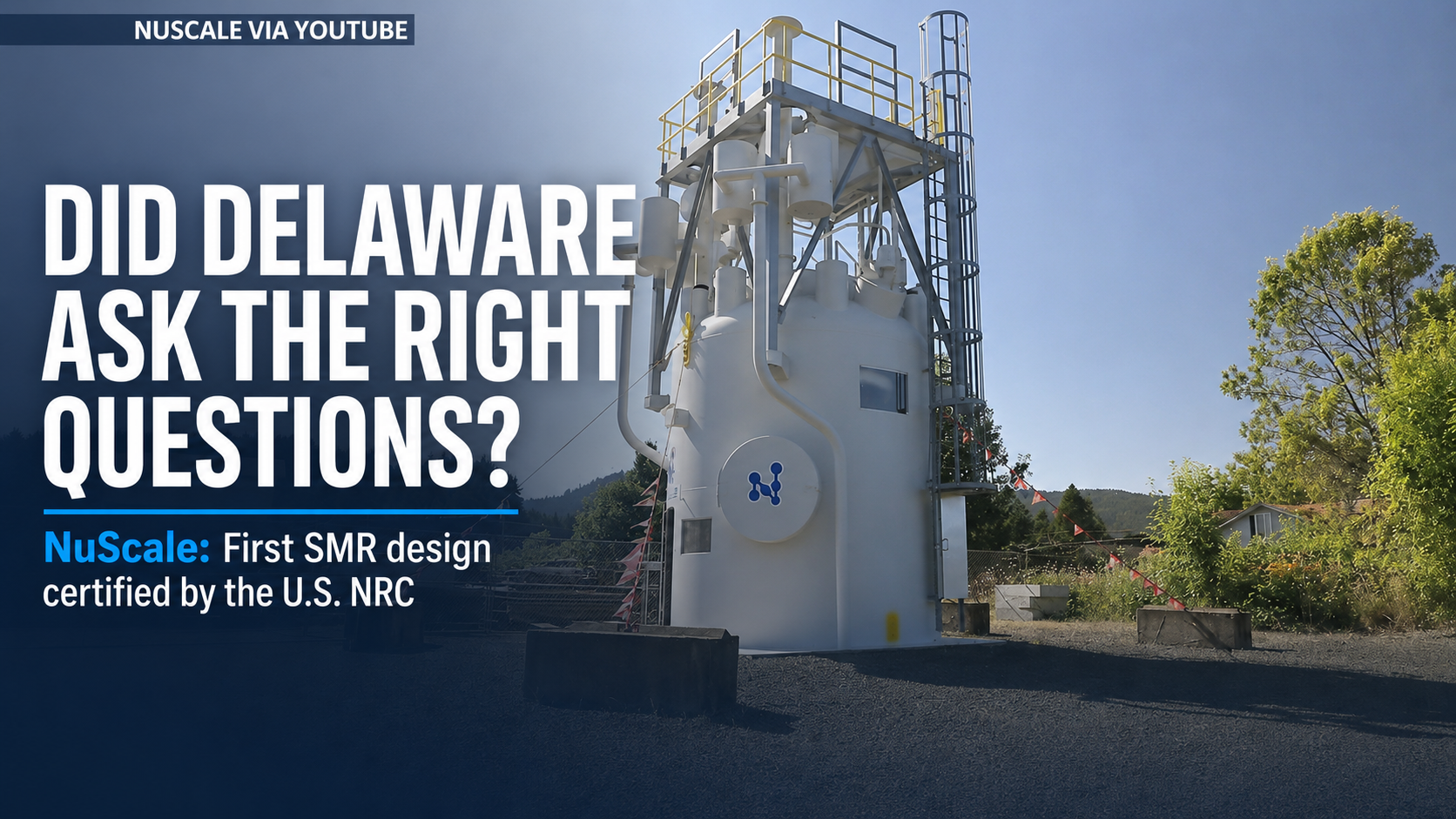
SMRs are designed to generate less electricity than conventional nuclear reactors. Supporters say they could be manufactured in sections, installed incrementally and placed on properties that cannot accommodate a traditional nuclear plant.
However, the technology remains commercially developing in the United States. Questions continue about construction costs, licensing schedules, financing and the risks utilities and customers could be asked to assume.
The General Assembly directed the task force to study nuclear energy’s economic impact, regulatory requirements, environmental implications and potential contribution to electric reliability. Its reporting deadline was extended to July 31, 2026.
The task force’s report is advisory. It does not authorize construction, approve a location or require the state to pursue nuclear power. But lawmakers could rely on it when considering future energy legislation and determining whether additional nuclear planning is warranted.
Delaware imports much of its electricity
Delaware generates substantially less electricity than its residents and businesses consume.
Reuter estimates the state currently imports between 45% and 55% of its electricity through PJM, the regional power grid serving Delaware and parts of 12 other states and the District of Columbia.
Importing electricity is a normal part of participating in a regional grid. It does not, by itself, indicate that Delaware faces an immediate shortage. PJM is designed to move power across state lines and allow utilities to purchase electricity from generators throughout the region.
But Reuter argues that Delaware’s dependence creates greater risk as regional demand grows, older generating plants retire and new projects face lengthy development and grid-connection delays.
Data centers, advanced manufacturing and other large electricity users are also adding to projected demand.
Delaware does not need to generate every unit of electricity it consumes. However, the state has limited control over when and where new regional plants are constructed, leaving its customers exposed to supply and price pressures elsewhere in the PJM market.
Intermittent power cannot carry the full load
Reuter argues that Delaware’s energy strategy relies too heavily on intermittent sources such as wind and solar.
Those facilities can contribute electricity when weather conditions permit, reduce fuel consumption and help meet emissions goals. But they cannot continuously produce power without storage, backup generation or other complementary resources.
An energy plan that depends heavily on intermittent sources without sufficient dependable generation would leave Delaware vulnerable during periods when the sun is not shining, the wind is not blowing or regional demand is particularly high, Reuter said.
He argues that Delaware should make the development of additional 24-hour generation a priority, including natural gas plants, nuclear power or a combination of the two.
Natural gas plants can generally be developed more quickly than nuclear facilities and can respond to changing electricity demand. Nuclear plants require longer development and licensing schedules but can provide large amounts of continuous electricity without direct carbon emissions.
Both carry costs and risks. Natural gas exposes customers to fuel-price volatility and future regulatory requirements. Nuclear projects require substantial upfront investment and can experience construction delays and cost overruns.
A responsible state plan would examine those risks without treating intermittent renewable resources as the equivalent of dependable, around-the-clock generation.
Rising electric bills add urgency
The debate is not limited to whether Delaware will have enough power. It also involves what residents and businesses will pay for it.
Residential and industrial electric bills are rising, placing additional pressure on household budgets and increasing operating costs for Delaware employers.
Reuter argues that those costs will continue climbing unless policymakers revise Delaware’s energy strategy and make affordability and dependable generation top state priorities.
Electric bills reflect more than the cost of producing electricity. They can also include transmission expenses, regional capacity charges, utility infrastructure investments, environmental compliance costs and other fees.
However, a tightening regional supply-and-demand balance can increase several of those costs. Delaware’s dependence on imported electricity leaves customers exposed to regional prices that state officials cannot directly control.
For households, higher electric bills reduce the money available for food, housing, health care and other necessities. For manufacturers and other energy-intensive employers, rising power costs can discourage expansion, weaken competitiveness and influence decisions about where companies invest.
Reuter’s position is that Delaware should not evaluate energy projects primarily according to environmental targets or political preferences. Each alternative should be measured by its total cost, reliability, construction schedule and ability to serve customers during periods of peak demand.
Participant questions task force’s approach
Reuter’s primary complaint is that the task force operated more like a broad discussion group than a technically organized panel working toward an actionable plan.
He said only a small number of the approximately 25 members and regular participants had direct experience with electricity generation.
Reuter recommended dividing the work among specialized groups focused on nuclear manufacturers, potential sites, technology selection, safety, environmental effects, permitting, government coordination and public communications.
Under his proposed structure, each group would have been assigned a leader responsible for investigating its subject and regularly reporting findings to the full panel.
Reuter said that structure was not adopted.
He also said no nuclear equipment manufacturer was invited to explain its technology, manufacturing capacity, construction schedules, costs or existing order commitments to the full task force.
According to Reuter, Westinghouse and another manufacturer were willing to make presentations but were not invited. He also said an offer to arrange a task force tour of the Salem and Hope Creek nuclear facilities in New Jersey was not accepted.
Manufacturers have a financial interest in promoting their products, and their claims would require independent scrutiny. However, direct presentations would have allowed task force members to question the companies about technological readiness, construction experience, pricing and financial risks.
Potential sites require closer examination
A complete nuclear feasibility review would eventually need to examine actual Delaware properties.
Potential sites would have to be evaluated for available land, transmission connections, water access, security, emergency planning and nearby development. The willingness of property owners and surrounding communities would also be important.
Reuter said the task force did not conduct sufficiently detailed discussions with potential site owners or determine whether particular properties could accommodate an SMR or a larger conventional reactor.
That distinction matters because a technology that appears promising in a general presentation may not be practical at an available Delaware location.
Preliminary site analysis would not commit the state to a reactor or a particular property. It would help determine whether nuclear power is a realistic Delaware option rather than a theoretical one.
Incomplete report could close the door prematurely
If the task force’s report is incomplete or overly negative, Delaware could abandon nuclear energy before fully understanding its potential.
That could leave the state more dependent on imported power from a regional market facing rising demand and generating-plant retirements.
Delaware could also lose time needed to examine sites, coordinate with federal regulators and develop a specialized workforce. Nuclear projects require years of planning, licensing, financing and construction, meaning a decision to delay preliminary work could have long-term consequences.
Dependable and competitively priced electricity also affects economic development. Manufacturers, health care facilities, technology companies and data centers consider energy availability when deciding where to invest.
A state without a credible plan for meeting future electricity demand could find itself at a competitive disadvantage.
Overly optimistic report also carries risks
A flawed report could create the opposite danger.
If the task force overstates the affordability or commercial readiness of SMRs, lawmakers could advance an expensive project without fully understanding the risks.
Nuclear facilities require substantial upfront investment. Construction delays and cost overruns can fall on customers if utilities are permitted to recover those expenses through electric rates.
Before advancing a project, policymakers would need to determine who would finance it, who would absorb the cost of delays and whether customers could be charged before a reactor begins producing electricity.
A responsible nuclear policy would protect ratepayers while allowing promising technologies to receive serious consideration. Private investors, utilities and manufacturers would need to bear meaningful performance risk rather than shifting every financial uncertainty to customers.
State plan must balance cost and reliability
The task force’s report does not need to provide a final verdict on nuclear power. The developing commercial market for SMRs makes absolute conclusions difficult.
A useful report should distinguish among what is known, what remains uncertain and what Delaware must investigate next.
Possible next steps could include independent cost studies, discussions with manufacturers, preliminary site reviews, federal regulatory coordination and comparisons among nuclear power, natural gas, renewable energy, storage and transmission investments.
Each alternative should be evaluated using consistent standards, including:
- Total cost to residential and business customers
- Dependable generating capacity
- Development and construction time
- Performance during peak demand
- Fuel and transmission requirements
- Environmental effects
- Financial risks associated with delays or cost overruns
Wind and solar power can remain part of that mix. But policymakers must distinguish between electricity produced when weather conditions allow and capacity that can be counted on around the clock.
The central question is not whether task force members support or oppose nuclear energy. It is whether their process produced enough evidence to justify the panel’s findings.
A report that dismisses nuclear prematurely could cause Delaware to lose a potentially valuable source of dependable, carbon-free electricity. A report that is too optimistic could expose customers to years of higher rates and construction risk.
Delaware may ultimately choose to pursue nuclear power, continue studying it or reject it. But with electric bills rising, demand growing and regional supplies tightening, Reuter argues that revising the state’s energy plan should be a top policy priority.
That decision should rest on rigorous technical and financial evidence — not an incomplete process, assumptions about future regional supplies or a predetermined preference for any particular energy source.
TO-GO BOX:
- The task force: The General Assembly created the Nuclear Energy Feasibility Task Force to study whether small modular reactors could help meet Delaware’s future electricity needs.
- The concern: Participant Kenneth J. Reuter Jr. says the review lacked sufficient industry input, technical structure and analysis of potential sites.
- The energy challenge: Delaware imports an estimated 45% to 55% of its electricity, while regional demand and electric costs are increasing.
- What is at stake: A flawed report could cause Delaware to reject a dependable energy source prematurely — or pursue an expensive project without adequately protecting ratepayers.