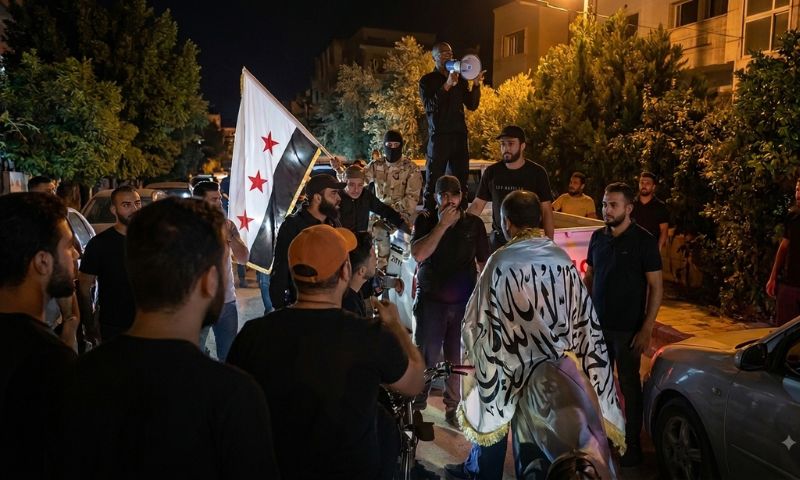
Dozens of demonstrators gathered on Tuesday evening, August 11, outside the residence of influential businessman Mohammad Hamsho in the Qura al-Sham district near Saboura, rural Damascus. Hamsho, long seen as a powerful figure closely tied to the former regime, is now the target of mounting public anger over allegations of profiteering during the conflict.
Protesters chanted slogans demanding that Hamsho be prosecuted, accusing him of looting national assets and referring to him as the “scrap metal thief.” One participant charged that Hamsho contributed to the displacement of hundreds of thousands of Syrians and enriched himself by extracting metal from homes destroyed during the war. “People remain displaced and their houses lie in ruins, while he lives comfortably in his mansion,” the protester said.
An activist who joined the demonstration told Enab Baladi—on condition of anonymity due to security concerns—that the protest was a spontaneous initiative led by local youth and independent activists rather than any organized group. He said public support for calls to bring Hamsho to trial is growing, and that additional demonstrations are planned outside the homes of Hamsho’s sons in Damascus’s al-Malki neighborhood and at his main corporate office on Baghdad Street. Activists are also preparing a graffiti campaign across Damascus and its suburbs targeting his companies and affiliated militias.
Alongside the protests, activists have launched a boycott campaign targeting businesses owned by or linked to Hamsho. Flyers titled “Boycott Mohammad Hamsho’s Products” were distributed near his residence, corporate offices, and surrounding neighborhoods. The list of targeted entities spans a wide commercial network, including Sama al-Sham Holding; Sama al-Sham Travel and Tourism; Saif al-Sham Equestrian Club; Yaafour Hotel and Resort; Sinalco soft drinks; Triview electrical appliances; Aramsoft; Runnet ISP; Ittisal mobile distributor; Tatweer Technology; Esnad Steel Structures; Asas Construction and Development; the Syrian Air Liquefaction Company; DAK Foods; and numerous subsidiaries under the Al-Ittihad brand covering cables, transformers, plastics, solar energy, electricity, copper, and motor rewinding, in addition to Pentalens Art Production and Cham Design and Printing.
The protests come amid ongoing legal proceedings. The Public Prosecution recently referred a complaint alleging death threats—filed by citizens Abdul Hamid Assaf and Aboud Diab—to the Cybercrime Court of First Instance in rural Damascus. Judicial sources told Enab Baladi that Hamsho failed to appear at a scheduled August 10 hearing intended to record his testimony. Assaf confirmed that the complaint cites threats delivered via social media.
This dispute follows a defamation lawsuit Hamsho filed in May 2025 against Assaf after activists released videos calling for an investigation into Hamsho’s wealth and his acquisition of scrap metal from destroyed neighborhoods. Assaf said activists had previously submitted a 70-page dossier to the Public Prosecution detailing alleged crimes, including the systematic dismantling of buildings to extract steel rebar. He added that activists have faced intimidation, indirect death threats, hacking attempts, and the online publication of personal and family photographs. Despite these pressures, Assaf said activists intend to pursue all legal avenues “until justice is served.”
Under Syrian criminal procedure, judges at the Cybercrime Court may order a defendant’s detention after interrogation if the alleged offense carries a prison term exceeding one year, if the defendant is considered a flight risk, or to prevent the destruction of digital evidence or witness tampering. If detained, the defendant would be held at Damascus Central Prison (Adra) pending bail.
These developments coincide with statements from activist and filmmaker Hassan Akkad, who recently disclosed that he spent five days in detention in Damascus. Although journalist Moussa al-Omar withdrew a complaint against him, Akkad said two lawsuits filed by Hamsho-affiliated companies—United and Ratingo—remain active following his media campaign criticizing the Sinalco brand and the Yaafour resort. Damascus Public Prosecutor Judge Hussam Khattab previously stated that Akkad’s arrest was carried out based on outstanding notices related to electronic defamation complaints filed by private citizens.
This article was translated and edited by The Syrian Observer. The Syrian Observer has not verified the content of this story. Responsibility for the information and views set out in this article lies entirely with the author.