Syria’s reconstruction could reinforce regional inequality, concentrate wealth in commercially attractive areas and undermine the country’s political transition unless the government establishes a coherent national strategy, strengthens institutions and addresses property rights, according to a new policy brief based on discussions among Syrian and international experts.
The report, “Syria’s Reconstruction: Navigating Political Realities and Opportunities,” was produced by the Syria Policy Dialogues initiative following a two-day workshop held in Damascus on 16–17 May 2026 by The Syria Report in cooperation with the Omran Center for Strategic Studies. The closed-door discussions brought together economists, bankers, businesspeople, urban planners, agricultural specialists, lawyers, civil society representatives, researchers, Syrian officials and foreign diplomats.
The brief argues that reconstruction should be understood as a political process with consequences for the distribution of power, resources and economic opportunity, rather than simply an exercise in rebuilding destroyed infrastructure. Participants broadly agreed that Syria remains in an overlapping phase of early recovery and initial reconstruction, while many of the legal, institutional and oversight mechanisms required for reconstruction on a national scale are still being developed.
The scale of the challenge is formidable. Citing a World Bank assessment, the report says the conflict destroyed nearly one-third of Syria’s pre-war capital stock, causing an estimated $108 billion in direct physical damage. Reconstruction costs are conservatively estimated at $216 billion, with a possible range of $140 billion to $345 billion. Total economic losses, including lost output and damage to human and institutional capacity, are estimated at about $800 billion.
Syria’s weakened economy further complicates the task. GDP contracted by 53 per cent between 2010 and 2022, while the Syrian pound lost 99 per cent of its pre-war value. The brief cites UNDP estimates that about 90 per cent of Syrians live below the poverty line and UNICEF figures showing that 16.7 million people require humanitarian assistance.
Reconstruction Without a Plan
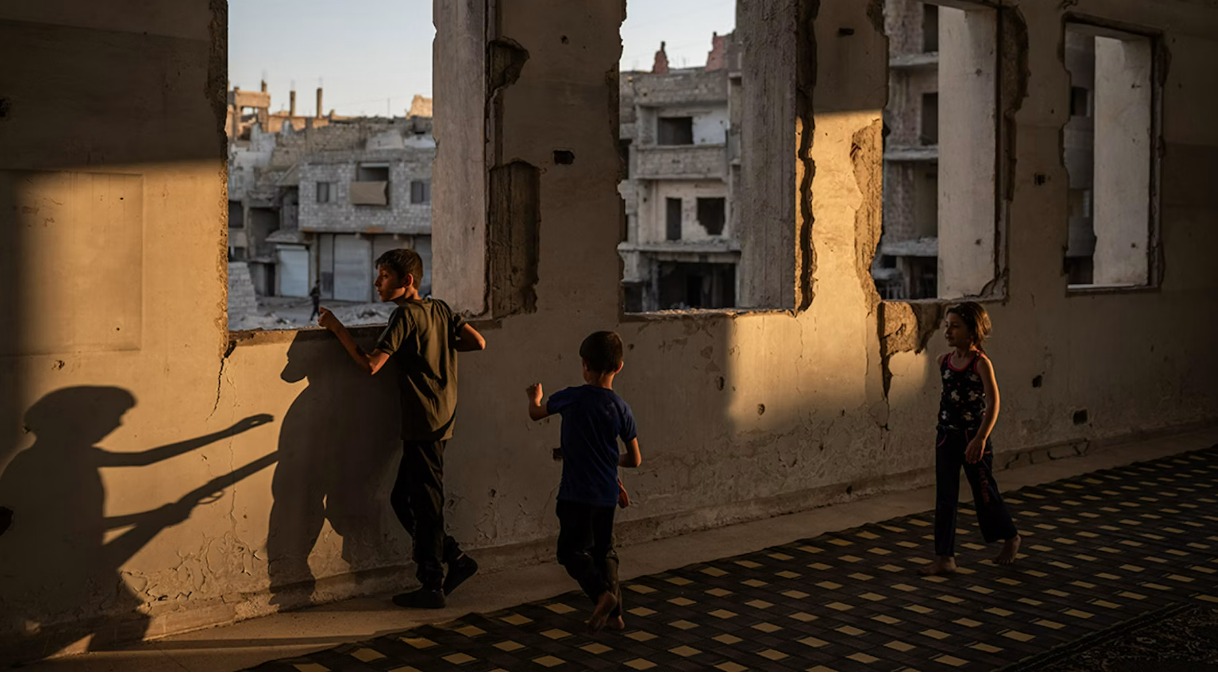
A central concern raised by participants was that reconstruction is increasingly being shaped by investment opportunities rather than by an integrated national plan. That could direct capital towards profitable urban real estate while leaving heavily damaged rural areas and poorer communities behind. The report warns that such a pattern risks reproducing some of the geographic and economic disparities that contributed to grievances before the 2011 uprising.
Housing emerged as one of the most politically sensitive issues. Between 30 and 40 per cent of Syria’s housing stock was located in informal or unregulated areas before the war, while millions of homes have since been destroyed or severely damaged. Property disputes, missing records, mass displacement and restrictions on property transactions have left the real estate market largely paralysed.
The affordability problem is equally severe. With most Syrians living below the poverty line, even subsidised housing finance remains beyond the reach of large sections of the population. Participants warned that new housing developments could therefore be absorbed primarily by investors and speculators rather than families displaced by the war.
The financial sector was identified as another major constraint. Participants said several public banks were operating under severe financial and operational strain, private deposits remained limited and foreign banks were still reluctant to establish correspondent relationships with Syrian institutions despite the easing of sanctions. Over-compliance with restrictions by international banks was described as a continuing obstacle to financial normalisation.
One Syrian banking representative summed up the challenge starkly: “Without a banking sector there will be no reconstruction process.”
The report also points to weak coordination between ministries and government bodies. Participants described a fragmented administrative system in which ministers and governors sometimes operate with limited coordination, while the absence of a prime ministerial office has removed a mechanism that historically played a coordinating role. Some participants proposed creating an independent reconstruction commission with cross-government authority.
Agriculture and rural development were repeatedly identified as areas that deserve greater priority. Participants argued that investment in irrigation, rural roads, agricultural processing and lending could generate employment and distribute economic gains more widely than a reconstruction model centred on urban property development.
Reconstruction, Justice and the Politics of Investment
The brief also links reconstruction to transitional justice. Participants argued that rebuilding should include accountability for economic crimes committed under the former regime, mechanisms to resolve property confiscation disputes and measures to ensure that reconstruction benefits are distributed equitably. Areas subjected to systematic destruction, they said, may also require community dialogue and formal recognition of past abuses as part of the rebuilding process.
International financing will be indispensable, but the report cautions that Syria currently lacks the institutional capacity to absorb very large funding flows effectively. One participant estimated that the country could struggle to deploy even $3 billion efficiently under present conditions. The Syrian government has expressed a preference for foreign direct investment rather than borrowing, while Gulf states have shown growing interest in sectors including infrastructure, telecommunications, aviation, logistics and real estate.
Participants nevertheless warned that private capital will naturally gravitate towards sectors offering the highest returns and lowest risks, potentially widening the gap between profitable developments and communities with the greatest reconstruction needs.
Among its principal recommendations, the report calls for a national reconstruction coordination mechanism with authority across ministries, a comprehensive reconstruction plan with clear sectoral and geographic priorities, stronger local government, reforms to property and investment laws, protections for affordable housing and agricultural land, and measures to stabilise the banking sector.
International partners are urged to align assistance with Syria’s political transition rather than donor timetables, expand technical support, address banking over-compliance, develop investment insurance and risk-mitigation instruments, and coordinate aid to avoid duplication and geopolitical competition.
The report concludes that the success of reconstruction will ultimately depend less on the sheer volume of investment than on how funds are allocated, who benefits and what kind of political and economic order emerges from the process. With Syrians already rebuilding homes and communities while national rules remain incomplete, the authors warn that further delay could create irreversible patterns of land use, property ownership and economic development.
This article was translated and edited by The Syrian Observer. The Syrian Observer has not verified the content of this story. Responsibility for the information and views set out in this article lies entirely with the author.