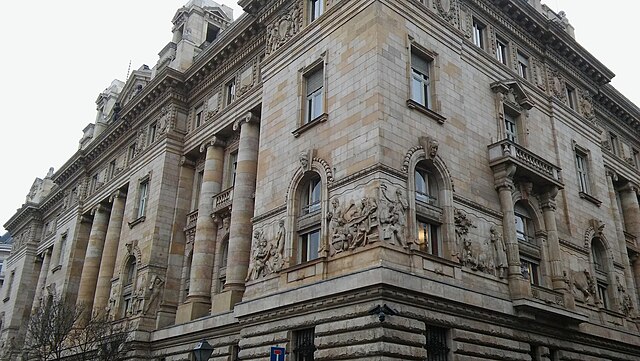
On the occasion of his 170th birthday and 100th anniversary of his death, we remember Alajos Strobl — the man who, around 1900, gave Budapest a public memory through his statues of kings, poets, musicians, and saints.
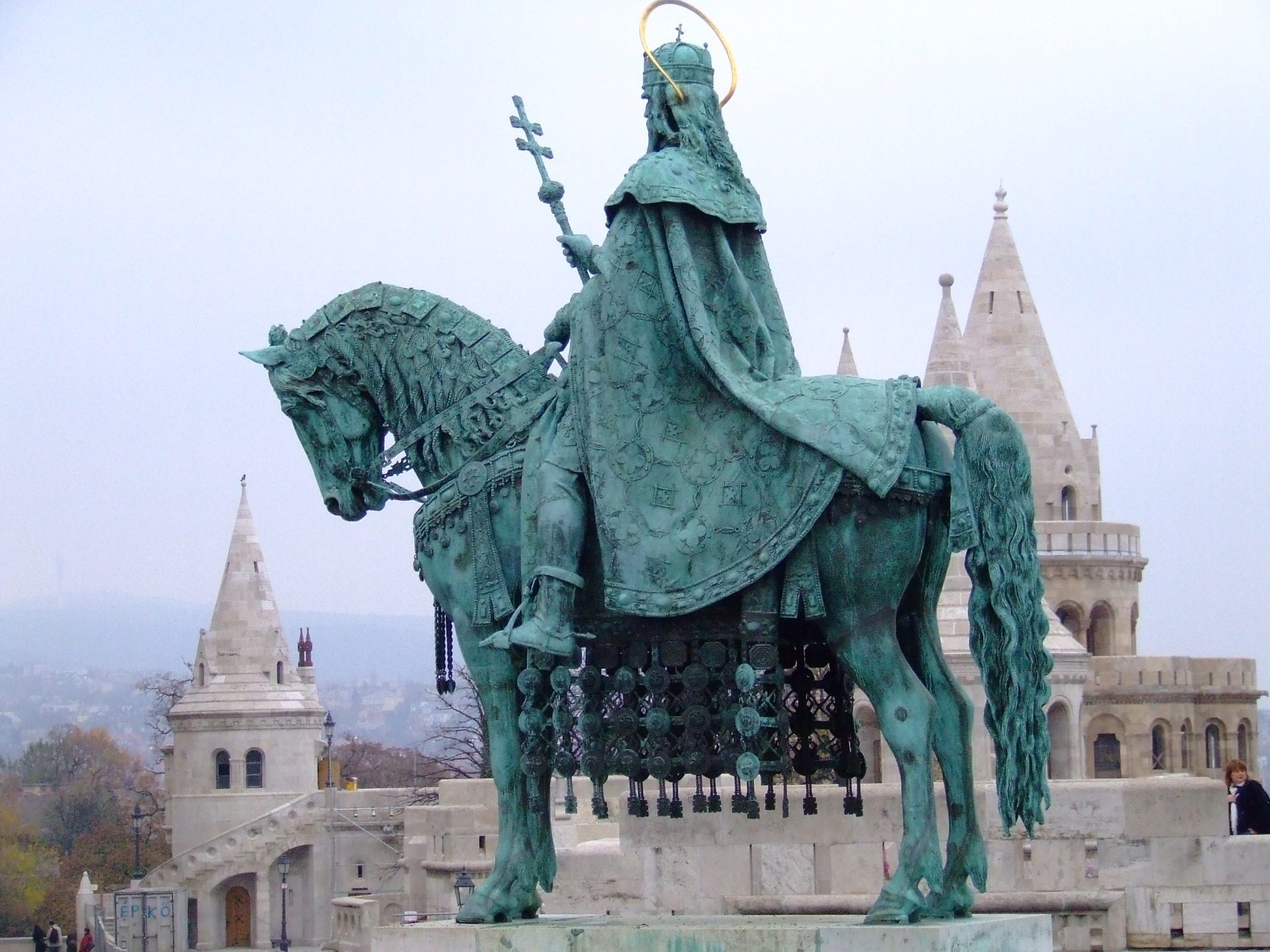
Anyone standing in front of the Opera House in Budapest encounters Ferenc Erkel and Ferenc Liszt. In the courtyard of Buda Castle, the Matthias Fountain cascades, János Arany sits before the Hungarian National Museum, and Saint Stephen on horseback rises above the Fisherman’s Bastion. These are prominent landmarks of a city that around 1900 worked with great determination on its own image. Less well known is the fact that many of these sculptures came from the same pair of hands.
Those hands belonged to Alajos Strobl. The year 2026 brings him into focus for two reasons: he was born in Liptóújvár in 1856 and died in Budapest in 1926. Between those two dates lies a body of work closely bound up with Budapest’s rise as a modern European metropolis. Strobl did not merely adorn the city. He gave it the figures and postures in which culture, history, and national self-confidence could find tangible form.
Strobl trained in Vienna, in the circle of Caspar von Zumbusch, one of the defining monumental sculptors of the Ringstraße era. There he learned the language of representative sculpture: confident anatomy, grand gesture, historical pathos, clear composition. It was an art that believed in the power of the public sphere and in the idea that monuments can not only display significance but also impose order.
In Budapest, this training took on a particular function. Following the unification of Buda, Pest and Óbuda in 1873, the city grew at tremendous speed. Boulevards, bridges, ministries, theatres and museums were springing up. The young capital wanted not merely to be administered, but to be seen. It needed forms through which its cultural and historical legitimacy could find expression.
Strobl became one of the artists who took on this task. His works were not detached from the city’s development but were part of it: they adorned opera houses and museums, palaces, squares and vantage points. In this way, his art became part of that urban self-presentation through which Budapest sought to be both a national capital and a European cultural metropolis at one and the same time.
The figures outside the Budapest Opera House illustrate Strobl’s commission with particular clarity. Erkel and Liszt are not mere decorations on an ornate façade. They mark a cultural programme. Erkel represents Hungarian national opera, Liszt European virtuosity and international standing. Between them, the entrance opens into a building that was itself a manifesto of cultural ambition.
Strobl’s strength lay in translating such programmes into calm, legible forms. His figures do not impose themselves on the architecture. They give it accent and meaning. They appear not as decorative afterthoughts, but as necessary components of the place. It is precisely in this that his stature as a sculptor of public space reveals itself.
In the Matthias Fountain of the Buda Castle Palace, Strobl unfolds his narrative side. King Matthias appears there not as an isolated ruler figure, but as the centrepiece of a hunting scene. Retinue, animals, movement and water combine to form a historical tableau. The fountain is a work of historicism, but not a dry monument. It transforms history into a scene.
The Matthias Fountain of the Buda Castle Palace – Photo: wikipedia
This corresponded to the needs of the metropolis, which around 1900 was fashioning a representative past for itself. Strobl’s Matthias is less a historical reconstruction than a cultural imagination. It shows how Budapest integrated its medieval royal tradition into a modern urban landscape. The fountain is therefore not only a work of art, but also a document of urban historical politics.
The Arany monument in front of the National Museum belongs to the same context. János Arany appears there as the embodiment of Hungarian literature and language. Its location in front of the museum transforms the poet into a figure of national memory. Yet Strobl avoids loud triumph. Arany sits composed, serious, and contemplative. Significance is created here not through pathetic gestures, but through concentration.
With the equestrian statue of Saint Stephen on the Fisherman’s Bastion, Strobl works with a different form of authority. Stephen appears not as a combative victor, but as a resting founder of the state. The power of the figure lies in its bearing, not in action. Against the historicist architecture of the Fisherman’s Bastion, the statue becomes part of a grand panorama of city, history, and national symbolism.
In the Budapest Basilica, Stephen appears once more in an entirely different guise. There he is not a figure in the urban panorama but a sacred form in white marble within the sanctuary, surrounded by light and holiness. On the Fisherman’s Bastion he becomes the state founder in the public realm; in the Basilica, the saint at the liturgical centre. The comparison reveals how confidently Strobl could move between different registers of representation.
He did not merely depict literary authority, royal history, religious devotion, and musical memory. He gave each of them its own bodily form.
Strobl was not only the creator of great monuments but also a teacher. At the Budapest Academy of Fine Arts, he shaped generations of sculptors. His studios in the so-called Epreskert — a studio and teaching district of the Academy — became a centre of artistic training. There, craft discipline, academic tradition, and a keen awareness of the history of European sculpture came together.
This aspect is of great importance to his work. Strobl understood art not as a spontaneous gesture, but as craft. Drawing, anatomy, mastery of materials, and composition formed the foundation of his work. This sets him apart from the later avant-gardes, but makes his art no less significant. His art belongs to that strand of modernity around 1900 that arose not from rupture, but from intuition, commission, and representative form.
Count Károlyi’s statue – Photo: wikipedia
Strobl was not an artist of radical new beginnings. He did not shatter the figure, did not question the pedestal, and did not seek scandal. His work remained committed to historicism, academic form, and public commission. That is precisely what makes it revealing. For the art of the turn of the century consisted not only of the avant-garde. It also encompassed monuments, opera houses, museums, and national rituals.
Within this visible culture, Strobl occupied a central position. His works show how a society translated its values into bodies, places, and gestures. They also reveal the limits of that worldview: some of the pathos seems overwrought today, some allegories too explicit, and some gestures too self-assured. In his finest works, however, the representative form is animated by sculptural precision. The coat has weight, the head has bearing, and the surface has tension.
When Strobl died in 1926, the world that had produced him was already broken. The Habsburg Monarchy had vanished, and Hungary was looking at its past differently in light of its lost historical borders. But the monuments remained. They continued to stand in front of the Opera, in front of the Museum, in the Castle, on the Fisherman’s Bastion, and in the Basilica.
Today they no longer feel like self-evident statements. They are historical testimonies of an era that believed in the public power of art. Yet that is precisely where their significance lies. Strobl’s work tells the story of a Budapest that envisioned itself as a European capital and needed images to match: kings, poets, musicians, founding fathers, and saints.
On the occasion of his 170th birthday and 100th anniversary of death, a closer look at Alajos Strobl is worthwhile not merely out of a sense of anniversary obligation. It leads to a fundamental question of European urban culture: how does a city give itself a face? Around 1900, Budapest found one of its answers in Strobl’s sculptures. They are made of bronze, stone, and marble. Above all, however, they capture the moment when a young capital learned to see itself through a historical lens.
Artificial intelligence was used for the translation of parts of the original German text.