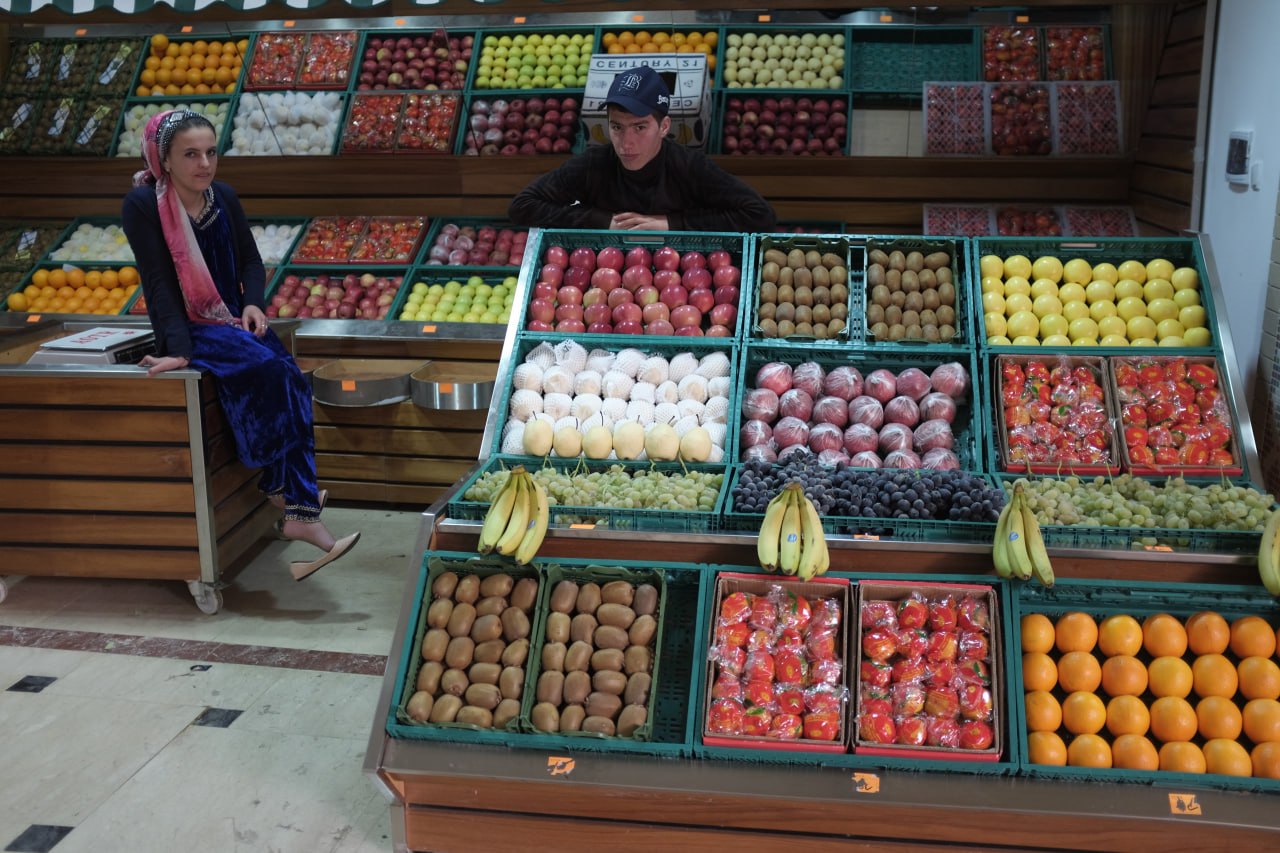
Fruit prices remain high across Tajikistan despite the peak summer season, as a smaller harvest, spring frosts and rising transport costs put pressure on supplies.
In the first half of 2026, Tajikistan harvested 13.1% less fruit than during the same period last year. Spring frosts and heavy rains damaged orchards in several producing regions, while higher diesel prices increased the cost of transporting produce from farms to urban markets.
Prices vary significantly depending on the region, variety, quality and place of sale.
According to Agroinform data as of August 3, ordinary apples cost an average of about 9 somoni per kilogram, while Aport apples sold for around 16 somoni and premium-grade apples for 26 somoni.
Pears averaged about 22 somoni per kilogram, apricots 17 somoni, peaches 16 somoni, grapes 15 somoni and figs 21 somoni. Strawberries cost about 47 somoni per kilogram and raspberries 26 somoni. Watermelons averaged around 5 somoni per kilogram and melons about 9 somoni.
“Fruit has become a luxury”
High prices for fruit, watermelons and melons have prompted widespread discussion on social media, with residents of Dushanbe and other parts of the country questioning why locally grown produce remains unaffordable for many families during the peak season.
One Facebook user, Jamoliddin Fakhriddin, cited prices of 20–25 somoni per kilogram for apples at Dushanbe markets, around 23 somoni for pears and 20–22 somoni for peaches.
“Have we really stopped growing fruit, watermelons and melons in recent years? Is everything now being imported, or is local produce being exported, making it expensive at home?” he asked.
Other users said advice from doctors to eat fresh fruit and vegetables every day is becoming increasingly difficult to follow because of household budgets.
“Every day on television, doctors advise people to eat several hundred grams of fruit and vegetables. But the simple question is: with what money? Many families’ incomes are barely enough to cover basic expenses,” wrote Sayedali Muhiddinov.
He argued that promoting healthy diets is not enough unless nutritious food is also affordable.
Some users said they had barely been able to buy even the seasonal fruits traditionally associated with Tajikistan.
“This year we didn’t even get to eat apricots — in Dushanbe they cost more than 20 somoni,” wrote Rustam Musoyev.
Others complained about melon prices. One participant in the discussion said imported melons from Uzbekistan were being sold for 40–60 somoni each.
“Prices for fruit, watermelons and melons have become excessively high,” wrote Manizha Kholmatova.
Some commenters also complained that high prices do not always correspond to quality.
“On top of everything being expensive, the fruit has no taste either,” wrote another user, Mardi Roh.
Others blamed intermediaries and retail markups, arguing that produce can sometimes be bought more cheaply directly from farmers.
Similar complaints have been reported in Sughd Region, where watermelons are selling for around 3–3.5 somoni per kilogram this year, compared with 2–2.8 somoni a year earlier.
For low-income households and large families, the increase is particularly noticeable. Social media users say fruit, once viewed as an everyday seasonal food, is increasingly becoming an occasional purchase.
Mehrgon market shows three price levels
Price differences are clearly visible at Dushanbe’s Mehrgon market.
In the main building, fruit is generally sorted by variety, size and quality, with larger produce and selected varieties commanding higher prices. Khafak apples sell for 20–25 somoni per kilogram, pears for 25–35 somoni and peaches for 20–40 somoni. Some imported melons cost 40–60 somoni each.
Across all sections of the market, grapes range from 12 to 40 somoni per kilogram, apples from 10 to 25 somoni, pears from 18 to 35 somoni, peaches from 20 to 55 somoni and figs from 18 to 45 somoni.
Watermelons are sold for about 5–7 somoni per kilogram and melons for 6–8 somoni.
Prices are generally lower in the outdoor stalls than inside the main building, while the wholesale area at the rear of the market offers some of the lowest prices.
Fruit harvest falls
From January through June 2026, Tajikistan harvested 258,700 tons of fruit — 13.1%, or about 39,000 tons, less than in the same period of 2025.
First Deputy Minister of Agriculture Nurali Asozoda said apricot production alone fell by 48,600 tons. He cited climate change and spring frosts among the main reasons, with stone fruits suffering particularly heavy losses.
According to preliminary Agriculture Ministry data, by August 1, dehkan and collective farms had harvested more than 250,000 tons of fruit, around 8,600 tons of grapes and more than 610,000 tons of watermelons, melons and other gourd crops.
What happened to the apricot harvest?
Fruit producers in Isfara and Asht said heavy rain during the flowering period was followed by a sharp drop in temperature, damaging flowers and buds.
Ikhtiyor Aliyev, head of the Isfara-based company Mevai Zarrin, estimated that some farms produced only 20–25% of a normal crop, with losses reaching as much as 70–80%.
The company usually processes around 200 tons of fruit a year. In 2026, it expected to receive only 60–70 tons.
Warm weather also caused cherries and peaches to bloom earlier than usual. Rainfall in March, followed by colder weather and sharp temperature fluctuations, damaged blossoms and developing fruit.
In early June, cherries in Dushanbe were selling for 20–50 somoni per kilogram, while peaches cost as much as 55 somoni.
The average nationwide price of peaches rose from 22.40 somoni per kilogram a year earlier to 37.40 somoni, while the average price of cherries increased from 22 to 33 somoni.
Transport has become more expensive
The cost of getting fruit from orchards to markets has also increased.
After harvesting, produce must be sorted, packed and transported quickly. This is particularly important for apricots, peaches, figs and berries, which spoil easily and can be damaged during transport.
Since the beginning of 2026, diesel prices have risen by 20.6%. In June alone, diesel became 6.6% more expensive.
Both agricultural machinery and the trucks used to carry produce from rural districts to cities rely heavily on diesel, meaning higher fuel prices are eventually reflected in retail prices.
What does the government expect?
The government’s forecast for 2026–2028 projects fruit production of 926,000 tons in 2026, grape production of 375,000 tons and production of melons, watermelons and other gourd crops at 1.398 million tons.
For 2027, production is projected at 1.004 million tons of fruit, 425,000 tons of grapes and 1.549 million tons of melon and gourd crops.
By 2028, the government expects production to reach 1.085 million tons of fruit, 477,000 tons of grapes and 1.719 million tons of melons and gourds.
Fruit and vegetable exports in 2026 are projected at 190,000 tons, while the dried-fruit export target is 106,000 tons.
If Tajikistan produces the projected 926,000 tons of fruit in 2026, that volume would theoretically be more than enough to meet minimum domestic consumption needs.
With a population of around 10.8 million, providing the minimum recommended 28.8 kilograms of fruit per person would require roughly 311,000 tons a year.
But total production does not translate directly into affordable fruit on store shelves. Part of the harvest is exported or processed, while some produce is lost during storage and transportation. Regional supply differences, retail markups and transport costs also affect the final price paid by consumers.
How much fruit should people eat?
Under Tajikistan’s Food Safety Program, the minimum fruit consumption standard is 28.8 kilograms per person per year.
High prices make it particularly difficult for low-income and large families to meet that level.
When household budgets are tight, families may cut back on fruit or replace it with cheaper processed sweets such as candies and confectionery products. While these products may cost less and appeal to children, they do not provide the nutritional value of fresh fruit.
The debate over seasonal prices therefore goes beyond the size of the harvest. It also raises broader questions about how much produce reaches the domestic market, how much is exported, how large the markups are between farms and retailers, and whether fresh fruit remains affordable for ordinary households.