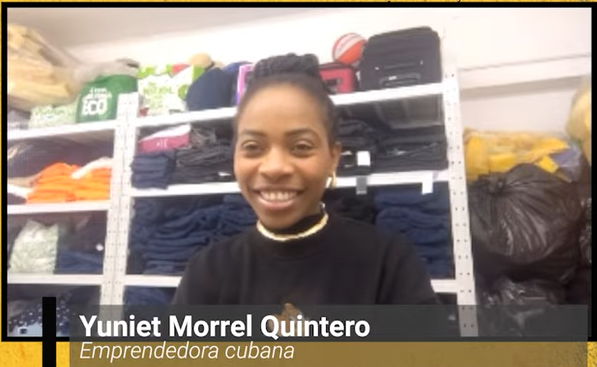
Screenshot from the interview
“The most sustainable garment is the one that already exists,” says Yuniet Morrel, creator of Looper Life and the Montevideo Sustainable Fashion Week.
By Yusimi Rodriguez Lopez (Diario de Cuba)
HAVANA TIMES — Like many Cubans, Yuniet Morrel Quintero opted to emigrate in order to give her son a better future than he would have on the Island. She arrived in Uruguay with her husband and young son in 2023. Three years later, she became the founder of Looper Life, the country’s first textile surplus bank, and organizer of the first Montevideo Sustainable Fashion Week.
A young woman determined to get ahead
Behind these recent achievements is the story of a woman whose life has been marked by sacrifice and determination, and who has been working since she was 17.
“At 17, I was already working as a seamstress from home while taking care of my grandmother. I had to finish high school through a workers’ education program,” the 34-year-old told Diario de Cuba, adding firmly that she will “never” hide that part of her life.
When she arrived at the university to enroll, the person reviewing her high school diploma questioned whether it qualified her for higher education. But the young woman from Placetas, Villa Clara, who says she loves studying, not only earned a degree in Tourism but eventually became Head of Customer Service and Public Relations at the Hotel Grand Aston at Cayo Santa María, a small island off Cuba’s north coast. That hotel is now closed following the exodus of international hotel chains from Cuba.
Before reaching that position and earning her degree, Yuniet also worked as a cook at one of the hotels in Villa Clara’s tourist district. Her passion for learning led her to educate herself independently, allowing her to steadily move up the ranks.
In Cuba, Yuniet worked as a Customer Service and Public Relations Manager.
Uruguay and the birth of Looper Life
Yuniet and her family eventually arrived in Montevideo, Uruguay, after a long difficult journey that included falling victim to a scam. She arrived with her diploma in hand, determined to have it recognized so she could work in the tourism industry. Reality quickly dissuaded her.
“Getting your degree recognized isn’t always as easy as people in Cuba imagine,” she explains.
She initially found work in a garment shop but eventually had to leave the job because she had no one to care for her son. After trying different occupations, she decided to buy a sewing machine and begin creating fabric items from home. That became the seed of Looper Life.
“I started making things with fabric scraps from the workshop where I had worked. That was the beginning,” she recalls.
She made bags, aprons, placemats, and potholders to sell. Shortly after launching her home business, she decided to participate in Expo Sostenible, an event promoted by Uruguay’s Ministry of the Environment to showcase sustainable initiatives.
Initially, her application was rejected. “Most of the event participants were large companies and well-established ventures,” Yuniet explains. But just days before the event, she received an email asking whether she was still interested in participating. She immediately said yes, although she confesses that she hadn’t fully considered what that would require.
She had to spend the next three days and nights sewing nonstop to produce enough merchandise for the exhibition. The effort paid off, though—she sold everything.
The expo introduced her to “a wonderful world of entrepreneurship in Uruguay,” which she determined to become part of. It wasn’t easy. She attended numerous training sessions, often walking long distances because she couldn’t afford transportation. She slipped into conferences held at private universities and attended every free event she could find.
Most importantly, the expo helped her realize there were many businesses like hers that worked with textile surplus materials—and that gaining access to those materials was everyone’s biggest challenge.
Yuniet and her family during the difficult journey from Cuba to Uruguay.
Failure… and the First Montevideo Sustainable Fashion Week
That realization led her to create the idea of a textile surplus bank that would connect fabric suppliers, plus companies whose employees regularly replace uniforms with designers and entrepreneurs who could reuse those materials.
Seeking funding, she presented a project to Uruguay’s National Development Agency that would culminate with the organization of a sustainable fashion event. Although the project was not selected for funding, Yuniet went ahead and organized the Montevideo Sustainable Fashion Week anyway, in collaboration with designer Steven Vazquez, from June 22 to 25, 2026.
The event attracted national attention and awakened the interest of Uruguay’s Ministries of Environment, Education and Culture, and Tourism. Yuniet Morrel assures it will not be the last edition.
“Future editions of Montevideo Sustainable Fashion Week have already been planned with a vision towards growth and evolution,” the entrepreneur says.
“For me, the platform’s greatest purpose moving forward is to open the field. Uruguay has an enormous amount of untapped talent, and my main focus will be integrating new designers and emerging entrepreneurs who need this space to gain large-scale visibility. I don’t see this as a static event, but as an engine for inclusion.”
“We want the runway to reflect all that creativity and, above all, to become a real tool for strengthening the market for responsible fashion by creating business opportunities that energize the local economy. Uruguayan design has tremendous potential, and we will continue building that bridge,” she affirms.
National Brand, Expansion, and Sustainability
Despite the lack of financing, Yuniet went ahead with her business initiative. She contacted textile suppliers, companies, and entrepreneurs, working even harder to validate her textile bank. Shortly after the fashion event, she applied for Uruguay’s National Brand certification for Looper Life. The recognition was not awarded to the business—but to her personally.
“They placed their trust in me. It means I’m the one who can make changes, work in three different areas, because the country has officially certified that it believes in me,” she affirms proudly.
Looper Life has now begun receiving orders from outside Uruguay and is expanding in ways that Yuniet is trying to manage with “wisdom” and “great care.” In fact, she still has no employees. She and her husband handle everything themselves.
Looper Life markets surplus textile materials, including fabric remnants and secondhand clothing in good condition. Whenever possible, the company also donates materials to organizations or individuals in need. For Yuniet, this is an essential part of making society itself more sustainable.
The Truth Behind the Message
Yuniet Morrel’s message promotes sustainable fashion. So does the way she lives. She proudly wears secondhand clothing.
“As the founder of Looper Life, Uruguay’s first textile surplus bank, and as the organizer of Montevideo Sustainable Fashion Week, my daily life is, by definition, sustainable fashion. It’s not just something I say into a microphone—it’s the reality I live and breathe 24 hours a day,” she says.
“My personal wardrobe reflects that perfectly: I proudly wear secondhand clothes and fully embrace circular fashion in my everyday life. Through Looper Life, I see the real impact of textile waste every day and understand the urgent need to reinsert these materials into the marketplace.”
“That’s why I know with certainty that the most sustainable garment is the one that already exists. Reusing clothing, giving materials a second life, and consuming consciously are not passing trends—they are environmental and economic necessities. As consumers, we have enormous power every time we decide to make a purchase. Sustainability begins with that very first choice.
“Wearing circular fashion and leading textile waste management through Looper Life is my daily way of demonstrating by example that a clean, ethical, and economically responsible fashion industry is entirely possible in our country,” concludes the Cuban entrepreneur from her new home in Uruguay.
First published in Spanish by Diario de Cuba and translated and posted in English by Havana Times.
Read more from Cuba here on Havana Times.