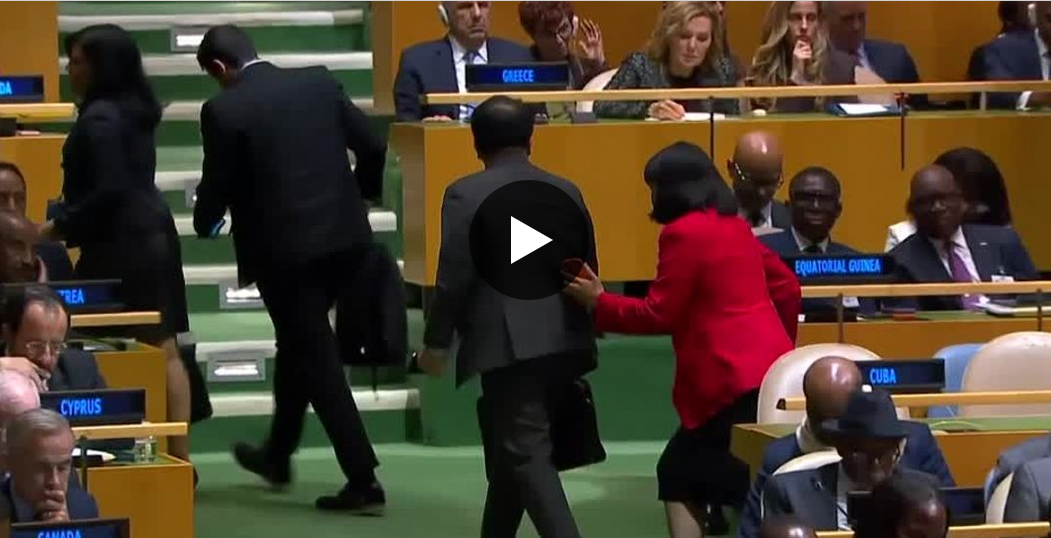
The Cuban delegation walks out of the UN session during the speech of Donald Trump. Screenshot / Reuters
By Francisco Acevedo
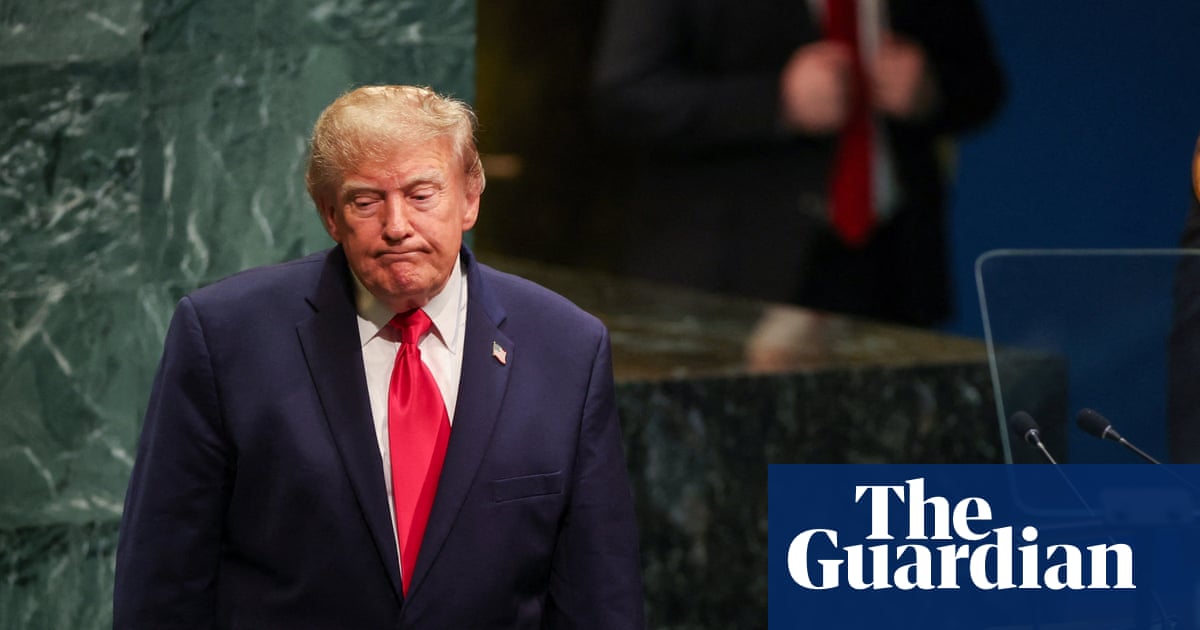
HAVANA TIMES – It happened just a few hours ago before the General Assembly of the United Nations. US President Donald Trump once again placed Cuba at the center of an international stage that, for years, seemed condemned to repeat itself in a largely meaningless vote against the embargo.
From the podium where governments proclaim principles, denounce grievances, and announce visions of the future, the US president uttered a phrase intended to cut through the diplomatic noise: his administration is working toward a fundamental change on the island.
He did not speak only of sanctions, isolation, or old disputes. He spoke of pressure—pressure that, he said, is the greatest the Cuban dictatorship has ever faced—and added a word that, in the language of politics, rarely appears without stirring up a storm: it will fall.
The controversial leader spoke so plainly about another nation that the Cuban delegation walked out of the chamber while he was speaking.
The gesture was more eloquent than any carefully drafted protest. In the solemn halls of the UN, where nations tend to shield their positions behind predictable formulas, the walkout left a clear image: a government unwilling to remain seated while the fragility of its political structure was being proclaimed to the world.
However, the speech was not limited to threats or predictions, because Trump also said that his Secretary of State, Marco Rubio, is conducting negotiations with Cuba.
The official United Nations report recorded that the U.S. president mentioned ongoing talks and a fundamental change for the island. And it is in that combination of public pressure and private negotiations—or a door left ajar, however one chooses to describe it—that the element transforming the situation appears.
Because it is one thing to shout from afar that a regime must disappear and quite another to try to turn accumulated pressure into a concrete tool for obtaining concessions, reforms, or verifiable changes before the rest of the world. International politics rarely moves in a straight line; it flows more like an underground current: on the surface, one hears threats, speeches, and gestures of defiance; underneath, representatives and emissaries test limits, gauge fears, and seek a way out that no one is yet willing to call by its name.
The sequence suggests that Rubio is trying to use the accumulated pressure as leverage, although the scope of those talks is unknown, as are, with any certainty, the identities of his interlocutors.
Nor is it known what demands have been made, what responses Havana has offered, or what conditions each side considers acceptable. But the fact that Washington is publicly speaking about negotiations on the world’s largest political stage while simultaneously escalating its rhetoric against Cuba’s leadership indicates that this is not a purely rhetorical strategy.
Pressure alone can cause a government to harden its position. Traditionally, here in Cuba it has translated into closing ranks, turning every hardship into a test of endurance and every outside criticism into an argument for strengthening internal control. But when pressure is accompanied by a door left ajar, it takes on a different character.
It ceases to be merely punishment and becomes an invitation, although in this case it is an invitation issued through a threat, from a position of power.
Cuba’s leadership needs to protect its narrative of control, and acknowledging that the pressure is having an effect would mean admitting that the system is not as impervious as it claims to be.
Publicly acknowledging negotiations driven by Washington could open cracks in a narrative based on absolute sovereignty and resistance. That is why, officially, what prevails is the silence to which we on this island have become so accustomed when it comes to matters of high politics.
The Cuban government continues to speak of dignity, independence, and national defense, while Washington advocates freedom, transition, and accountability. Between the two shores, words will attempt to conceal or reveal the true extent of the exchanges, because in diplomacy almost nothing is what it seems.
The Cuban delegation’s abrupt departure from the New York chamber demonstrated the political cost of hearing, at the UN itself, that the structure governing Cuba is under pressure.
Leaving the chamber avoided the image of a delegation forced to sit through a direct accusation, but it also produced another, perhaps more powerful image: that of a government responding with denial rather than argument.
Every gesture has a price, and this silent protest may satisfy allies and reinforce an internal sense of identity, but it may also strengthen the perception of isolation.
The traditional strategy of economic encirclement always turned into a spiral of everyday suffering that allowed the Cuban government to present itself endlessly as the only barrier against foreign aggression. But now that strategy has been modernized and refined to hit them where it hurts most, where they truly feel it.
On the one hand, the dictatorship continues calculating how much it can withstand without jeopardizing its stability, while the United States will have to demonstrate that its demands are not simply a repetition of old threats, but part of a strategy capable of producing real change.
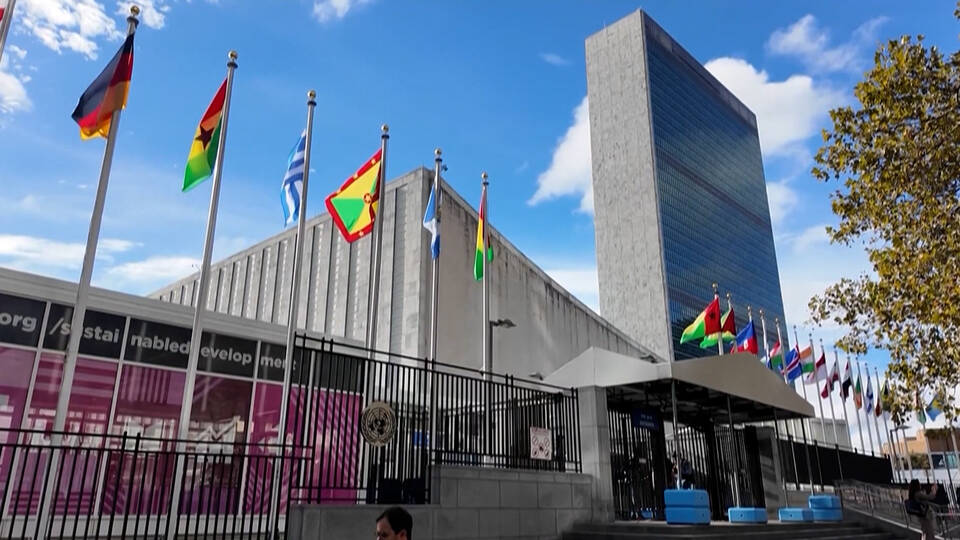
Between the UN podium, where the world watched in surprise as Trump delivered an aggressive speech toward a “sovereign” nation, and the closed rooms where negotiations are taking place, the island’s future is beginning to take shape, though its outlines remain imprecise.
All we know is that a channel for dialogue exists, but the essential details remain hidden: who is negotiating directly, what is being offered, what is being demanded, and what each side is willing to concede.
Trump sought to portray the fall of the dictatorship as an inevitable outcome, one way or another. But regimes do not fall simply because someone announces their downfall. Sometimes they erode slowly; sometimes they negotiate their survival; sometimes they turn an external threat into fuel for resistance.
Cuba has been placed at the center of the international stage, under the UN’s spotlights, and Washington no longer appears to be choosing between pressure and dialogue. Instead, it is attempting to do both at the same time. And within that tension between the visible fist and the door left ajar may lie the real battle over the island’s future.
Read more from Cuba here in Havana Times.