There are three major events happening in the night sky above Massachusetts this month. WBUR Morning Edition host Tiziana Dearing spoke with Sky & Telescope’s Kelly Beatty about what to expect when you look up.
Partial solar eclipse: Aug. 12
A total solar eclipse will take place worldwide Wednesday afternoon. It happens when the moon covers the sun. This type of eclipse usually takes place roughly every 18 months. The last one New Englanders were treated to crossed our region in 2024 and was greeted with much fanfare. This time, the views will be arguably less spectacular as only a sixth of the sun will be covered.
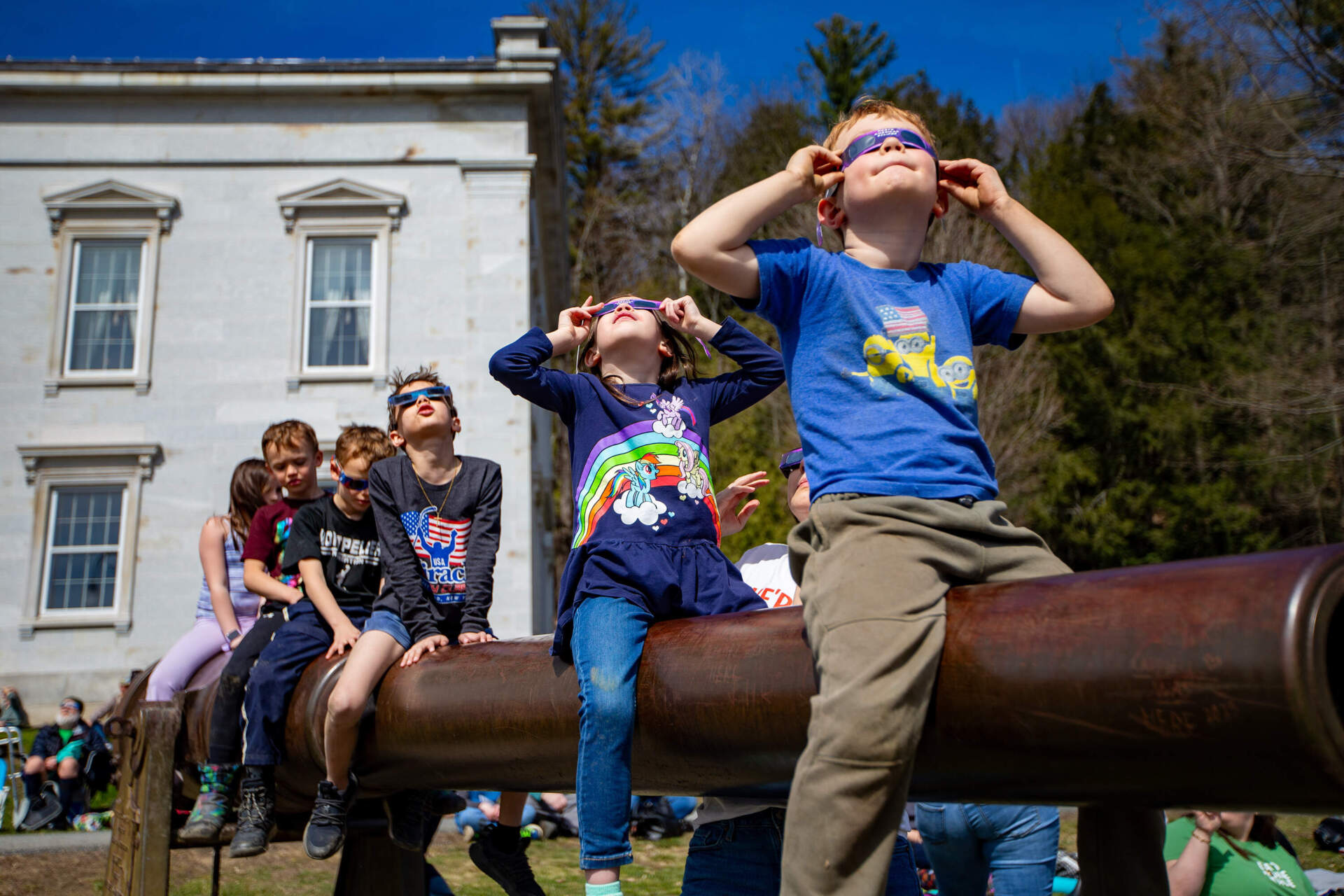
Beatty said there’s still some magic in watching even a partial eclipse. He stressed that you’ll want to observe the partial eclipse safely, however, typically with specialty eclipse glasses. (You’ll want to make sure those glasses are approved for this use and aren’t damaged or scratched at all. Regular sunglasses won’t work.)
Eclipse watchers on Boston Common look up as the eclipse reaches its peak in 2024. (Robin Lubbock/WBUR)
If you’re caught without the right equipment, Beatty has another trick: You can use binoculars to safely view the celestial event by reflecting the eclipse onto a piece of paper. That can be done by covering one side of the binoculars with tape or a small piece of paper. Then, prop the binoculars on a tripod and point them at the sky so sunlight streams through.
“You’ll get a very nice image of the partially eclipsed sun that can be seen all around,” he said.
The celestial show will offer the best views for Greater Bostonians and the broader region at around 2 p.m., he said.
Perseids meteor shower peak: Aug. 12-13
The annual Perseids meteor shower will peak the same night. The meteors look like they originate from the constellation Perseus, hence the name. But the meteors are actually debris from a comet called Swift-Tuttle, Beatty said, which drops rubble as it orbits the sun. And they’re hitting the upper atmosphere really fast, at roughly 133,000 thousand miles per hour. When they do, you’ll see that streak of light over the sky.
A meteor from the annual Perseid meteor shower falls from space over ruins at Fort Churchill State Historic Park on Aug. 12, 2012, in Silver Springs, Nev. (Kevin Clifford/AP)
Beatty said the peak starts at around 9 p.m., and he expects there will be a lot of action this year.
“ From a really dark location, super dark, you might see anywhere from around one [meteor] per minute and up to 100 per hour ideally,” he said. “But most of us deal with light pollution, so I would say more realistically, one every other minute. But that’s still a lot of meteors to enjoy.”
Beatty said if you can stay up later you’ll likely be able to see even more meteors streak across the darkness.
Near-full lunar eclipse: Aug. 27- 28
Now it’s the moon’s time to shine.
From the later evening into the early morning, a near-full lunar eclipse will be visible over Massachusetts. The peak is set to occur just after midnight. If you look up, you’ll see about 96% of the moon covered by the sun.
Light shines from a total lunar eclipse over Santa Monica Beach in Santa Monica, California, in 2021. (Ringo H.W. Chiu/AP)
Beatty said it’ll look like the moon is wearing a tiny, light-colored “beanie cap.”
“ The rest of the moon will be plunged into Earth’s shadow,” he said. “You might get some of that coppery color that total lunar eclipses are known for.”
Beatty said you can even ditch the special glasses to look at this eclipse. (Again, don’t burn your retinas during the solar eclipse, though.)
The next (almost) total lunar eclipse will not happen again until the end of 2028.
This segment aired on August 7, 2026.