A rising number of children returning to Syria are struggling to re-enter the national school system, confronting a steep linguistic barrier after years of studying in foreign languages during displacement. As families resettle across the country, education authorities and local initiatives are rolling out targeted programs to help students bridge the gap and reintegrate into Syrian classrooms.
These efforts coincide with regional campaigns, most notably the Letters of Return initiative in Aleppo Governorate. At the same time, the Ministry of Education is monitoring the situation of returnee students to ensure a smooth transition across all governorates.
Language Emerges as the Central Obstacle
Parents who spoke to Al-Thawra described daily challenges their children face upon returning to Syrian schools.
Mona Salama, a mother of two recently back from Turkey, said her eldest son was unable to keep pace with the fifth-grade curriculum due to limited Arabic proficiency. After an assessment, he was placed in the fourth grade. Her younger son, now in second grade, adapted more easily but still requires extensive tutoring at home.
Years of instruction in a foreign language, Salama explained, left her children struggling to read, write, and comprehend lessons in Arabic. Although repeating a grade was emotionally difficult for her eldest son, she believes it was necessary to rebuild his foundational skills.
Aref Al-Issa shared a similar experience. His third-grade daughter, also returning from Turkey, faced months of difficulty due to her limited fluency. The challenge extended beyond Arabic classes, affecting her ability to understand other subjects and participate in lessons. With additional support at home, she is gradually improving, though Al-Issa stressed that she still needs time to catch up.
For Qutaiba Adnan, who returned from Germany, daily study sessions at home have become essential. While the added workload strains the household, he said it remains crucial for stabilizing his child’s academic progress.
Tailored Support Seen as Key to Academic Recovery
Arabic language teacher Abdul Hamid Al-Muhammad noted that returnee children display widely varying levels of proficiency after years of foreign-language instruction. This gap affects reading comprehension, writing skills, and overall engagement with the curriculum—particularly in primary grades.
He emphasized the need for customized language programs that allow students to acquire skills gradually and at their own pace. Most children, he said, adapt quickly when provided with a supportive environment and clear teaching strategies.
Family involvement is equally important. Regular practice at home—reading together, speaking Arabic daily, and encouraging conversation—can significantly accelerate language acquisition and ease the psychological stress of reintegration.
Aleppo Launches 400 Centers Under “Letters of Return”
To meet rising demand for language support, the Department of Cultural Development and Adult Education—part of the Aleppo Culture Directorate—has launched the Letters of Return campaign.
Khalifa Hout, head of the department, told Al-Thawra that the initiative responds to the influx of families returning after the liberation of several areas. Many children had been educated in Turkey, Germany, and other countries, making immediate integration into Syrian schools difficult.
The campaign aims to strengthen basic Arabic skills, reinforce national identity, and ease social reintegration. It targets children and youth aged 7 to 18—the group most in need of linguistic support before resuming formal schooling.
Organized through Aleppo’s Cultural Development and Adult Education Committee—chaired by the Governor and including directors of education, social affairs, religious endowments, and culture—the campaign works closely with the Directorate of Education. Mosques, schools, and civil society organizations have joined the effort.
The first phase, launched during the summer break, will run until the start of the academic year. Using an interactive map, officials established roughly 400 centers across Aleppo city and its countryside, with plans to open more as needed.
More than 12,000 students enrolled in the first week. Hout said that while the need remains immense, this initial phase provides a foundation that will be expanded and refined based on assessments during the school year.
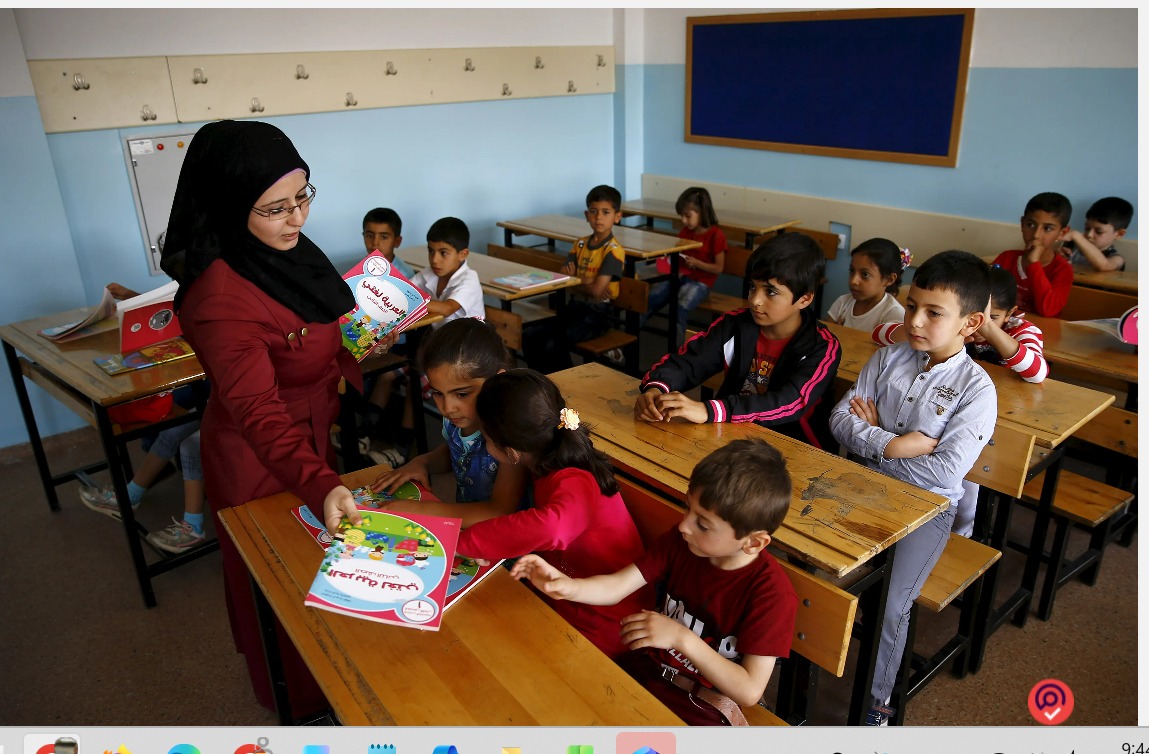
The curriculum relies on summer clubs managed by the Education Directorate, with dedicated classrooms for returnee children and additional instruction offered at mosque-based centers. Participating institutions and NGOs have been supplied with approved textbooks designed to reinforce core language skills.
Aleppo was selected as the pilot governorate due to its high number of returning families from Turkey and Europe.
“Arabic Is Life” Initiative Seeks to Close the Gap Nationwide
Mohammad Said Kaddour, Director of Education at the Ministry of Education, told Al-Thawra that officials have documented widespread language deficiencies among returnee students. To address this, the ministry is preparing summer catch-up courses to help students acquire essential skills and transition smoothly into higher grades.
The Curriculum Development Directorate has produced a specialized textbook titled Arabic Is Life, designed for children with limited proficiency or those who studied abroad. Kaddour said the ministry plans to implement the textbook nationwide under a unified framework governing grade advancement. Rather than pushing returnees directly into the standard curriculum, the resource provides structured reinforcement tailored to their needs.
For students lacking official transcripts, the ministry uses a placement method known as Sabr, which assesses Arabic and mathematics skills to determine appropriate grade levels. Kaddour stressed that language barriers are carefully considered to ensure fair evaluation focused on potential rather than penalizing students for gaps created by displacement.
Looking ahead, the ministry plans to address the geographical dispersion of returnee students. Because they are spread across wide areas, officials are studying the establishment of permanent learning hubs in city centers, alongside sustainable funding mechanisms to ensure long-term support.
UNHCR: Language Barriers Undermine Reintegration
The United Nations High Commissioner for Refugees (UNHCR) underscored the challenge in its report Protection and Reintegration Insights – Syria, Q1 2026. The agency found that many children returning from Turkey and Lebanon face learning obstacles due to prior instruction in Turkish or French.
Curriculum differences and language barriers have forced some students into grades below their age group, affecting self-esteem and retention rates. The report highlights the urgent need for expanded language and academic support programs nationwide.
Bridging the language gap remains essential for helping returnee children settle into classrooms and continue their education—reinforcing the need for sustained, nationwide support across all Syrian governorates.
This article was translated and edited by The Syrian Observer. The Syrian Observer has not verified the content of this story. Responsibility for the information and views set out in this article lies entirely with the author.