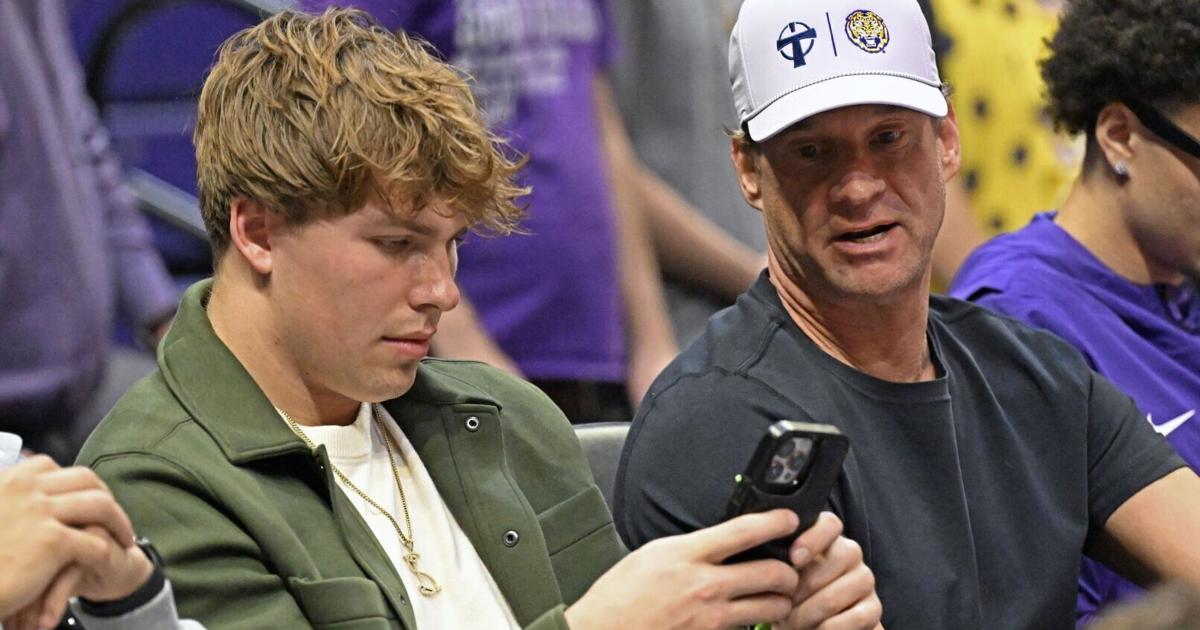
Tania Leavitt remembers when her son Sam said, “This is the place.”
The current LSU quarterback thought his football home would be Michigan State. Tania, a retired fitness trainer, and Jared Leavitt, a former BYU linebacker who worked for Oracle, moved to East Lansing to be by their son’s side for a year. They loved it there.
Then there was a coaching change. Oregon State coach Jonathan Smith, who didn’t recruit the Oregon native Leavitt out of high school, was Michigan State’s hire and he was bringing his quarterback, Aidan Chiles, with him. The writing was on the wall.
Leavitt traveled to Tempe, Arizona, and talked ball with Arizona State coach Kenny Dillingham and offensive coordinator Marcus Arroyo. Leavitt grew up studying X’s and O’s with a brother 10 years his elder, NFL safety Dallin Leavitt. By fourth grade, Sam was contesting his father’s play calls during games.
“Dad, they are running blah, blah, blah. Like, why are we doing that? That’s not gonna work,” Jared recalled Sam saying. “He was definitely looking at the game and trying to figure out what was our angle to win, how were we gonna score and the why.”
The lifelong film junkie clicked with Dillingham and Arroyo, and Arizona State became home.
“And it was phenomenal,” Tania said. “It was, like, the best Cinderella story ever.”
The stands in Tempe filled as the Sun Devils flipped from 3-9 to 11-3 with a College Football Playoff run in 2024. It was a “magical” two years, Tania said, even if the story ended with an injury-shortened 2025 season and consternation over Sam’s absence from a team banquet before he entered the transfer portal.
As LSU coach Lane Kiffin tried to explain after his exit from Ole Miss, two things can be true at once: A person can love one job, then decide another job is better.
The quarterback he chose out of the transfer portal made a similar decision.
“Everybody gets down on these kids. They didn’t create the system,” said Tania, who tried her best not to doom-scroll social media after her son’s decision to transfer, again, to LSU.
In this unwieldy portal era, a highly ambitious athlete made another choice that satisfied his competitive instinct. Leavitt sees LSU as a place where he can train like a pro. He’s been chasing the NFL longer than some considered reasonable.
Ryan Paul, who trained both Leavitt brothers, remembers his first game of catch with sixth grader Sam, who spun the football with enough juice that it wasn’t boring. He was a natural “mover,” blessed with more agility than his run-through-a-wall older brother.
He believed he was a future pro, just like his brother.
“I was like, ‘OK, you’re delusional,’ ” Paul said. “But the way things are looking, he’s not too delusional.”
Leavitt has always pushed himself. He grew up with a whiteboard in his room with the words, “How great do you want to be?”
He asked Paul, constantly, if he was working as hard as his older brother. It took a few years for him to get there, mostly because Paul had to remind the younger Leavitt that working hard didn’t mean wildly “crashing out” in every exercise.
“You can be intense,” Paul said, “without going to a level where you’re gonna pop an aneurysm.”
His brain was worth preserving. Leavitt’s coach at West Linn High School, Jon Eagle, admired his quarterback’s unshakable confidence. He could follow frustrating interceptions with 80-yard touchdown drives.
He lacked fear as a passer. Leavitt once rocketed a football 35 yards from one hash to the other, its flight path a steady 6 feet above the ground. No one was amazed because Leavitt did this all the time.
What sticks with Eagle most is how quickly Leavitt could count down from 100, subtracting seven every time: 100, 93, 86, 79, 72, 65, 58, 51, 44, 37, 30, 23, 16, 9, 2.
“He can get that thing in under 10 seconds,” said Eagle, who has long believed the quickest thinkers are the best quarterbacks.
Leavitt absorbed Eagle’s playbook with ease.
“A lot of kids need several reps of doing something before they get it. You could sit down in a meeting room 30 minutes before practice, and by the time we got out there, he would do it,” said Eagle, who believes he was luckier to coach Leavitt than the other way around.
He became a state champion before his prep career ended, but Leavitt had to bounce between states to claim it. He played his first season as a varsity starter in Utah because Oregon shuttered sports during the COVID-19 pandemic.
He was sacked a handful of times in one game by Lone Peak edge rusher John Henry Daley, who has transferred from BYU to Utah to Michigan.
“We had good players,” Jared said of his son’s 6-5 Pleasant Grove squad, “but it was tough to go out there and get hit in the mouth.”
Leavitt returned to Westview High School as a junior, fully understanding how hard it is to win. He wanted to grow as much as possible, so he inevitably transferred to West Linn as a senior to play for former NFL quarterback Chris Miller.
But Miller took a pro coaching job before Leavitt arrived. Eagle swooped in, synched up with Leavitt and even convinced the aggressive playmaker to not run the ball in the regular season to preserve his body.
When Leavitt was cut loose, West Linn went on a run and Eagle won his fourth state title.
“He’s an SEC quarterback,” Eagle said. “He might be an NFL quarterback.”
Eagle won’t disparage Oregon State for not realizing this because sometimes “you’re just not someone’s flavor of ice cream.” And sometimes you are before circumstances change.
Leavitt thought he found a suitor in Washington State offensive coordinator Eric Morris. Then just after Leavitt’s visit to the Cougars, Morris took a head coaching job at North Texas. Morris is now at Oklahoma State.
Leavitt landed at Michigan State and loved it. Then Oregon State’s staff moved in.
“Sam’s been through the wringer, man,” Eagle said. “People say all this stuff about kids moving. But look, coaches do it. Why can’t players do the same thing? They’re just trying to make the situation for themselves better. I don’t know how you can find fault in that.”
Leavitt tried to explain as much during a recent LSU football women’s clinic, calling Arizona State a “comfortable situation.” He just wanted to “do something a little bit different.”
“You talk about being a pro, trying to become the best version of yourself,” Leavitt said of LSU. “There’s no other place to do it.”
That touched off another round of bitter replies on social media, as anonymous accounts accused him of chasing money. Tania would remind them her son donated earnings from the sale of his Arizona State jersey back to the school’s NIL collective.
But there’s no use in the argument. The quarterback who will guide LSU through what’s bound to be a noisy season, considering Lane Kiffin’s exit from and looming return to Ole Miss, offered his mother sage advice for handling online criticism.
He asked her to picture them walking down the road, with Tania slightly behind him.
“You’re hearing everything people are saying about me. By the time we get to the end, you’re ready to fight. You’re angry,” he said. “You know what? I got AirPods in. I got my Beats on. I don’t hear a word. I don’t care. So don’t listen.”
If Kiffin can turn Leavitt into a dual-threat star like he did with transfers Jaxson Dart and Trinidad Chambliss at Ole Miss, the chatter should quiet.
If LSU’s investment in the No. 1 transfer class in America correlates to a playoff run, Leavitt’s decision shouldn’t be that hard to understand.
“He was an integral piece of getting Arizona State back to relevancy, and he could have stayed and they probably would have been just as competitive,” Paul said, “but it wouldn’t be the same as this roster at LSU. There’s no way. They don’t have the money.”
He made his own choice this time.
Tania believes her son has found home again.
He has been deep sea fishing and duck hunting with LSU linebacker Whit Weeks. A local farmer has been providing Leavitt with fresh produce. He lives just around the corner from his offensive coordinator, Charlie Weis Jr.
LSU is just a little different, but it could be everything he wants and needs.
“He just wants to win,” Tania said. “He wants to be the best that he can be, for real.”