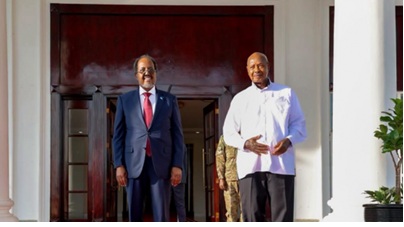
Kampala, Uganda (WDN)— Somali President Hassan Sheikh Mohamud arrived in Kampala on Friday for high-level talks with Ugandan President Yoweri Kaguta Museveni, ahead of a summit of troop-contributing countries to the African Union Support and Stabilization Mission in Somalia (AUSSOM).
The meeting comes at a pivotal moment for Somalia, as the country confronts mounting security challenges, uncertainty over international support for AUSSOM, and an unresolved political dispute over the country’s electoral framework.
According to the Somali Presidency, the two leaders held extensive discussions on the longstanding bilateral relationship between Somalia and Uganda, reaffirming their commitment to expanding cooperation in security, politics, economic development, and institutional capacity-building.
Security dominated the discussions, with both presidents reviewing the ongoing campaign against Al-Shabaab and the need to strengthen regional cooperation in counterterrorism operations.
President Museveni reaffirmed Uganda’s commitment to supporting Somalia’s stabilization efforts. Uganda remains one of the largest troop contributors to AUSSOM, having played a central role in Somalia’s security architecture for more than two decades.
The two leaders also reviewed Somalia’s progress in rebuilding state institutions, reforming its security forces, and extending government services into areas recovered from Al-Shabaab. President Hassan Sheikh expressed appreciation for Uganda’s longstanding contribution to Somalia’s peace and stabilization efforts, describing the partnership as essential to the security of the wider Horn of Africa.
For his part, President Museveni praised Somalia’s efforts to rebuild national institutions and combat terrorism, pledging that Uganda would continue supporting both the Somali government and its people.
The discussions also covered the agenda for the AUSSOM summit, where participating countries are expected to address the mission’s future, sustainable financing, force generation, and strategies for strengthening Somalia’s national security forces as international support evolves.
Both leaders agreed that Somalia’s security remains fundamental to the stability of the Horn of Africa and emphasized the importance of sustained cooperation among regional governments, the African Union, and international partners.
Beyond Security: Could Politics Also Be on the Agenda?
While the official readout focused almost exclusively on security and bilateral cooperation, the timing of the meeting has inevitably fueled broader political speculation.
Somalia is not only confronting a difficult security environment but also an ongoing political impasse over elections and governance. Talks between the Federal Government and opposition groups have yet to produce a comprehensive agreement on the country’s electoral roadmap, leaving key constitutional and political questions unresolved.
Against that backdrop, some political observers believe regional leaders attending the Kampala summit could quietly encourage Somali stakeholders to pursue greater political compromise alongside military cooperation.
President Museveni has long been regarded as one of Africa’s most influential statesmen on regional security issues and has frequently emphasized that military victories are difficult to sustain without accompanying political settlements and inclusive governance.
Whether Museveni raises Somalia’s domestic political dialogue privately with President Hassan Sheikh remains unknown. Neither government has indicated that electoral negotiations or concessions to the opposition formed part of their bilateral discussions.
Nevertheless, analysts note that international and regional partners increasingly view Somalia’s security and political challenges as deeply interconnected. Progress against Al-Shabaab, they argue, is likely to be more sustainable if accompanied by broad political consensus and cooperation among Somalia’s major stakeholders.
As the AUSSOM summit opens in Kampala, attention will not only focus on troop levels, funding, and military operations but also on whether regional leaders encourage renewed efforts to bridge Somalia’s political divide. For many observers, durable security will ultimately depend not only on battlefield gains but also on the ability of Somali leaders to forge an inclusive political settlement that commands broad national support.
WardheerNews