Jakarta, IO – The global economic order is undergoing a profound paradigm shift. Mounting geopolitical uncertainty, global supply chain fragmentation, intensifying competition for strategic resources, and the imperative to bolster national economic resilience have driven governments worldwide to take a far more active role in economic development.
Across the globe, the state is no longer acting merely as a referee or regulator. Instead, governments are stepping in as investors, capital providers, industrial architects, and managers of strategic assets.
State intervention has re-emerged as a primary engine for driving economic transformation, enhancing national competitiveness, and safeguarding long-term stability. Indonesia is following a strikingly similar trajectory.
In recent years, key policy moves have underscored the state’s expanding footprint in Indonesia’s economic landscape—ranging from the consolidation of state-owned enterprises (SOEs) and the establishment of sovereign wealth fund Danantara, to industrial downstream processing, aggressive infrastructure rollouts, and various National Strategic Projects (PSNs).
These developments raise increasingly urgent questions about the trajectory of Indonesia’s economic future. On one hand, an empowered state role is seen as essential for accelerating industrialization, increasing domestic value addition, and fortifying economic resilience.
On the other hand, critical questions loom over its impact on market efficiency, private sector innovation, economic governance, fiscal health, and long-term sustainability.
Amid these dynamics, Indonesia stands at a crucial crossroads in defining its future growth model. The debate is no longer about whether the state should intervene in economic development, but rather how state participation can foster growth that is productive, competitive, innovative, and sustainable.
At Wednesday’s Economic Frontline 2026 forum, themed “State Capitalism 2.0: Driving Indonesia’s Next Phase of Growth,” economists, academics, policymakers, business leaders, and civil society gathered to dissect the opportunities, risks, and broader implications of rising state capitalism for Indonesia’s economic outlook.
Beyond ‘good or bad’: redefining state intervention
A panel of experts and economists argued that the role of the state in the national economy can no longer be debated strictly through a simplistic lens of “good or bad.”
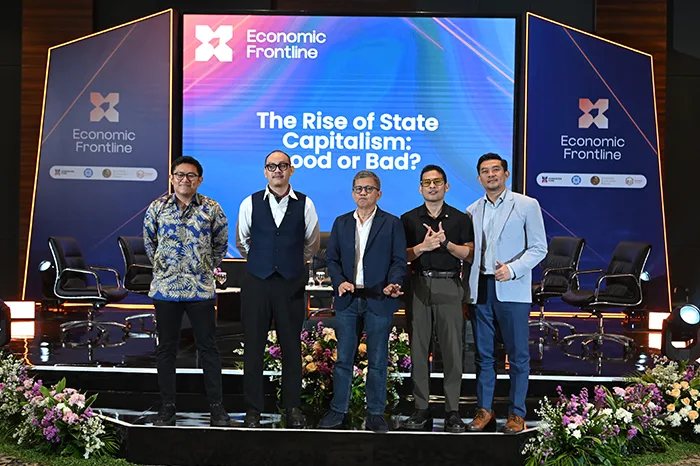
Speaking at a session titled “The Rise of State Capitalism: Good or Bad?”, panelists stressed that the true effectiveness of state intervention hinges on policy objectives, strategic timing, and targeted beneficiaries.
Opening the session, Dr Harryadin Mahardika posed a provocative question: Is state capitalism truly inherently flawed? Does expanding government intervention inevitably lead to systemic inefficiency and market failure?
Dr Harryadin Mahardika. (Source: Special)
Dr Harryadin noted that many global economists offer a compelling counter-perspective on state intervention. Notably, Italian-American economist and academic Mariana Mazzucato argues for the concept of the “entrepreneurial state.” Under this framework, a state must actively innovate; without an entrepreneurial mindset, national progress stalls.
“We can observe this in China, where the state acts as an entrepreneur, channeling policies and capital directly into building new, high-growth industries,” he said.
He further referenced South Korean economist and author Professor Ha-Joon Chang, who famously coined the term “Kicking Away the Ladder” and argued that developed nations frequently forbid developing countries from deploying protectionist policies and government intervention—the exact tools those advanced economies originally used to build their wealth.
Advanced economies demand that developing nations adopt free-market principles and curb state involvement, effectively pulling up the ladder behind them.
Read More: National Food Supply Remains Secure, Says Bapanas Chief
Constitutional mandate and the “hybrid” middle ground
Political commentator Rocky Gerung emphasized that state involvement in the economy is an explicit constitutional mandate under Article 33 of the 1945 Constitution. In his view, state capitalism in Indonesia represents a historical choice that cannot be discarded without reshaping the nation’s foundational principles.
While pragmatic adaptation is essential amid global turbulence, Rocky cautioned that economic development must remain grounded in social equity and environmental stewardship, rather than a narrow pursuit of GDP growth.
Echoing the necessity of government action, Jahen F. Rezki, a researcher at the Indonesian Institute of Economics and Business (LPEM FEB UI), pointed out that government steps in to address market failures and systemic bottlenecks.
“For instance, when the state envisions developing a new sector, the private sector cannot operate entirely on its own. Private enterprise needs a coordinator—a referee to set the rules and ensure smooth operations,” Jahen explained.
“That is the fundamental function of state capitalism. However, it must operate within limits. The state does not need to run every single business line.”
He proposed a “hybrid state capitalism” model as a balanced middle path for Indonesia. “The real question isn’t whether it is good or bad, but rather when to apply it and what the strategic objectives are,” Jahen argued.
“Government involvement remains vital because, constitutionally, the state must be present. Simultaneously, the state must carve out ample space for the private sector to thrive.
“This dynamic combination ensures that when citizens require public backing, the state is there, while allowing the public and private sector to actively contribute to and benefit from economic progress.”
Illustrating the hybrid approach, he pointed to South Korea’s historical playbook: “When South Korea developed its industrial baseline, the government provided low-cost credit to industrialists, particularly in the steel sector, with the clear objective of helping domestic businesses scale up and capture export markets.”
Similar pragmatism is evident in China and Singapore, Jahen noted: “Look at Huawei—it built its foundation first before receiving structured government support. Another prime example is Singapore’s Temasek. The government simply ensures robust oversight and execution without micromanaging daily operations.”
Guardrails against market failure and the role of institutions
Offering a critical counterweight, Bhima Yudhistira, executive director of the Center of Economic and Law Studies (Celios), raised concerns regarding the potential for “government failure” and rent-seeking behavior.
Bhima questioned the overarching master plan of national economic development, asserting that Indonesia has yet to establish a roadmap as laser-focused as those seen in China or Vietnam. He urged policymakers to adopt success metrics beyond conventional growth figures, prioritizing indicators such as citizen well-being and environmental sustainability.
In his view, public debate often gets bogged down in surface-level comparisons between State Capitalism, socialism, and the welfare state. “What truly matters is establishing the essential framework—such as defining the limits of growth and formulating clear exit strategies for government intervention.”
Responding to these perspectives, Fithra F. Hastiadi, an expert staffer and spokesperson on economic issues at the Government Communications Agency (Bakom), affirmed that, within a sovereign framework, state intervention aims to eliminate market inefficiencies and build economies of scale.
“I see President Prabowo’s approach as deeply practical and pragmatic. It aligns directly with our constitutional mandate, where the supreme priority is preventing state failure. A state fails when it allocates the most resources to those who already hold the most power,” he observed.
“What we need instead are rules of equity—allocating the most support to those who need it most. The government’s central focus today is building inclusive economic institutions so that the fruits of development directly benefit the broader public.” (des)