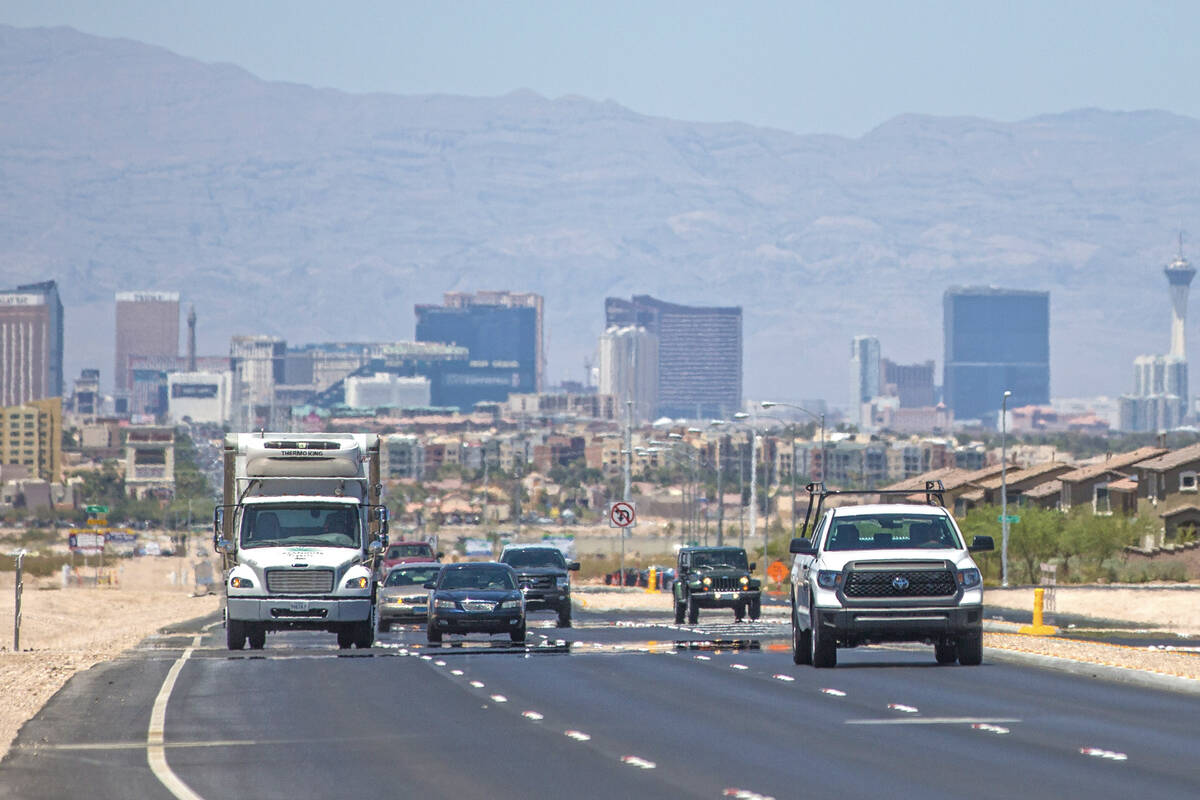
Clark County’s population growth is dramatically slowing, according to a new report from UNLV.
UNLV’s Center for Business and Economic Research reported last year in its annual report that the county would hit 3 million residents by 2045. It’s now estimated the county won’t reach that population figure until 2055, according to its 2026 Population Forecast report released Wednesday.
The revised forecast from CBER projects the county will reach about 2.77 million residents by approximately 2040, pass 3 million in 2055 and approach 3.08 million by sometime around 2060.
After the county gained roughly 40,000 residents in both 2026 and 2027, the county is then expected to add around 38,000 residents in 2028 before annual gains are then expected to slow sharply, the new report shows. From 2032 onward, Clark County is projected to add only between 14,000 and 16,000 residents a year through 2060.
Andrew Woods, director of CBER, said the time of never-ending exponential growth for the state is over — for now.
“Policymakers, businesses, and community leaders should prepare for a world where population growth is not a given, but instead earned through long-term planning and investment in jobs, education and workforce training, healthcare, and other features which contribute to our quality of life,” he said.
The county has outpaced the national population growth rate for the country for more than five decades, however CBER said that gap is now closing and the county’s annual growth rate will drop from 1.6 percent this year to about 0.6 percent in 2029, then hold somewhat steady through 2060.
“The change reflects a slower long-term growth outlook for Southern Nevada,” reads the report. “CBER now expects Clark County to add about 204,000 residents between 2026 and 2036, compared with about 347,000 residents over the comparable period in last year’s forecast.”
However, the CBER report said that slower population growth does not technically mean a weakened economy and estimates the county will add approximately 17,000 jobs this year and 20,000 next year, with “softer” growth in 2028 and 2029. Also, the report states hiring is expected to pick up again in 2030 due to new hotel inventory coming online and the highly anticipated opening of Bally’s Las Vegas next to the A’s ballpark on the Strip.
From 2026 to 2036, the county is then projected to add about 117,000 jobs. The largest gains for job growth will most likely be in accommodation and food services sectors along with healthcare, social assistance, transportation and warehousing.
Real GDP for the county is forecast to grow from approximately $200.8 billion this year to $370.5 billion by 2060, measured in fixed 2026 dollars. Over the same time period, real GDP per capita is projected to rise from around $80,000 to more than $120,000.
“CBER projects that Clark County’s natural change, the difference between births and deaths, will turn negative around 2032,” continues the report. “After that point, growth depends entirely on net migration, meaning Clark County will need to gain more residents from people moving in than it loses from people moving out.”
The report outlines there are a number of causes for this drop.
“Birth rates in Clark County run below the national average, and net migration, both domestic and international migration, is expected to come in lower than in past forecasts, “continues the report. “A higher share of the migrants who do arrive are retirees, which is a change from previous decades. Together, these factors are expected to accelerate the aging of the county’s population.”
Contact Patrick Blennerhassett at pblennerhassett@reviewjournal.com