Britain’s recent announcement of aid cut to Malawi coupled with earlier cuts by the USA threaten to haunt the country’s economy with catastrophic effects in health and education sectors, econ-omists and other experts have warned.
The UK announced on Thursday a 60 percent cut in aid for 2026/27 financial year with further reductions to 90 percent by 2028/29 financial year while the USA has terminated contracts worth $230.4 million, affecting vari-ous programmes, especially in health and education.
In separate interviews at the weekend, economists alongside experts in education and health sec-tors expressed fear that the reductions in external support are likely to affect public budgets and the performance of sectors that have traditionally relied heavily on donor financing.
They warn that the situation may lead to collapse of primary healthcare services, closure of com-munity-led organisations, loss of livelihoods and mental health challenges, reversal of gains in education, including access, retention, and learning outcomes, but also weakening of long-term institutional capacity.
Economic woes to worsen
University of Malawi (Unima) macroeconomics lecturer Edward Leman said donor aid cuts have already contributed towards increased domestic borrowing, which can crowd out private sector investment by pushing up interest rates and limiting access to credit.
He said: “The greatest concern is that development partners have historically supported essential social sectors such as health and education, where reductions in financing could have significant implications for service delivery and human development.
“Government will need to eliminate unnecessary spending, strengthen institutions, and reduce leakages to ensure that limited resources generate maximum impact.”
Economist Christopher Mbukwa, who teaches economics at Mzuzu University, expressed fear that the reduction in foreign currency inflows to key sectors will likely worsen poverty and may worsen inflation due to forex exchange effects on critical imports.
“It may lead to increased fiscal deficit unless domestic revenue generation increases to bridge the gap which is unlikely considering the dismal economic growth prospects,”he said.
Health sector already in turmoil
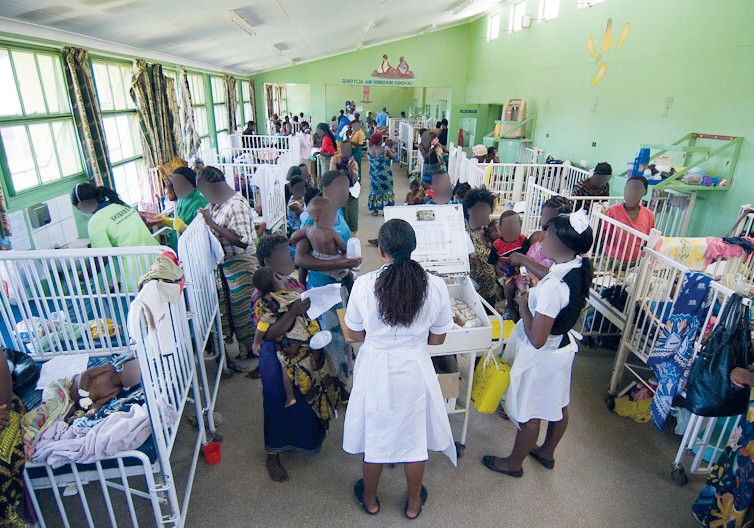
International Coalition on Health Financing Advocacy chairperson Maziko Matemba feared col-lapse of primary service delivery as donor funds historically subsidized frontline health costs, commodity procurement, and rural clinic operational budgets.
He said: “Dozens of community-led organisations (CLOs) and local health NGOs face total clo-sure, which will prompt a mass layoff of trained community health workers and overwhelm public hospitals.
“The rapid USAid shutdown completely dismantled community-led planning networks and essen-tial tracking systems, directly interrupting continuum-of-care models for high-risk populations.”
Matemba said specialised surgeries and maternal health programmes previously propped up by US funding are actively reeling from severe funding gaps, while key scientific innovation labs and health research initiatives have been shelved entirely, abruptly ending clinical trials and cutting off medical student scholarships.
On his part, Malawi Health Equity Network executive director George Jobe agreed, saying, re-duced funding threatens the availability of medicines, HIV, TB and malaria services, maternal and child health programmes, immunisation, and community health services.
“Some implementing partners have also scaled down operations, affecting service delivery, while other projects and programmes completely closed down. There is also an indirect and silent men-tal health challenge arising from lost livelihoods of people who were on the projects,” he said.
Health financing specialist Norah Mwase urged government to catalyse reforms in public finance management to improve budget absorption and transparency, leveraging digital tools for real-time expenditure tracking.
She said there is need to delegate budgetary authority to district health management teams, en-abling demand-driven resource allocation based on local epidemiological data such as malaria incidence and maternal death audits.
“The sector can also leverage public-private partnerships for supply chain management, drawing on expertise from local NGOs and other key players to ensure continuous availability of essential medicines,” said Mwase who also teaches economics at Unima.
Education lost a lot already
Based on Mid-Term Review of the National Education Sector Investment Plan (Nesip) covering the years from 2020 to 2025, the government overspent on wages (K343.65 billion from K289.07 billion budget), while underspending on projects (K44.69 billion instead of K80.6 billion budget)
However, development partners significantly contributed to infrastructure, spending K436.38 bil-lion, which was 31 percent more than the planned K332.24 billion, underscoring the donors’ space in Malawi’s education.
The withdrawal of support by development partners such as USAid, which has put at risk about $140 million (about K245.14 billion) in assistance to Malawi’s education sector until 2029 has worsened the situation.
Link for Education Governance executive director Limbani Nsapato said basic education, skills development, system strengthening and stakeholder coordination will now be affected as the UK Aid has been supporting that.
In a separate interview, Civil Society Education Coalition executive director Benedicto Kondowe added that donors have also been supporting teacher development, learning materials, infra-structure, inclusive education, girls’ education and assessments.
Meanwhile, Minister of Finance, Economic Planning and Decentralisation Joseph Mwanamvekha has said the cuts are not the making of the new government, nor was it a sign of lost trust as donors’ decisions to cut aid were made before the new regime.
He promised to provide a pathway on how the government will deal with the situation, but did not do so by press time.