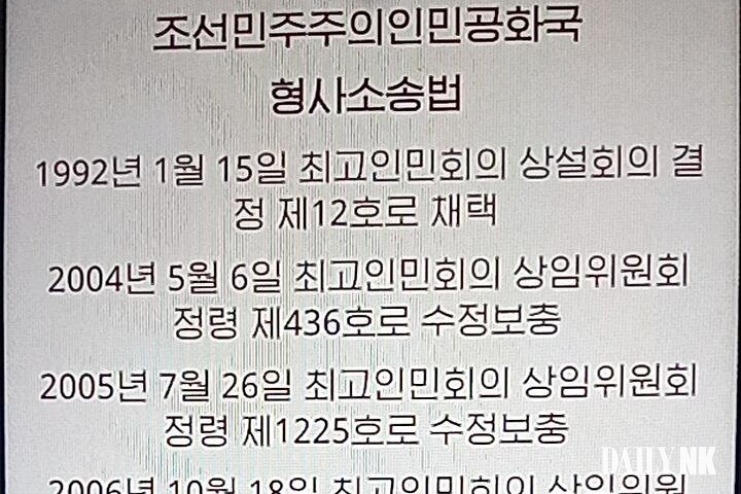
A portion of North Korea’s criminal procedure law, showing the law’s title and a list of amendment dates. (Daily NK)
North Korea revised its criminal procedure law in 2022 and again in 2025. The changes shortened detention and investigation periods. They also required defense lawyers in serious criminal cases for the first time. Daily NK obtained copies of the amended law.
An analysis of the two revisions shows North Korea has strengthened some procedural protections for suspects and defendants in recent years. The 2025 amendment also addresses judicial cooperation with foreign countries for the first time. It folds North Korea’s separate military logistics tribunal system into its main military tribunal system. This analysis focuses on the 2022 and 2025 revisions. How a separate 2023 amendment fits into this picture requires further confirmation.
The most notable change in the 2025 revision is a new requirement for defense lawyers in certain cases. Article 98 of the amended law mandates a lawyer’s involvement in the most serious cases. That includes cases carrying a possible life sentence of reform through labor or the death penalty, as well as cases involving suspects under 18.
Under the previous law, suspects could waive their right to legal assistance altogether. The 2025 revision requires a lawyer’s participation in the most serious cases and in juvenile cases, regardless of the suspect’s own wishes. On paper, this strengthens the defense rights of suspects and defendants. How independently North Korea’s defense lawyer system actually functions remains a separate question.
The 2022 revision also shortened several procedural deadlines. Under the 2021 version of the law, suspects could be held for up to two months before trial. The 2022 amendment, in Article 138, cut that to one month. Indictment periods were shortened too. Under the 2021 law, cases involving reform-through-labor sentences or the death penalty allowed 20 days for indictment. Labor discipline cases allowed five days. The 2022 revision, in Article 222, cut those periods to five days and three days, respectively. Notification of an appointed defense lawyer also sped up. It went from three days under the 2021 law to 24 hours under the 2022 revision, per Article 101.
Foreign judicial cooperation added, military tribunals merged
The 2025 revision also newly addresses judicial cooperation with other countries. Article 8 states that North Korea will carry out judicial cooperation with other nations based on international treaties it has signed or joined, and on the principle of reciprocity. This appears to be the first time North Korea’s criminal procedure law has included a standalone provision on cooperation with foreign judicial systems.
“This provision reflects an aspect of North Korea’s internationalization, or its move toward becoming a normal state,” said Lee Kyu-chang, head of the human rights research division at the Korea Institute for National Unification (KINU), a South Korean government-funded think tank focused on Korean unification and North Korea policy. “North Korea has renamed state institutions to match names commonly used in the international community. It has announced plans to establish a police system. And it renamed its former Ministry of State Security the National Intelligence Agency.”
Lee also said the foreign judicial cooperation provision appears aimed at strengthening cooperation on criminal justice matters. That includes the forced repatriation of North Korean escapees and overseas workers in China, Russia and elsewhere, he said.
The revised law also changes North Korea’s military judicial system. Article 41 of the 2025 revision abolishes the separate military logistics tribunal system and folds it into the main military tribunal system.
Key changes to North Korea’s criminal procedure law
2021 law compared with the 2025 revision. Based on a comparison table from the Korea Institute for National Unification (KINU), reorganized by Daily NK with the 2021 law added.
Compliance with legal principles and procedures
2021 · Article 8
The state shall handle and process criminal cases according to the principles, procedures, and methods set out in this law.
2025 · Article 8
Same as 2021, plus: judicial cooperation with other countries shall follow international treaties the state has signed or joined, and the principle of reciprocity.
New: first standalone provision on foreign judicial cooperation.
Jurisdiction of special tribunals
2021 · Article 48
Military tribunals hear military crimes and general crimes by soldiers, security personnel, and military-sector employees. Military logistics tribunals hear crimes harming munitions-industry operations. Railway tribunals hear crimes harming railway operations.
2025 · Article 41
Military tribunals now also hear crimes against the state and military criminal offenses. Military logistics tribunals eliminated and folded in. Railway tribunals unchanged.
Separate military logistics tribunal system merged into the main military tribunal system.
Waiver of right to defense counsel
2021 · Article 57
A suspect or defendant may waive the right to assistance of defense counsel, with no exceptions.
2025 · Article 98
Waiver still allowed, except defense counsel is now mandatory in cases eligible for a life sentence of reform through labor or the death penalty, and in any case involving a suspect under 18.
New: mandatory defense counsel in the most serious and juvenile cases.
Requesting and appointing defense counsel
2021 · Article 61
A suspect, defendant, family member, relative, or organization representative may request counsel from a preliminary examiner or judge, who must notify appointed counsel within three days.
2025 · Article 101
Same request now goes to an investigator or judge, who must notify appointed counsel within 24 hours. New: a suspect who waived counsel can later request it.
Notification window cut from three days to 24 hours; “preliminary examiner” role replaced by “investigator.”
Indictment and detention periods
2021 · Article 259
Pretrial detention for indictment capped at 15 days, extendable five days for complex or serious cases. Cases eligible for a labor discipline sentence capped at five days.
2025 · Article 222
Prosecutor must process a case within five days of the investigation’s end; labor discipline cases within three days. Detention length now matches the indictment period.
Case-processing and detention windows shortened and tied together.
Source: Korea Institute for National Unification (KINU), reorganized by Daily NK with the 2021 law added
“North Korea operated the military tribunal and military logistics tribunal systems separately, but military and logistics matters are closely linked,” Lee said. “Distinguishing between them in practice was likely difficult. This may have raised the need for integrated operation.”
Taken together, the 2022 and 2025 revisions show North Korea narrowing detention and indictment timelines, limiting interrogation periods and requiring defense lawyers in the most serious and juvenile cases. On paper, the changes are not insignificant.
Whether the amendments will bring real protections for the North Korean people remains uncertain. North Korea’s investigative and judicial bodies have limited independence. In politically sensitive or system-related cases, the authorities’ judgment is likely to take precedence over the letter of the law.
“The North Korean authorities’ moves to strengthen protections for people’s rights through revisions to the criminal procedure law can be seen as part of a response to international human rights criticism,” Lee said. “Separate from institutional improvements, monitoring is needed. We need to know whether the revised provisions are actually applied, and whether human rights for the North Korean people are improving.”
The revisions ultimately show North Korea reworking the outward form of its legal system while adding some procedural protections on paper. Whether that translates into real gains for defendants’ rights, rather than a change in legal text alone, will depend on how the criminal justice system operates going forward.
Read in Korean
Reporting from inside North Korea
Daily NK operates networks of sources inside North Korea who document events in real-time and transmit information through secure channels. Unlike reporting based on state media, satellite imagery, or defector accounts from years past, our journalism comes directly from people currently living under the regime. We verify reports through multiple independent sources and cross-reference details before publication.
Our sources remain anonymous because contact with foreign media is treated as a capital offense in North Korea — discovery means imprisonment or execution. This network-based approach allows Daily NK to report on developments other outlets cannot access: market trends, policy implementation, public sentiment, and daily realities that never appear in official narratives.
Maintaining these secure communication channels and protecting source identities requires specialized protocols and constant vigilance. Daily NK serves as a bridge between North Koreans and the outside world, documenting what’s happening inside one of the world’s most closed societies.