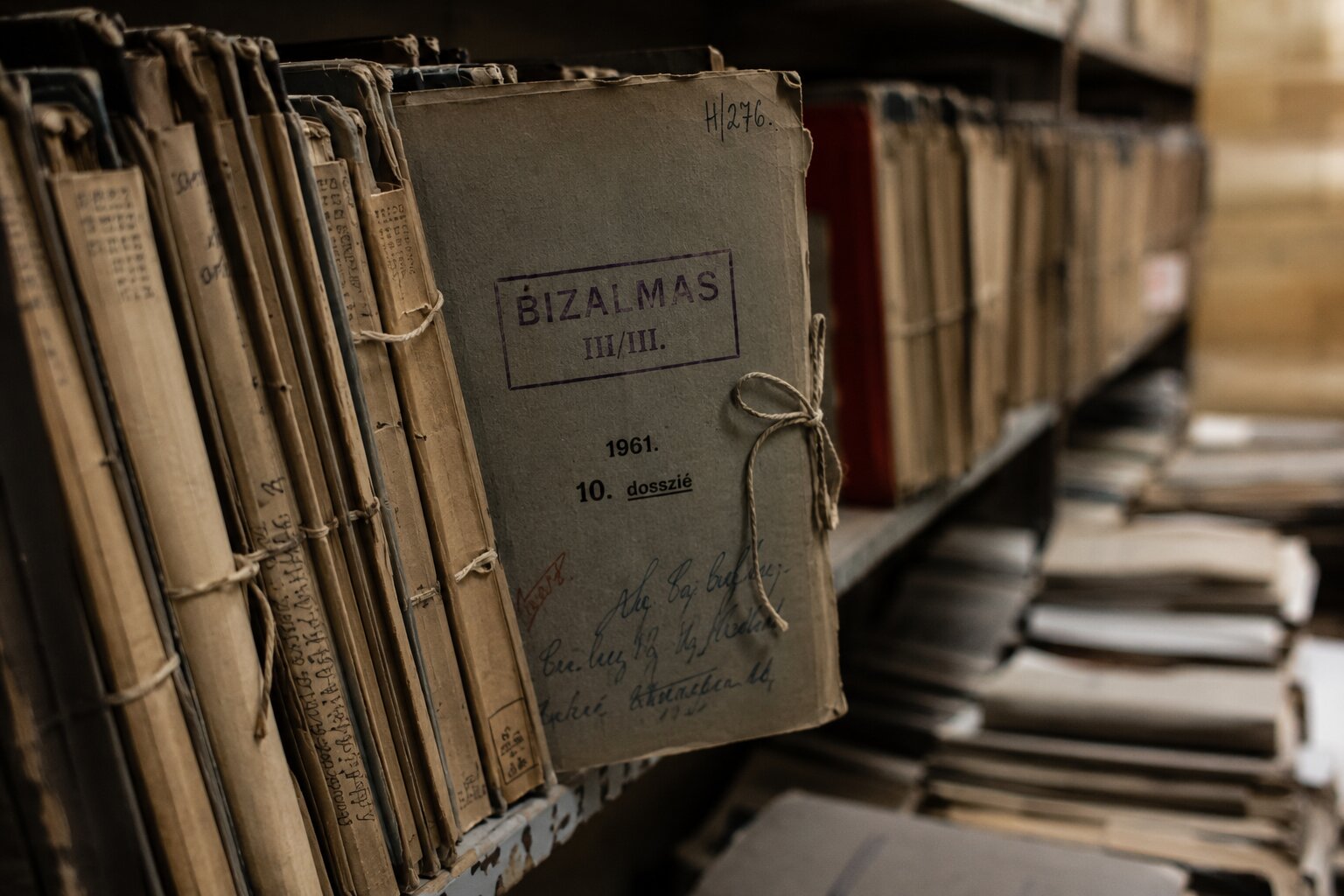
A public consultation on the release of secret service files was launched on Friday. The draft legislation and related documents are available on the government’s website.
Government spokesperson Vanda Szondi announced on Thursday that the government, at its meeting this week, had discussed the full disclosure of the secret service activities of the former regime and the Historical Archives of the State Security Services, and had decided to submit a new legislative proposal to fulfil promises that have remained unmet since the 1990 change of regime to the present day.
The published documents may be commented on until 11 July at the email address tarsadalmiegyeztetes@im.gov.hu.
According to the published documents, the aim of the draft law is to broaden access to historical records and documents in order to promote academic research, strengthen public trust, create the conditions for the accumulation of knowledge, and thereby contribute to the authentic preservation of national memory.
The government proposes adopting an entirely new piece of legislation to replace the current one, as it considers the existing law to suffer from numerous shortcomings.
The new regulation will establish a modern framework — one that also makes use of the possibilities offered by digital technologies — for the accessibility, researchability, and long-term preservation of the records. According to the draft, the new law will enter into force on 20 October.
Under the draft law on the comprehensive disclosure of the secret service activities of the former regime and on the Historical Archives of the State Security Services, certain data on persons recorded in connection with the operation of the state security network will become available online to anyone.
The draft drops the concept of “network person” and instead defines a category of persons that encompasses those who were entered into state security records not as subjects of surveillance or as victims, but in connection with the operation of the state security network.
To this end, the unclassified descriptive data of the so-called hatos kartonok, B-dossiers, B-logs, and magnetic tapes — with due regard to the personal and memorial rights of victims — will become publicly accessible in the public interest following the entry into force of the law: the unclassified descriptive data of the hatos kartonok and magnetic tapes on 20 October, and those of the B-dossiers and B-logs on a rolling basis, but no later than 31 December.
According to the statement published on kormany.hu, once the law enters into force, the secret services will be required to review all documents and databases in their possession and decide within a short deadline whether to maintain the classification or not. If not, the documents will be transferred to the archive, where specialists will begin the necessary analyses and assessments.
Documents for which the custodian of the secret recommends maintaining classification on grounds of national security or other justified interests will be reviewed by the Advisory Committee for the Review of Classified Documents, whose work will involve not only national security experts but also historians, archivists, and lawyers.
The legislation would also require everyone to hand over any documents falling within the scope of the law that are unlawfully in their possession to the Historical Archives of the State Security Services following the law’s entry into force; failure to do so may carry criminal consequences.
According to the statement, the so-called “hatos kartonok” — index cards that are to be made public in the first phase — contain data relating to the recruitment of network agents.
The magnetic tapes, which are also being made public in the first phase, are data storage media onto which the G, H, and K databases were copied in January 1990. The G database contains the operational registry, the H database contains the network registry, and the K database contains the registry of the Central Counter-Intelligence Database. These were copied onto the tapes in bulk, without any organisation, according to kormany.hu.
The second phase of the disclosure involves the publication of the names of people who came into contact with the networks, their recruitment files, and the assessments made about them. These documents reveal from whom the recruited individuals gathered information. Simultaneously, the surviving files from the so-called B-dossiers are being published on an ongoing basis, the statement reads.
According to the content summary attached to the draft legislation, the B-dossier is a dossier used to collect documentation relating to persons who were recruited or in whom recruitment was unsuccessfully attempted, while the B-register is the record book used when the B-dossiers were archived.
Attention was also drawn on kormany.hu to the fact that personal identifiers and particularly sensitive data — such as health status, pathological addiction, and sexual life and orientation — are redacted from the published files. The reason for this is that the surveilled individuals named in the reports were the victims, whose personal rights must be protected, they explained.
The personal data of individuals named in intelligence files are currently protected for thirty years after their death; the draft, however, proposes that the data would become accessible without anonymisation five years after the year of death.
The National Assembly is expected to vote on Tuesday on amendments to the law on uncovering the secret service activities of the former regime and on the establishment of the Historical Archives of the State Security Services, submitted by Márton Melléthei-Barna (Tisza). The proposal establishes the Advisory Committee for the Review of Classified Documents.
Artificial intelligence was used for the translation of parts of the original Hungarian text.