With the official announcement of the final complementary third of its members—those appointed directly by President Ahmed al-Sharaa—the new Syrian People’s Assembly is now complete and set to convene next Monday. Above all, this step confirms that the long-anticipated legislature is finally a reality rather than a subject of speculation.
In recent days, Syrian journalists and activists have repeatedly questioned the delays surrounding the assembly’s formation and launch. The country urgently needs a legislative authority capable of driving the political and legal reforms meant to anchor Syria’s transitional phase.
Yet despite the repeated postponements and long stretches of official silence, public reaction has been marked by widespread apathy. The detachment is reminiscent of past decades, when it was nearly impossible to find an average Syrian who could name even a handful of parliamentary members.
The reason for this indifference is not difficult to identify: the Syrian public played no meaningful role in selecting the assembly, leaving citizens with little reason to feel invested in a body chosen on their behalf.
Assurances Confront Deep Skepticism
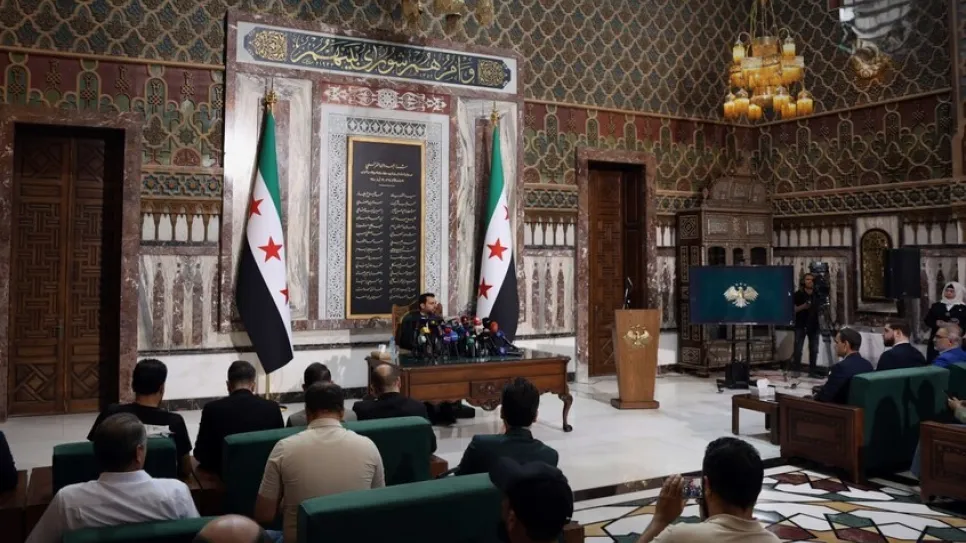
During a press conference today, Mohammad Taha al-Ahmad, head of the Higher Election Committee for the People’s Assembly, announced the final roster of members, including the presidentially appointed third. Al-Ahmad sought to reassure the public, insisting that members understand the weight of their national responsibility, will honor the trust placed in them, and will actively exercise their legislative and oversight roles to build state institutions and meet public aspirations for security, stability, and justice.
One can only hope the new members rise to those expectations. Still, it remains a civic right to express serious reservations—not about the personal qualifications of individual members, but about the mechanism through which they assumed office. The skepticism centers on the very notion of “representing the people.”
Demographics vs. Political Representation
To understand the official view of representation, one can look to the breakdown provided by Mohammad Hamza Shamout, Secretary-General of the People’s Assembly. Shamout noted that the appointed third includes 23 public notables and 47 experts, among them 12 master’s degree holders and 17 PhDs. Geographically, they are distributed across the provinces: 14 from Aleppo, 7 from Hasakah, 6 from Homs, 6 from Deir ez-Zor, 5 from Damascus, 5 from Reef Damascus, 5 from Hama, 5 from Idlib, 4 from Daraa, 4 from Latakia, 3 from Raqqa, 2 from Quneitra, 2 from Tartus, and 2 from Sweida.
This demographic diversity is commendable, but it represents only the baseline minimum of a functioning legislature. Historically, even the most compliant parliaments in the region have featured a mix of regions and educational backgrounds.
True representation requires political representation. A genuine parliament must serve as an arena where diverse political perspectives, ideologies, and movements engage in debate, negotiation, and compromise. That process is what grants legislative decisions the legitimacy to speak for all Syrians.
Any standard parliament naturally includes a majority aligned with the executive. But it must also include an opposing bloc capable of challenging government policy. This structural opposition is precisely what Syrians lacked for decades—an absence that reduced parliament to a decorative institution within a broader authoritarian system.
The Core Mandate of the Transitional Phase
The current People’s Assembly consists of two components: the newly appointed third and the earlier selected two-thirds. Despite official claims that the “electoral colleges” genuinely reflect the public will, these mechanisms have yet to convince observers. The fundamental question remains: can a ruling authority genuinely select its own opposition?
Officials have pointed out that the new roster includes individuals associated with specific political groups. Yet these figures entered the assembly in their personal capacities, not as representatives of distinct political platforms—a distinction that carries significant weight.
Government circles frequently insist that these shortcomings are temporary features of the transitional phase, promising a more robust system in the future. But the counter-argument is critical: the transitional phase is precisely when Syria needs a powerful and genuinely representative parliament.
A truly representative assembly is essential to channel the popular will, build a cohesive national identity, and drive comprehensive institutional reform. Such a body should have served as the alternative to the missed opportunity of a General National Congress—a misstep for which the country has already paid a heavy price.
This article was translated and edited by The Syrian Observer. The Syrian Observer has not verified the content of this story. Responsibility for the information and views set out in this article lies entirely with the author.