The Kurdish National Council (ENKS) and the Democratic Union Party (PYD) have traded sharp accusations regarding the obstruction of their joint negotiation delegation, pointing blame at one another for the ongoing deadlock in talks with the Syrian central government.
The public row intensified following media statements by PYD Co-chair Perwin Youssef, who accused the ENKS of systematically hindering the joint delegation’s mandate. Youssef declared that the delegation’s activities had completely stalled, urged the ENKS to “return to the Kurdish ranks,” and floated the idea of convening a new comprehensive Kurdish conference.
Responding to the allegations, an official within the Kurdish National Council stated to Syria TV that numerous past agreements and experiences have deeply entrenched a profound lack of trust in the PYD. The official asserted that the PYD lacks real seriousness or genuine belief in collective political action and Kurdish unity.
Accusations of Unilateralism and Diminishing Influence
The ENKS official noted that the council had previously granted ample time to the PYD and the commander of the Syrian Democratic Forces (SDF), Mazloum Abdi, to rectify past missteps. However, he claimed they persisted in unilateral decision-making and acting independently, which ultimately triggered futile military conflicts that harmed both the Kurdish population and the wider Syrian public.
The source added that the political reality on the ground has fundamentally shifted since the initial months following the fall of the Assad regime. He argued that the SDF and the PYD no longer possess the sweeping influence or unique privileges that would afford them a political role larger than their actual weight among either the Kurdish popular base or the broader national stage.
Dispute Over Legitimacy and Structural Protocols
In an official statement released on Monday, the Kurdish National Council countered the PYD co-chair’s remarks, labeling them inaccurate and full of contradictions. The ENKS maintained that the paralyzing gridlock within the joint delegation stems directly from the unilateral policies and exclusionary decision-making practiced by both the PYD and the SDF.
The ENKS clarified that any meetings or strategic decisions concerning the joint Kurdish delegation must strictly adhere to the principle of consensus among all its constituents. It added that unilateral invitations to hold meetings constitute a direct breach of the founding understandings of the delegation and undermine the core spirit of political partnership.
Furthermore, the council accused the PYD of operating secretively behind a separate entity dubbed the “Technical Delegation.” This group reportedly engaged in direct negotiations with the Syrian government despite an explicit, prior agreement to activate the unified joint delegation. The ENKS stressed that this separate track severely weakened the overall negotiating position with Damascus regarding Kurdish national rights and deepened political polarization across the Kurdish political landscape.
The Fate of Unity Agreements and Future Conferences
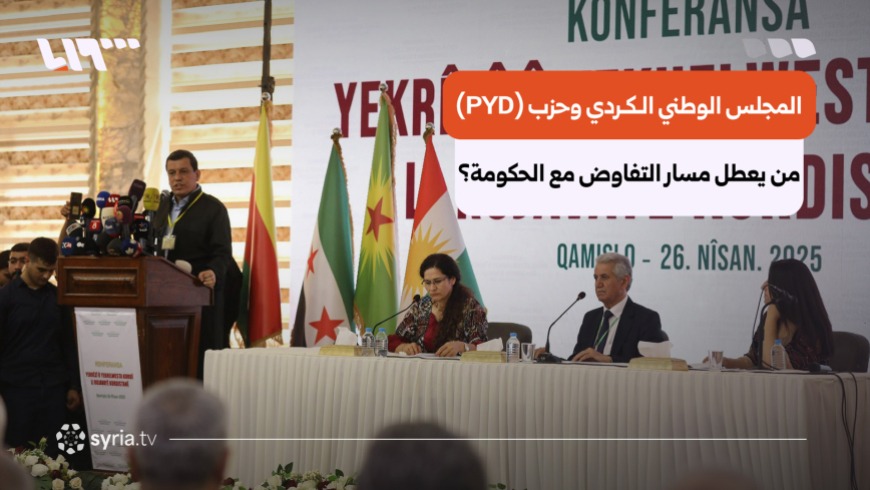
The ENKS renewed its accusations against the PYD for torpedoing previous bilateral accords and freezing the implementation of the outcomes from the “Kurdish Unity and Position Conference,” which convened in Qamishli in April 2025. It also accused the PYD of stymieing international diplomatic efforts aimed at enforcing earlier understandings tied to the Damascus negotiation track.
Accordingly, the ENKS rejected Youssef’s call for a new Kurdish conference, characterizing it as a transparent maneuver to bypass the resolutions of the April 2025 Qamishli conference. The council described the existing framework as an inclusive political umbrella that enjoyed broad consensus, Kurdish regional participation, and international attendance, reaffirming its commitment to those outcomes as the agreed-upon political reference point.
Detailing its recent diplomatic activity, the ENKS stated that the joint Kurdish delegation has held dozens of internal meetings, conferred with foreign delegations, and dispatched an official letter to Syrian President Ahmad al-Sharaa requesting a formal audience—which has yet to receive a response. Parallel diplomatic overtures have also been made to several European nations to garner support for the delegation’s mandate.
The statement revealed that during meetings with President Ahmad al-Sharaa and Foreign Minister Asaad al-Shibani, the leadership of the Kurdish National Council directly requested the scheduling of an official meeting with the joint Kurdish delegation to jumpstart a formal political negotiation track regarding the Kurdish file in Syria.
This public friction follows a meeting held last Sunday in Qamishli by Kurdish political parties allied with the PYD and entities operating within the Autonomous Administration. The ENKS boycotted the proceedings. Following the session, PYD Co-chair Gharib Hasso stated to the Hawar News Agency that the meeting was convened at the explicit request of the Kurdish delegation originally formed in the wake of the April 26, 2025, unity conference.
This article was translated and edited by The Syrian Observer. The Syrian Observer has not verified the content of this story. Responsibility for the information and views set out in this article lies entirely with the author.