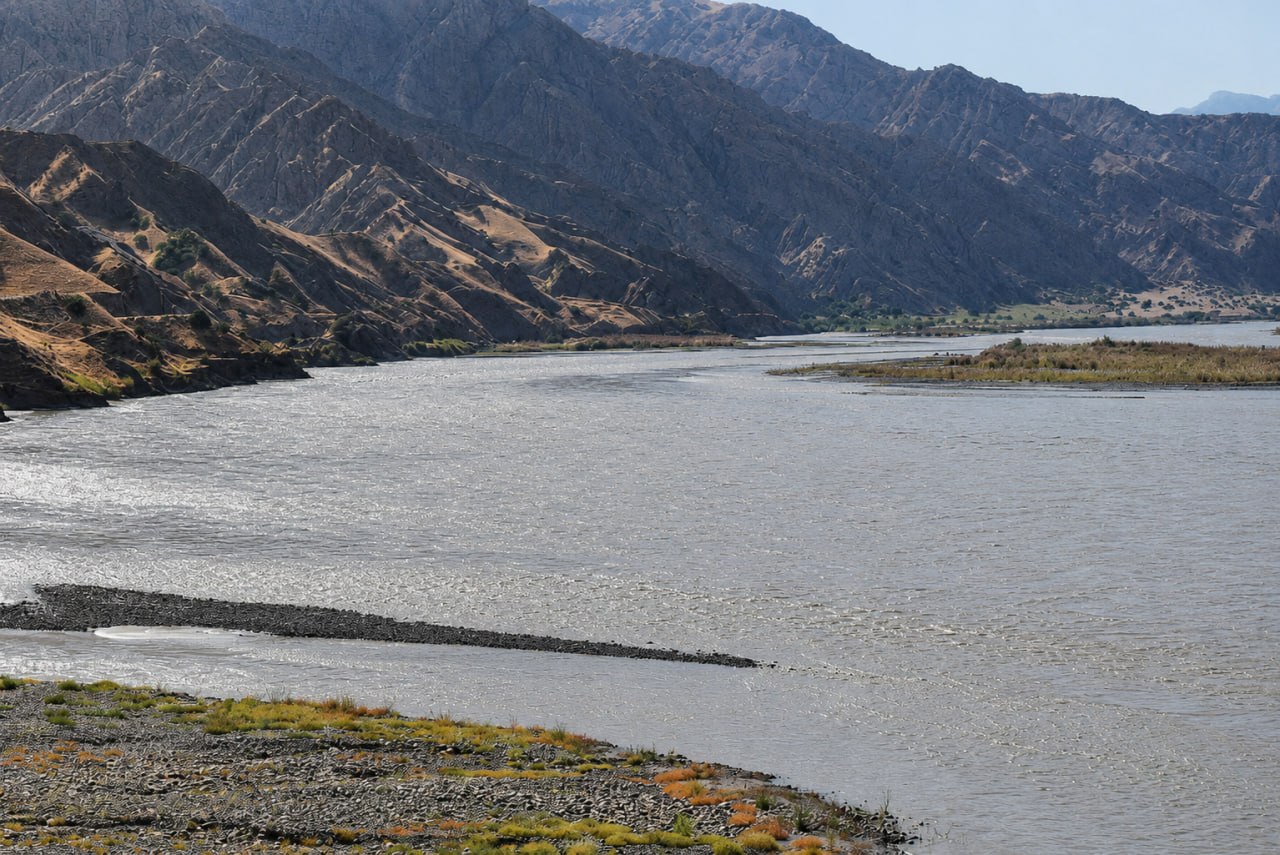
Water flow in the middle and lower reaches of the Amu Darya has declined by 54–77% over the past several decades, with human activity—not climate change—identified as the primary cause, according to a new scientific study.
The research, published in ScienceDirect, examined the effects of climate change and human activity on the Amu Darya and its major tributaries between 1931 and 2020. Scientists used the period from 1931 to 1950 as a historical baseline to measure long-term changes.
According to the authors, the dramatic decline in river flow is largely the result of expanding irrigation, increasing water withdrawals, and the construction of canals, reservoirs, pumping stations, and other hydraulic infrastructure that has altered the river’s natural flow.
Human impact outweighs climate effects
Most of the Amu Darya’s water originates in its mountainous upper reaches, where snowfall and glaciers provide the bulk of the river’s flow. Farther downstream, however, large volumes of water are diverted to irrigate agricultural land.
The researchers found that average temperatures across the basin rose by 0.51–0.83 degrees Celsius during the study period, while annual precipitation increased by 6–13%.
Under normal conditions, higher precipitation would be expected to increase river discharge. The study estimates that climate change alone could have boosted the Amu Darya’s flow by 14–20%.
Instead, river discharge declined sharply.
According to the researchers, extensive water withdrawals and other human interventions not only offset the additional water generated by increased precipitation but resulted in an overall reduction in river flow.
In the middle and lower reaches, human activity accounted for an estimated 114–120% of the decline in discharge. Even in the upper reaches, where climate change partially increased water availability, river flow still fell by 22% because of human influence.
Lower reaches have experienced the steepest decline
The most significant reduction was recorded in the lower reaches of the Amu Darya.
At the Kyzyljar monitoring station, located near the river basin’s outlet, annual flow fell by 77% compared with the 1931–1950 baseline. Near Kerki, the decline was 22%, which the authors attribute to the fact that the largest water withdrawals occur farther downstream.
The study also notes that climate change affects different parts of the basin in different ways. Rising temperatures in the upper reaches can temporarily increase river flow by accelerating snow and glacier melt. Over the longer term, however, continued glacier retreat is expected to reduce water availability.
Researchers also found that the Amu Darya remains highly dependent on precipitation, making the river increasingly vulnerable to fluctuations in rainfall and snowfall.
Agriculture remains the largest water consumer
The study identifies irrigated agriculture as the dominant driver of water consumption in the basin.
During the Soviet period, particularly between the 1950s and the 1990s, extensive networks of canals, reservoirs, and pumping stations were built to support the expansion of irrigated farmland for crops such as cotton, wheat, and rice.
According to the study, the area of irrigated land in the Amu Darya basin expanded by approximately 150% during that period.
Today, agriculture accounts for about 92% of all water withdrawn from the basin.
Tributaries also show declining flows
The decline is not limited to the main river. Researchers also recorded reduced flows in the Amu Darya’s principal tributaries, including the Vakhsh, Kunduz, Kofarnihon, Surkhandarya, Zarafshon, and Kashkadarya rivers.
Across this group of tributaries, river discharge declined by between 4% and 34%. The study attributes most of this reduction to human activity, noting that these figures apply to the tributaries collectively rather than to each river individually.
The Panj and Vakhsh rivers together contribute about 66% of the Amu Darya’s total flow, making them especially important to the basin’s water balance.
For the Vakhsh River, researchers analyzed data from monitoring stations at Gharm, Komsomolobod (now Nourobod), and Tutkaul.
The upper section near Gharm recorded a slight increase in flow of about 3%, while discharge declined by 1.8% at Komsomolobod and by 2.6% at Tutkaul.
Climate change contributed positively at all three locations, increasing water availability by roughly 8%. However, this effect was more than offset by human activity, which reduced flow by an estimated 5% at Gharm, 11% at Komsomolobod, and 10% at Tutkaul.
The findings suggest that the impact of human activity becomes more pronounced farther downstream.
The study provides less detailed analysis of the Kofarnihon River. Although it is identified as one of the Amu Darya’s major tributaries, the researchers do not report a separate estimate of its flow reduction. They note, however, that both the Vakhsh and Kofarnihon are relatively less sensitive to changes in precipitation than other rivers in the basin, while the glacier-fed Vakhsh is more responsive to rising temperatures.
Recommendations
The authors say their findings highlight the need for improved water resource management across Central Asia.
They recommend modernizing irrigation systems, reducing water losses, introducing water-saving technologies, strengthening cooperation over transboundary rivers, and expanding monitoring of snowfall, glaciers, precipitation, and river discharge to improve long-term water security.