By Socrates Smythe Saywon | Smart News Liberia
MONROVIA – The largest cocaine seizure has taken a new turn, with Justice Minister Cllr. N. Oswald Tweh publicly identifying ten individuals allegedly linked to the attempted export of 237.6 kilograms of cocaine through Roberts International Airport (RIA), while revealing that three key suspects remain on the run.
The disclosure has intensified public concern over the integrity of airport security operations and raised troubling questions about how such a massive quantity of narcotics was able to penetrate Liberia’s aviation and cargo handling systems.
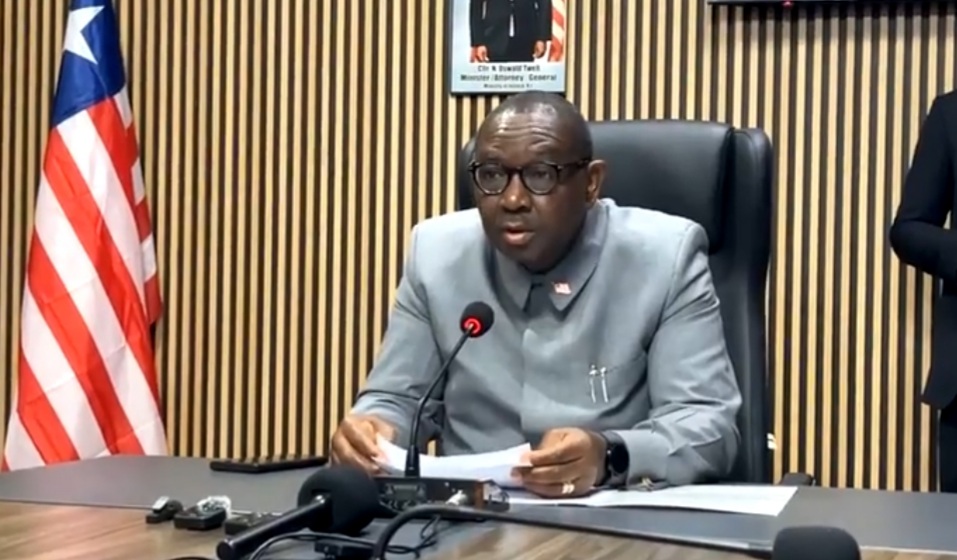
Speaking at a press conference held Friday, June 19, 2025, at the Ministry of Justice in Mamba Point, Minister Tweh unveiled the names of airport personnel, cargo handlers, security officials, and company executives identified as persons of interest in the ongoing investigation into the June 8 drug interception.
Among those named were Philip Yeoh, Security Manager of GLS Menzies; Festus S. Musa, a cargo handler for GLS Menzies; Ruth Gbapaywhea and Geraldine Zeon, both scanner agents at Roberts International Airport; Archie Nyanfor, a cargo handler with Express Handling Services; Arthur B. Abdullai, Chief Executive Officer of Express Handling Services; and Mohammed Gbowrah, Security Director of Roberts International Airport.
The Justice Minister further disclosed that three additional suspects remain at large. They include Paul J. King, Chief Executive Officer of GLS Menzies, Oscar Browne, Chief of Intelligence for RIA Security, and Emmanuel T. Zeon, a transporter for Express Handling Services.
The case stems from the June 8 interception of approximately 237.6 kilograms of cocaine concealed inside six cargo boxes that were reportedly destined for Europe via Brussels Airlines. Authorities said the shipment contained 198 compressed plates of cocaine with an estimated street value of US$19.2 million.
While the seizure itself stunned the nation, subsequent disclosures have exposed what appears to be a far more complex network involving multiple actors operating within Liberia’s airport and cargo handling infrastructure.
The latest revelations have also fueled public debate about whether the attempted shipment could have succeeded without assistance from individuals occupying sensitive positions within the airport’s security and cargo management system.
During hearings before the 55th House of Representatives earlier this week, lawmakers received detailed briefings from senior government officials, including Liberia Drug Enforcement Agency (LDEA) Officer-in-Charge DCP Fitzgerald T.M. Biago and Justice Minister Tweh, on the progress of the investigation.
One of the most revealing testimonies came from John Buway, Deputy Managing Director of the Liberia Airport Authority, who described how airport screeners detected irregularities while examining the cargo.
According to Buway, operators became suspicious after X-ray images failed to match the declared contents of the shipment.
“For example, you have human hair in the cargo. The images in the X-ray machine are showing paint,” Buway told lawmakers, highlighting discrepancies that immediately triggered concern among screening personnel.
He explained that unusual weight measurements and suspicious imaging prompted airport staff to isolate the cargo and notify national security authorities for further investigation.
“We immediately asked the national security apparatus to investigate. That is where our responsibility stops,” Buway stated.
His testimony has drawn attention to the role played by airport screening personnel in preventing what could have become one of the largest successful cocaine exports ever recorded from Liberian soil.
However, the discovery has also exposed serious concerns about vulnerabilities within the country’s border management and aviation security systems.
Perhaps the most alarming aspect of the investigation is the growing evidence suggesting that the operation may have been connected to a wider international trafficking network.
Minister Tweh disclosed that investigators have uncovered transnational elements linking the attempted shipment to organized criminal operations beyond Liberia’s borders. The revelation has heightened concerns that Liberia may be increasingly vulnerable to exploitation by sophisticated drug trafficking syndicates seeking transit routes into Europe and other international markets.
The Justice Minister also raised a critical question that many Liberians are now asking: How did such a substantial quantity of cocaine enter Liberia in the first place?
The attempted export of nearly 238 kilograms of cocaine suggests that the narcotics had already crossed Liberia’s borders before arriving at the airport. That reality has shifted attention toward possible weaknesses at the country’s entry points and the effectiveness of existing anti-narcotics enforcement mechanisms.
Although the seizure marks a success for law enforcement, it also highlights potential weaknesses within systems designed to detect and prevent the movement of illicit drugs.
The naming of airport security officials, scanner operators, cargo handlers, and company executives has further intensified demands for accountability and transparency as investigators work to determine the full scope of the alleged conspiracy.
Many Liberians are closely watching whether the government will be able to apprehend the three suspects who remain at large and whether the probe will ultimately expose the financiers, facilitators, and international connections allegedly behind the US$19.2 million cocaine shipment.
For a government that has repeatedly pledged to crack down on drug trafficking and organized crime, the outcome of this case could become a defining test of its commitment to dismantling narcotics networks operating within Liberia’s borders and holding all responsible parties accountable, regardless of their position or influence.