By Stephen G. Fellajuah
ACCRA, Ghana, June 19, 2026 — President Joseph Nyuma Boakai has called for the establishment of a global reparatory justice mechanism to address the enduring impacts of slavery and colonial exploitation, positioning Liberia among African nations advocating for a coordinated international response to historical injustices.
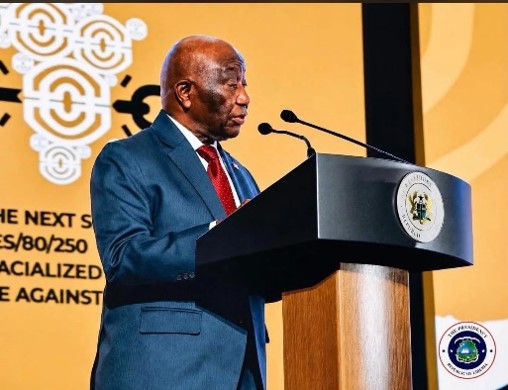
Speaking at the High-Level Consultative Conference on Next Steps for United Nations Resolution A/RES/80/250 on the Transatlantic Slave Trade in Accra on Thursday, Boakai said reparatory justice must extend beyond financial compensation to include truth-telling, reconciliation, cultural restoration, educational advancement, institutional development, and social cohesion.
The two-day conference brought together representatives of the African Union, the Caribbean Community (CARICOM), the Community of Latin American and Caribbean States (CELAC), the Global African Diaspora, United Nations agencies, civil society organizations, and development partners.
Boakai outlined five priorities aimed at advancing the reparations agenda. He called for the development of a common African position and implementation framework in collaboration with CARICOM and Diaspora organizations, supported by a coordinated roadmap with clearly defined responsibilities and timelines.
He also urged the United Nations and the African Union to establish a joint expert commission tasked with designing a Global Reparatory Justice Mechanism.
The Liberian leader emphasized the importance of confronting historical erasure through education and research, calling for stronger teaching of African history, preservation of archives, and support for universities and research institutions across Africa and the Diaspora.
Boakai further advocated for the restitution of stolen cultural artifacts and heritage objects, while promoting development partnerships to address inequalities linked to slavery and its aftermath.
“The scale and depth of the trafficking of enslaved Africans and racialized chattel enslavement cannot be measured fully in financial terms alone. Yet the transatlantic slave trade, forced labor, and resource extraction generated enormous wealth that shaped the economic foundations of many societies across the world,” he said.
According to Boakai, the transatlantic slave trade and its consequences contributed significantly to inequality and underdevelopment in Africa and across the Global South.
As part of his proposals, the President also called for international development initiatives grounded in shared responsibility and mutual respect to address persistent disparities rooted in historical injustices.
He stressed that the call for reparatory justice is not intended to assign personal guilt to present generations but rather to encourage acknowledgment of historical realities and support efforts toward healing and reconciliation.
“This resolution has opened a door. Whether that door leads to meaningful justice, reconciliation, and healing now depends on our collective resolve,” Boakai said.
He urged participants to remain united in advancing the reparations agenda and ensuring that the legacy of slavery is addressed through concrete actions aimed at restoring dignity, correcting historical wrongs, and promoting a more equitable future.
Boakai’s remarks place Liberia within a growing coalition of African and Caribbean nations seeking international recognition of the long-term effects of slavery and colonial exploitation, as momentum builds around global discussions on reparatory justice.