- by croatiaweek
- June 17, 2026
-
in
News
(Photo: Museums and Galleries of Konavle)
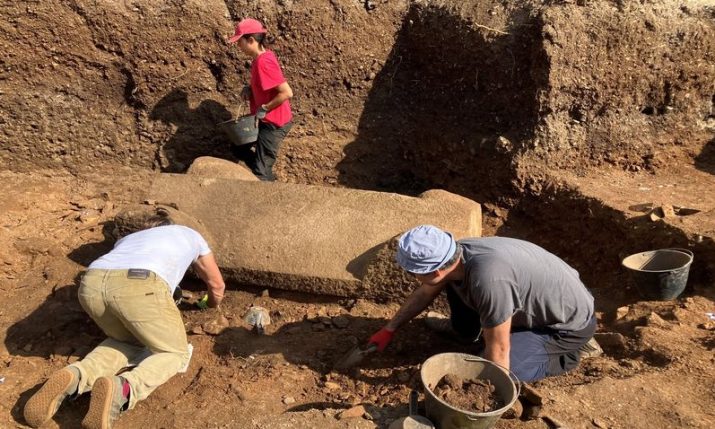
CAVTAT, 17 June 2026 – Archaeologists in southern Croatia have uncovered an exceptionally rare and valuable late antique sarcophagus during protective excavations at the Zorina 8 site in Cavtat.
The discovery was made within the necropolis of the ancient Roman colony of Epidaur and is being described as one of the most significant recent archaeological finds in the country.
Research carried out by the Museums and Galleries of Konavle revealed numerous burials of different types, with the most notable being a stone sarcophagus of the Salonitan type, dated broadly between the 4th and 6th centuries AD.
What makes the find particularly important is the fact that the sarcophagus was discovered in its original position as a sealed and untouched burial unit. Archaeologists found preserved lime mortar between the lid and the stone chest, confirming that it had remained closed since antiquity. Such intact finds are extremely rare in the Croatian archaeological record.
The sarcophagus, which weighs around five tonnes, was uncovered at a depth of approximately three metres. Inside, archaeologists identified the primary burial of a single individual.
(Photo: Museums and Galleries of Konavle)
Although the skeletal remains were poorly preserved, organic deposits and other material recovered from the tomb will undergo further laboratory analysis.
The excavation was led by archaeologist Helena Puhara, with expert collaborators Jelena Beželj from the Museums and Galleries of Konavle and Krešimir Grbavac from the Archaeological Museum of the Dubrovnik Museums. A wider team of archaeologists and specialists also participated in the research and documentation of the find.
Among the most demanding phases of the project was the lifting of the heavy stone lid, the extraction of the sarcophagus and its relocation to a new site. The operation was coordinated by conservator-restorer Siniša Bizjak in cooperation with sculptor Tomislav Šalov and a team of assistants.
(Photo: Museums and Galleries of Konavle)
Following the completion of the archaeological investigations, the sarcophagus has been placed in a publicly accessible location in Cavtat. It now stands at the junction of pathways leading to the Račić Family Mausoleum, St Rocco’s Cemetery and the steps descending towards Ključice beach.
The relocation ensures that both residents and visitors can view the monument and gain a deeper appreciation of Cavtat’s rich ancient heritage and its connection to the former Roman colony of Epidaur.
The project received emergency funding from Croatia’s Ministry of Culture and Media, which supported the excavation, protection and relocation of the sarcophagus. Additional support was provided by the Municipality of Konavle, the Conservation Department in Dubrovnik and the landowners involved in the project.