There is an entire historical category of women who dressed as men to work, travel, or get an education — in times and places where their mere presence was considered scandalous.
James Barry, born Margaret Ann Bulkley, lived as a man in order to study medicine and serve as a surgeon in the British army in the nineteenth century, at a time when women were simply barred from medical training. The French writer Amantine Dupin adopted the male pen name George Sand and wore men’s clothing so that her work might be read and taken seriously. It was armour — the kind women of that era were forced to wear just to gain entry into male-dominated spaces, or to hold any kind of authority.
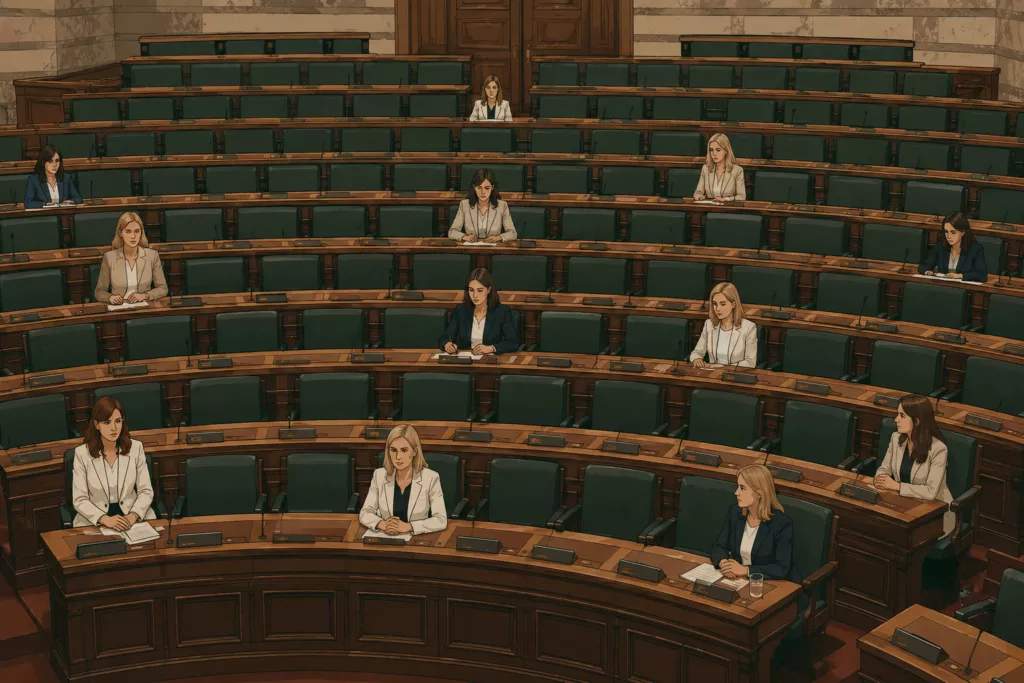
Today, when so much appears to have changed, a new question emerges. What do women actually do when they finally reach public office? What policy priorities do they bring to shaping society in a state where women provably continue to face gender discrimination?
According to a statement from the Mediterranean Institute for Gender Studies, the 2026 parliamentary elections recorded an increase in women’s representation in the House of Representatives — even though, of 753 candidacies in total, only 224 were women. As the Institute noted: “Women’s representation is growing; inequality remains.”
But the question, beyond the numbers, is about real change. And that is not going to come if women enter parliament without a gender equality agenda — if they simply absorb the political codes and priorities deemed safe, whether by their party or by what they perceive as the dominant mood of society. The same applies to young MPs. The fact that the average age has dropped means nothing in itself, if the young people being elected carry the same conservative assumptions wrapped in different packaging.
What does it matter to me, as a woman, if the women being elected support policies that curtail my freedoms? What use would one of ELAM’s eight female candidates in parliament be if she is representing a far-right party? When a candidate chose, on the occasion of World Family Day, to celebrate the “Greek Orthodox family” — positioning herself aggressively against human rights, or what they prefer to call the “woke agenda” — what exactly did she bring to the table? What freshness did a young female Speaker of the House offer when she declared that Cyprus “is not ready” for same-sex marriage? And what renewal am I supposed to expect from a 24-year-old who attributes his election to divine will?
The same question can be put to Greece. Why should the gender of Maria Karystianou move me, when on the legally enshrined right to abortion she declared that “such issues must be resolved through public consultation”?