Geopolitical priorities are eclipsing justice in postwar Ethiopia.
The newly signed U.S.–Ethiopia structured dialogue should not be understood as a routine diplomatic reset. It arrives after eight years in which Ethiopia’s democratic opening was first celebrated, then militarized, and finally buried beneath war, mass displacement, and the systematic denial of suffering.
Official statements emphasize familiar priorities: trade, investment, defense cooperation, security partnership, and regional stability.
Yet beneath this language lies a more consequential question: is Washington seeking to help rebuild a shattered political order, or helping normalize the very system that shattered it?
This question matters because Ethiopia’s current government no longer pursues a coherent diplomatic doctrine rooted in constitutional order, civilian protection, or long-term peace.
What has emerged instead is a transactional foreign policy centered on regime survival. Ethiopia has become a permissive arena for competing powers, creditors, arms suppliers, intelligence actors, Gulf monarchies, Western governments, and geopolitical rivals.
Transactional State
The same state can simultaneously court the United States, the United Arab Emirates, China, Russia, Turkey, Iran, Israel, and Europe, through security bargaining, geopolitical leverage, and regime preservation.
This dynamic was visible during the Tigray war, when Ethiopia became a convergence point for overlapping forms of foreign military support.
Open-source investigations and international reporting documented or alleged the deployment of foreign-supplied drones, including Iranian systems, while other reports pointed to Turkish, Chinese, Emirati, and Israeli-linked drone capabilities or surveillance roles in the conflict.
Bellingcat examined evidence of Iranian-made drones in Ethiopia; Al Jazeera reported that armed drones helped shift the trajectory of the war; and subsequent analysis identified Ethiopia as a major example of the rapid expansion of drone warfare across Africa.
Claims that Israeli and Iranian systems may have operated in support of the same war effort further illustrated the extraordinary transactional character of Ethiopia’s war economy.
Such revelations should have triggered sustained international scrutiny. Instead, Ethiopia is steadily being reintegrated into the language of strategic partnership.
Reform Illusions
When Abiy Ahmed came to power in 2018, many Western governments embraced him with remarkable enthusiasm. His reformist rhetoric, prisoner releases, opening of political space, and rapprochement with Eritrea were interpreted as evidence of democratic transformation. Millions of Ethiopians also believed a new chapter had begun.
But Western diplomacy moved too quickly from optimism to endorsement. It mistook political performance for institutional transformation. It rewarded rhetoric before the state had built the constitutional, civic, and security safeguards necessary for a durable democratic transition.
The consequences have been catastrophic. Over the past eight years, Ethiopia has moved from promised reform to national fragmentation.
The war in Tigray produced mass displacement, siege, starvation, conflict-related sexual violence, ethnic cleansing, documented war crimes and crimes against humanity, and credible allegations of genocidal violence.
UN experts described mass killings and abuses in Ethiopia as “staggering” and warned that accountability and civilian protection remained urgent. The U.S. State Department concluded in 2023 that all major parties to the Tigray conflict committed war crimes.
Recent medical and human rights reporting has further documented the scale and brutality of sexual violence in Tigray, including findings suggesting that some acts may amount to crimes against humanity and potentially genocide.
Nor did Ethiopia’s violence end with Tigray. Amhara, Oromia, and other regions remain trapped in cycles of armed conflict, mass arrests, drone strikes, militia violence, insurgency, and collective punishment.
Ethiopia is not merely confronting isolated security incidents. It is experiencing a profound collapse of political legitimacy, social trust, and state authority. Internationally, the government presents itself as the indispensable force preventing national disintegration. Domestically, it governs amid — and often through — the fragmentation that sustains that narrative.
This contradiction sits at the center of Abiy Ahmed’s rule: the state presents itself as the cure for a crisis it has also helped produce.
Atrocity Governance
Ethiopia today is not only suffering from the absence of peace. It is living through the normalization of atrocity governance. Violence no longer functions solely as a breakdown of order; in many places, it has become an instrument of governance itself.
Federal forces, regional forces, allied militias, insurgent groups, informal security actors, and local armed structures now operate within an expanding ecosystem of fear. Civilians are trapped between state violence, insurgent violence, militia violence, and communal retaliation.
The state does not simply fail to control violence. It often derives political utility from fragmentation, manipulates insecurity, and governs through fear. Ethnicity, religion, historical grievance, human insecurity, and fears of national collapse are repeatedly weaponized. Insecurity becomes political capital.
This is why luxury projects can rise in Addis Ababa while millions elsewhere live amid displacement, hunger, detention, disappearance, militarization, and uncertainty. The contradiction reveals a governing imagination in which spectacle replaces repair, coercion substitutes for legitimacy, and the suffering of the periphery is treated as the price of power at the center.
The Pretoria Agreement was supposed to create a path away from catastrophe. It mattered because it reduced some of the large-scale fighting in Tigray. But Pretoria was never a comprehensive transitional justice framework.
It did not establish a credible truth process, a reparations program, a criminal accountability mechanism, or a serious institutional reform agenda. It was fundamentally a ceasefire and political arrangement, not a moral reconstruction of the country.
UN experts later warned that the federal government had failed to fully implement commitments relating to human rights, transitional justice, and territorial integrity, even as hostilities expanded elsewhere.
Tigrayan political leadership also bears responsibility for the failure of meaningful repair. Too often, accountability has been treated as a slogan rather than a victim-centered process. Collective grief has repeatedly been absorbed into factional competition.
Even worse, the suffering of Tigrayans has been instrumentalized as a pathway back to political relevance rather than transformed into a sustained movement for truth, acknowledgment, reparations, institutional reform, and guarantees of non-repetition.
But the failures of Tigrayan elites do not absolve the Ethiopian state. The federal government remains the primary authority responsible for protecting citizens, preventing atrocities, ensuring accountability, and rebuilding the constitutional order it helped fracture.
A state that has presided over mass violence while resisting meaningful repair should not be rewarded with diplomatic rehabilitation absent credible safeguards.
Electoral Façade
This is what makes the coming election particularly troubling. Ethiopia is moving toward another electoral process while the underlying foundations of political legitimacy remain broken.
Far more than ballots, credible elections require civic space, freedom from fear, meaningful political competition, independent media, protection for opposition actors, and public confidence that outcomes will not be determined by violence.
In a country marked by war, repression, displacement, militarized administration, and widespread mistrust, elections conducted without national reckoning risk transforming democratic language into political cover.
The new structured dialogue therefore carries significance far beyond bilateral diplomacy. According to Ethiopian state media, the framework centers on economic prosperity, trade and investment, defense and security cooperation, and regional peace and stability.
These priorities reflect Washington’s strategic anxieties. The Horn of Africa matters. The Red Sea matters. Sudan’s collapse matters. Migration, counterterrorism, Gulf influence, Chinese investment, Russian opportunism, Turkish engagement, and intensifying multipolar competition all shape the calculations of major powers.
Strategic Amnesia
But geopolitical complexity cannot become an excuse for moral amnesia.
The old unipolar language of a “rules-based international order” has weakened considerably. A more fragmented global environment is emerging — one in which abusive governments can increasingly shop for patrons, arms suppliers, surveillance technologies, diplomatic cover, loans, and security partnerships.
Ethiopia’s government understands this dynamic well. It plays external powers against one another, not to strengthen democratic sovereignty, but to expand the regime’s room for maneuver.
Europe’s posture reflects a similar failure. For years, European policy has viewed Ethiopia largely through the prism of migration management, refugee containment, and outsourced border control.
Ethiopia has effectively been treated as a geopolitical buffer: before Libya, before the Mediterranean, before Europe’s domestic political panic over migration.
The EU has used visa policy to pressure Ethiopia over deportation cooperation, while analysts have documented how Ethiopia has been incorporated into Europe’s broader migration-control architecture.
Yet the cruelty of this logic is difficult to ignore. Europe wants Ethiopia to contain migration while the Ethiopian political crisis itself is helping generate the desperation that pushes people to flee.
A sentiment increasingly voiced by Ethiopians captures the country’s deepening despair: people once left mainly in search of opportunity or to escape state repression. Today, many are searching for another country because their own feels as though it is dying quietly.
That statement is less rhetorical than diagnostic. Ethiopia has become unbearable not only for the poor, but increasingly for middle-income and affluent citizens who no longer trust the state to protect life, dignity, property, or the future itself.
Diplomacy Reimagined
This is why international law cannot be reduced to decorative rhetoric. The contemporary legal question is whether states that know — or should know — of serious risks can continue arms transfers, military assistance, security cooperation, and diplomatic rehabilitation without incurring responsibility of their own.
Common Article 1 of the Geneva Conventions obliges states not only to respect international humanitarian law, but to ensure respect for it. The International Committee of the Red Cross has emphasized that arms-transfer decisions must account for the risk that weapons could facilitate serious violations.
The Arms Trade Treaty similarly reflects the principle that transfers should not proceed where there is a serious risk of grave international crimes.
That is the contemporary norm at stake: the legal and political responsibility of states not to reinforce coercive institutions in the aftermath of atrocity absent credible safeguards and accountability mechanisms.
A responsible U.S.–Ethiopia dialogue would redefine discussions of trade, security, or regional stability around human security. It would place concrete benchmarks at the center of engagement: safe and voluntary return for displaced communities; independent monitoring in conflict-affected areas; credible investigations into atrocity crimes; survivor-centered reparations; protection for journalists and civil society; humanitarian access; release of political detainees; and enforceable safeguards ensuring that military cooperation does not strengthen abusive institutions.
It would also apply pressure across the political spectrum: the federal government, regional authorities, the Tigray People’s Liberation Front, armed movements, militia networks, and political elites alike. No actor should be permitted to instrumentalize victims while evading responsibility.
The United States should engage Ethiopia; the question is how. Whether diplomacy becomes a mechanism of repair or a pathway to rehabilitation will determine its consequences. If the structured dialogue proceeds without accountability, it will stabilize impunity and, rather than reversing regional fragmentation, entrench the very political logic that produced it.
Diplomacy should not become the art of helping governments escape the consequences of mass violence. Its purpose is to prevent power from converting suffering into silence.
If Washington and its partners lose sight of that principle, history may record the message with brutal clarity: victims were told to wait, perpetrators were welcomed back to the table, and diplomacy once again mastered the language of engagement while saying too little about justice.
Query or correction? Email us
While this commentary contains the author’s opinions, Ethiopia Insight will correct factual errors.
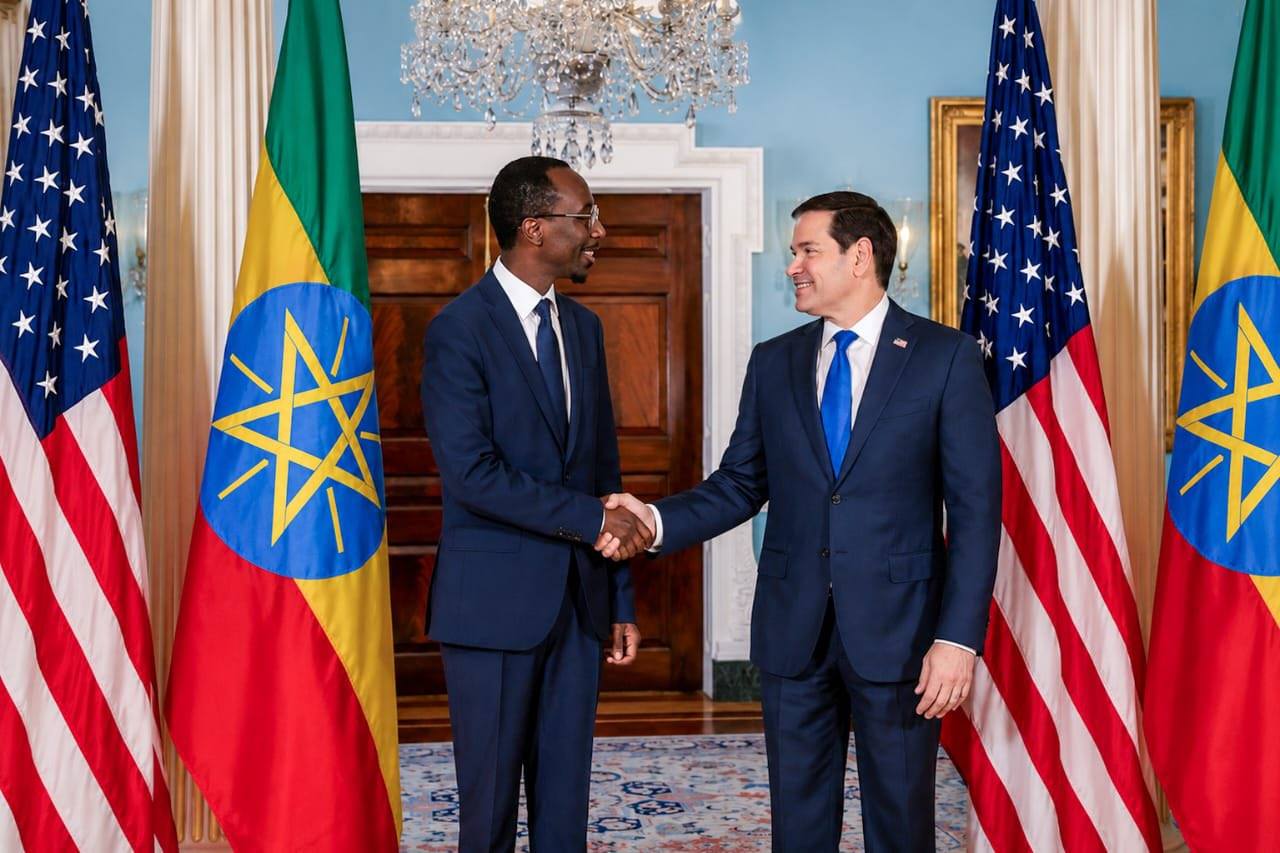
Main photo: Ethiopian Foreign Minister Gedion Timotheos and U.S. Secretary of State Marco Rubio during talks in Washington, D.C., May 2026. Source: Ethiopia’s Ministry of Foreign Affairs.
Published under Creative Commons Attribution-NonCommercial 4.0 International licence. You may not use the material for commercial purposes.