As Syria navigates its post-war transition, questions are mounting over the role of family networks, patronage, and informal alliances in shaping the country’s emerging centers of economic and administrative power.
While the new administration led by transitional President Ahmad al-Sharaa has sought to project the image of a more centralized, institutional state, the case of the Badawi family has become a focal point for deeper concerns about governance, transparency, and the risk of reproducing old patterns of influence under new political conditions.
A recently published mapping exercise by researcher Karam Shaar offers a descriptive look at the relationships between economic and administrative figures believed to operate at the intersection of family ties, state authority, and private wealth. The map highlights what it identifies as the “Badawi family network,” a constellation of actors whose influence spans government institutions, development bodies, and key sectors of the economy.
According to the mapping, the network illustrates how power can take shape in a political environment emerging from war — one in which family structures, public institutions, and economic activity frequently overlap. Critics argue that such arrangements allow informal power networks to reconstitute themselves inside both the state apparatus and the wider economy.
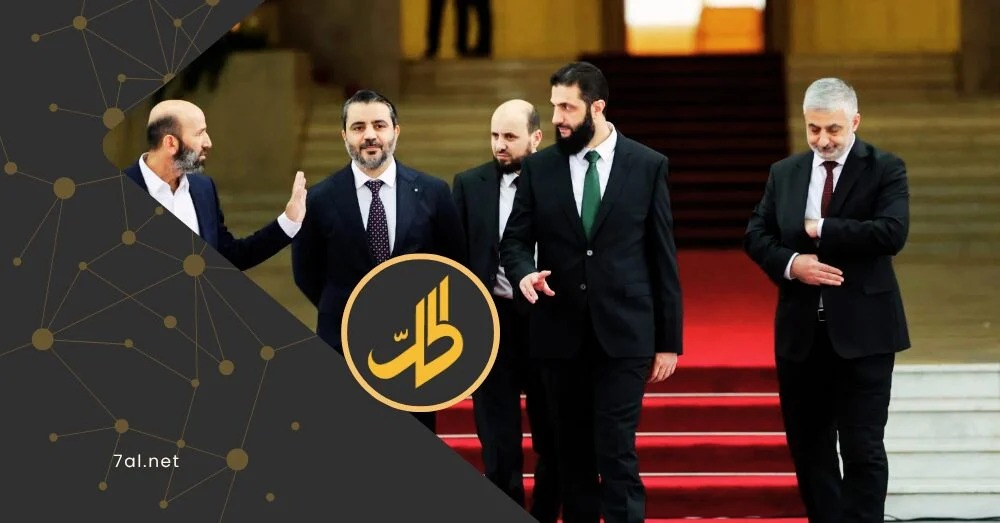
At the center of the network is President Ahmad al-Sharaa, presented as the primary political reference point within a broader cluster of economic and administrative actors. Some of these figures are linked to wartime institutions in northwest Syria, where economic, security, and administrative roles often converged.
A Family Embedded Across State and Economy
Within this framework, Musab Badawi appears at the intersection of government and development institutions. Through his leadership of the Planning and International Cooperation Commission, his close ties to Damascus Governorate and the Higher Institute of Administration, and his reported links to private companies, he is portrayed as giving the family access to the state’s planning machinery.
The economic side of the family’s influence is associated with Saad Badawi, whom the map links to activities across the food, health, and charitable sectors — areas especially sensitive in fragile or post-conflict economies. Control over food production, healthcare, and social support can translate into significant public influence.
Saad Badawi is known for managing Rayan Food for Food Industries and Al-Yamama Feed and Poultry Company. He is also linked to Binnish Hospital and the Ghiras al-Ataa charitable foundation. The overlap between food supply, medical services, and charitable work suggests a broader strategy of building social reach alongside economic power.
Hudhaifa Badawi, according to the map, is connected to more sensitive files tied to state sovereignty, including border crossings, customs, and supply bodies. These sectors are central to an economy dependent on fees and cross-border trade as major sources of public revenue. Control over such institutions allows significant influence over the movement of goods, tariffs, and customs income.
But the most prominent figure in the network is Qutayba Badawi, whose trajectory reflects the convergence of family power, money, and political authority. Known by the aliases “al-Mughira Binnish” and “Abu Hamza,” and reportedly referred to as the “whale of Idlib’s economy,” Qutayba joined Jabhat al-Nusra early in the war before becoming the emir of Idlib within Hayat Tahrir al-Sham. He later assumed economic responsibilities linked to trade, energy, and border crossings, including the Bab al-Hawa crossing with Turkey.
Qutayba came to oversee the movement of border crossings and customs points through which equipment for the oil sector and its exports pass. At the same time, he was a partner in decision-making inside the national oil company. Critics say this raises serious questions about conflicts of interest, since the same official appeared to wield influence over oversight, production, and economic decision-making.
Such an arrangement, they argue, blurs the separation between planning, implementation, and supervision. It creates what some describe as a form of circular management, in which an individual effectively oversees decisions in which he is also involved — undermining independent oversight and weakening institutional safeguards against corruption.
A Test for the Credibility of the Transition
The debate now centers on whether this model reflects personal competence and administrative necessity in a fragile transitional phase, or whether it represents an updated version of the corruption patterns Syrians endured for decades.
While the government speaks of attracting foreign investment and advancing reconstruction, networks of this kind may become a serious obstacle to building the rule of law and genuine state institutions.
Shaar has warned that the concentration of authority in the hands of families or narrow entities remains a source of concern because it opens the door to corruption and authoritarian control. He described Qutayba Badawi’s recent departure from the Syrian Petroleum Company as a positive step toward institutional reform. Badawi submitted his resignation from the company’s board of directors earlier this month.
For Syria’s new authorities, the controversy is more than a question of individual appointments. It touches the credibility of the transition itself. If the new state is to distinguish itself from the system it replaced, its institutions will need to demonstrate that public authority is no longer allocated through family proximity, wartime networks, or economic leverage — but through transparent rules, accountable governance, and a clear separation between public office and private interest.
This article was translated and edited by The Syrian Observer. The Syrian Observer has not verified the content of this story. Responsibility for the information and views set out in this article lies entirely with the author.