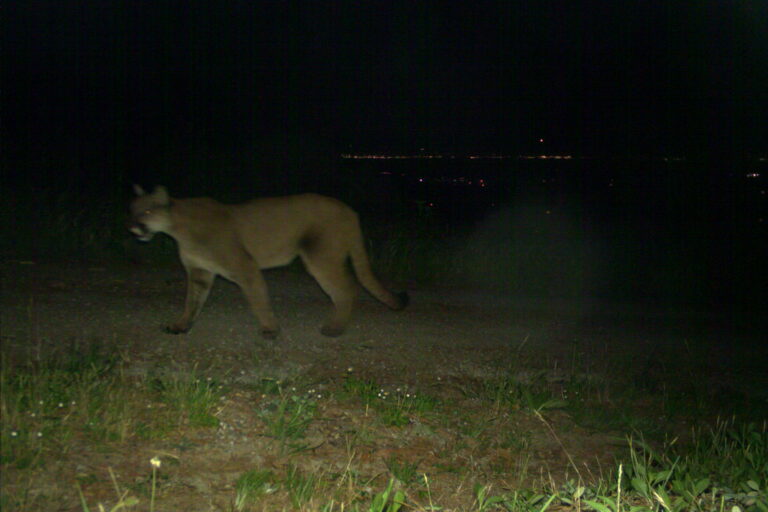
A new study from two California counties finds that artificial light at night is a stronger driver of wildlife behavior at the edge of urban environments than noise. This has ripple effects for predators and prey. Researchers analyzed more than 35,000 camera-trap days from 61 stations in San Mateo county, on California’s central coast, and Orange county, in Southern California, between 2022 and 2024. They tracked an apex predator, the puma (Puma concolor); the bobcat (Lynx rufus); and an ungulate prey species, the mule deer (Odocoileus hemionus). The paper was published in Urban Ecosystems. “While scientists have known for a while that wildlife change their behavior around cities, often becoming more nocturnal to avoid humans, our study isolated exactly what part of the urban environment is driving this,”co-author Zara McDonald, biologist and president of the Felidae Conservation Fund, told Mongabay by email. “Our key finding is that artificial light pollution is actually altering the predator-prey dynamic.” Predators like pumas and bobcats avoided bright lights at night, such as areas lit by streetlights and other electric lighting. Mule deer, however, were more active in those same areas, though they avoided bright moonlight and noisy areas. The authors say the deer use human-modified spaces that predators avoid. A puma on the urban edge in California. Camera trap image courtesy of Felidae Conservation Fund “Essentially, artificial light is acting as a spatial barrier for carnivores and a ‘protective shield’ for prey,” McDonald said. The contrast was visually striking in the images and footage captured on…This article was originally published on Mongabay