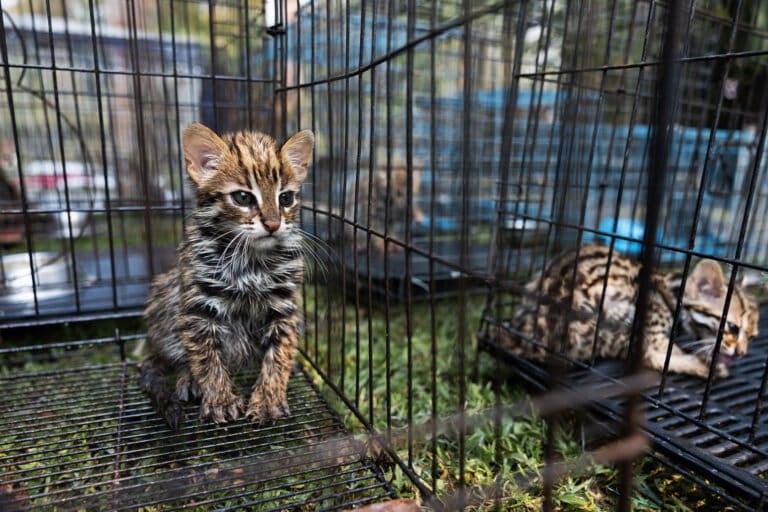
Nuntita Ruksachat, head veterinarian at the Khon Kaen wildlife rescue center in northeastern Thailand, holds up a feline cub no larger than her hand. Part of a litter rescued just days ago, the cub’s fur is patchy, revealing blistered skin underneath. Its whiskers, clearly singed, are short and stubby. “They were rescued from a burned sugarcane plantation,” she says. Behind her, cats pace inside rows of cages. More than 50 leopard cat (Prionailurus bengalensis) cubs are currently housed at the rescue center, which is run by Thailand’s Department of National Parks, Wildlife and Plant Conservation’s (DNP). The youngest are kept in cages, while older ones have been moved to larger enclosures. Leopard cats are small wild felines found across much of Asia, from Afghanistan to South Korea. Roughly the size of domestic cats, their bodies are slightly leaner, and their fur is marked with black spots and stripes. The leopard cat is a highly adaptable species, and as forests have shrunk across its range, it has learnt to live in human-dominated landscapes. In Thailand’s northeast, sugarcane plantations provide leopard cat mothers and their litters with shelter and prey. But every crop burning season — the period between December and April, when farmers in Thailand typically burn their fields — those same plantations can turn lethal. The rescue center receives a steady influx of leopard cat cubs from across the northeast. Most are found alone and weak on plantations or in nearby forests, some with scorched fur and whiskers. Rows of…This article was originally published on Mongabay