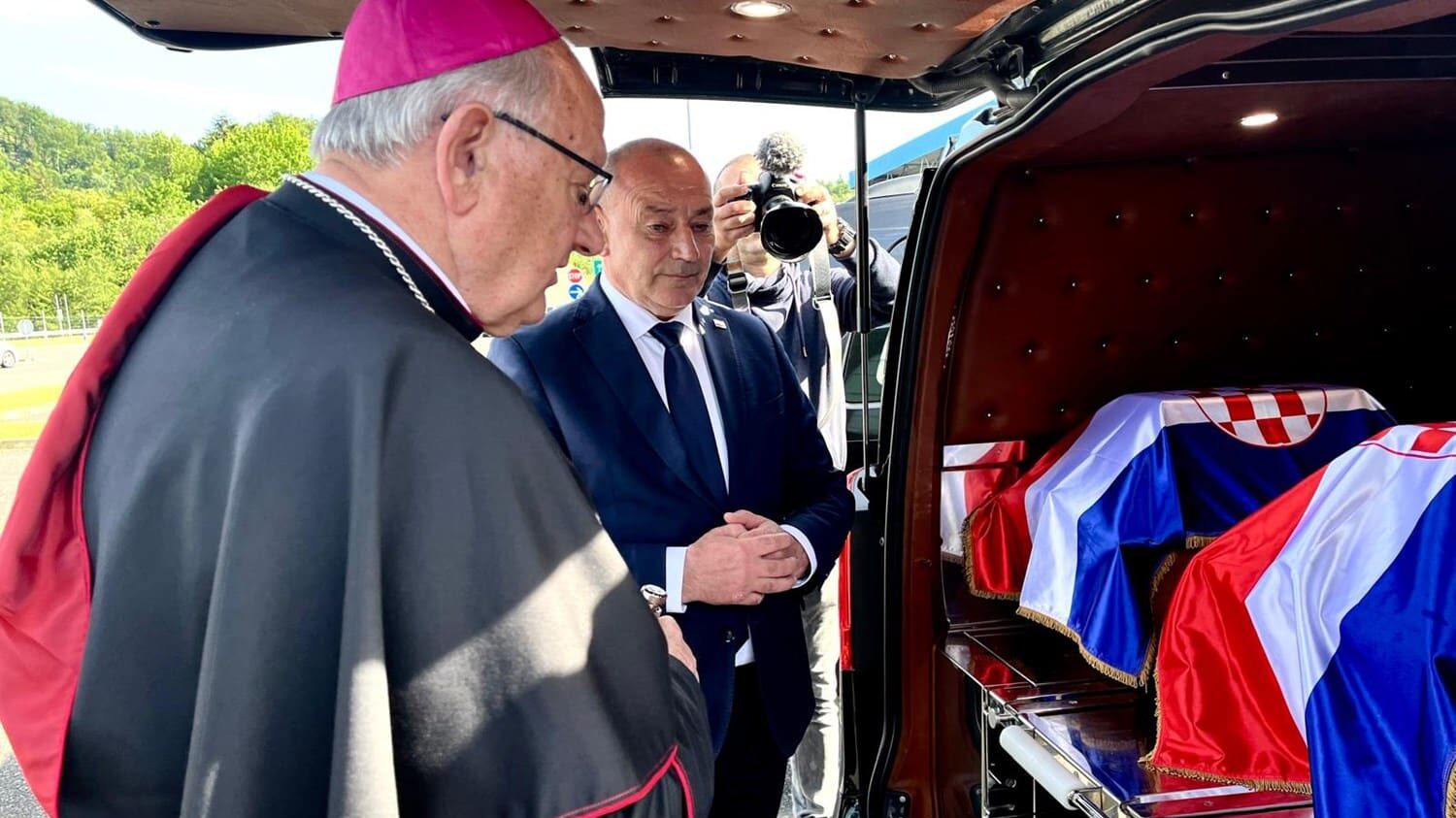
Minister Tomo Medved (R) attends the handover of the remains on Wednesday. Photo: Croatian Government,
The handover of the remains of 500 Croats killed at the end of World War II in Slovenia was a humanitarian and civilised act, Croatia’s Minister of Veterans’ Affairs, Tomo Medved, said on Wednesday at the Macelj border crossing, where the transfer took place, according to a Croatian government statement.
“Every victim deserves a dignified burial,” Medved said.
He explain that said the victims – mostly men aged 18 and 40, but also including minors – were exhumed from four mass graves located along the so-called “Way of the Cross” from May to autumn 1945.
The “Way of the Cross” refers to a forced march from Austria to Slovenia taken by members of the defeated forces of the Independent State of Croatia, NDH – a fascist state established under the auspices of fascist Italy and Nazi Germany, as well as fleeing civilians. Many were executed along the way.
They were forced to march after being handed over to the victorious Yugoslav Partisans near Bleiburg, Austria, from May to August 1945.
The NDH had established racial laws and death camps in which Jews, Serbs, Roma and dissident Croats were killed, and its governing Ustasha movement was notoriously brutal. However, those killed in 1945 included civilians, and most of the killings were extrajudicial executions.
The ministry statement said that based on personal belongings, religious items and clothing, it is “undoubtedly” the case that all the victims were Croats who bore signs of violent death, including gunshot wounds and broken bones, the minister’s statement added.
Anticipating possible “divided reactions” within Croatian society, Medved stressed that he condemned Nazi, fascist and communist regimes alike.
“We are now fulfilling our moral obligation toward those who were executed without trial or sentence, who were silenced and erased from public memory for decades,” he said, adding that without truth and confronting the past, there can be no mature society or stable future.
The largest number of victims found in Slovenia were exhumed in Kosnica, where 307 sets of remains were found. Another ten victims were exhumed in Trebce, 22 in Podstenice/Rugarski Klanci, and 161 in Cerklje ob Krki. The exhumations were carried out between 2013 and 2017, and the remains stored at the Dobrava Cemetery in Maribor, where Medved laid a wreath on Wednesday.
Individual identification will not be possible due to the fragmented condition of the remains, Medved warned, announcing detailed anthropological analysis and the organisation of a dignified burial.
Medved thanked Slovenia for its cooperation and added that numerous other mass graves containing victims of different nationalities have been identified there. However, without “comprehensive research, it is not possible to determine the exact number of victims or their identities”, according to the statement.
“That is why we continue to search institutionally, systematically and responsibly for graves from World War II and the post-war period, while emphasising that resolving the fate of those missing from the Croatian War of Independence [in the 1990s] remains our priority,” Medved stressed.
Over the past ten years, Medved’s ministry has conducted more than 630 field surveys and investigated nearly 100 locations in 16 counties, where the remains of at least 2,300 victims have been found and exhumed, the government statement said.