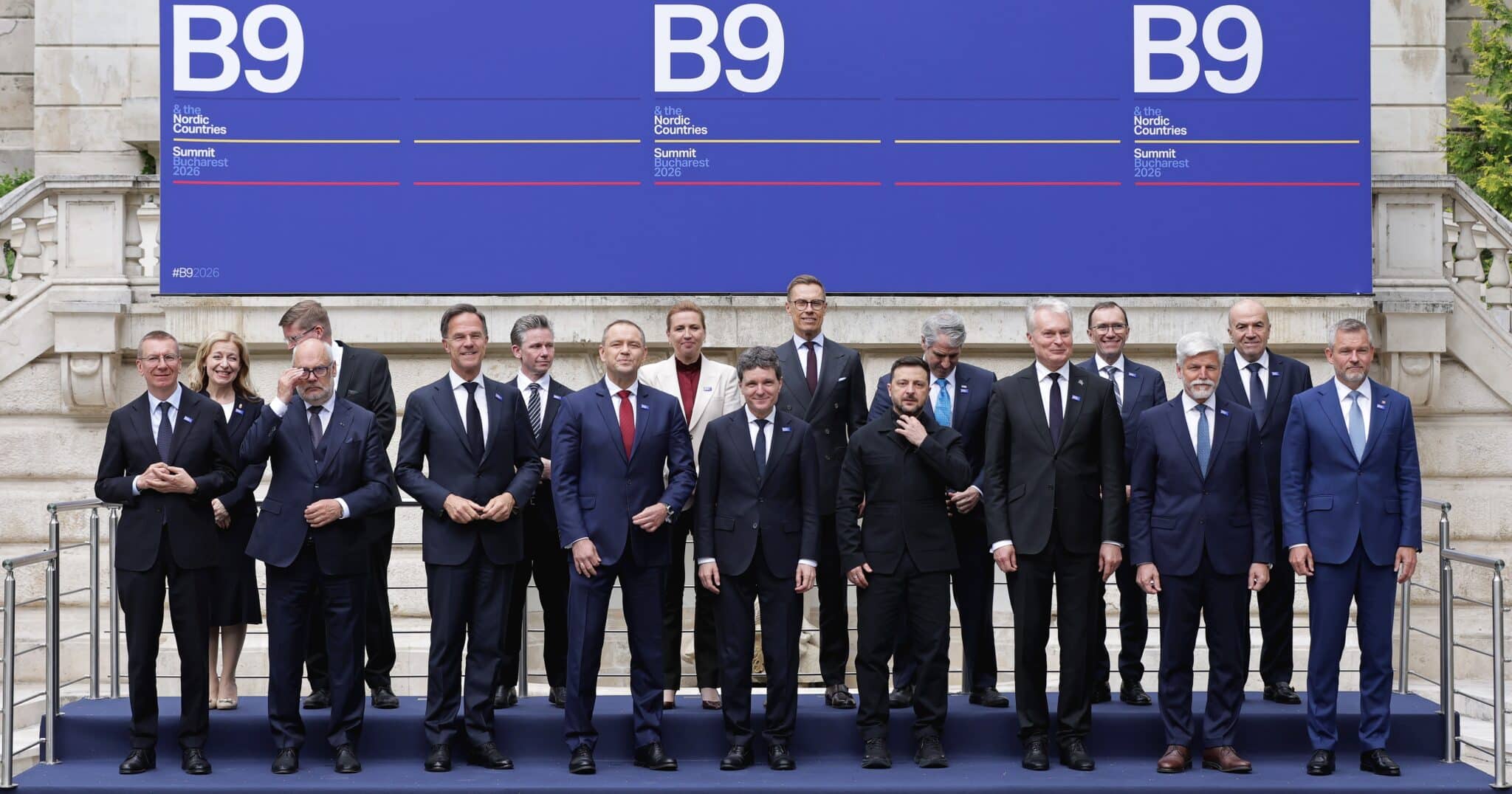
Romanian President Nicusor Dan (C), Ukraine’s Volodymir Zelensky (C-R), Poland’s Karol Nawrocki (C-L) and NATO chief Mark Rutte (5-L), with delegation heads from B9 and Nordic countries in Bucharest, 13 May 2026. Photo: EPA/ROBERT GHEMENT.
Leaders of 14 NATO countries from Eastern and Northern Europe pledged on Wednesday to deepen cooperation on defence and regional security, amid growing concerns over Russia’s continued military action causing instability along the Alliance’s eastern border.
At a regional security summit of the so-called B9 group in Bucharest, the leaders stressed the need for stronger military coordination, higher defence spending and better protection of critical infrastructure across NATO’s easternflank.
“We condemn Russia’s highly confrontational actions against allies and partners, including sabotage, cyber-attacks, and a wide range of hybrid attacks and destabilising activities,” the leaders said in a joint statement.
“Repeated airspace violations on the Eastern Flank underscore the urgent need to continue strengthening NATO’s air and missile defence, including against unmanned aircraft systems (drones) threats,” they added.
Russia has repeatedly violated the airspace of Romania, Poland and the Baltic states with drones, although it has denied intentionally targeting NATO member countries.
The so-called B9 group brings together nine Central and Eastern European NATO allies and was launched in Bucharest after Russia’s 2014 annexation of Crimea from Ukraine. Its members are Bulgaria, the Czech Republic, Estonia, Hungary, Latvia, Lithuania, Poland, Romania and Slovakia.
Wednesday’s statement was also endorsed by NATO’s five Nordic members – Denmark, Finland, Iceland, Norway and Sweden.
Ahead of the NATO summit in Ankara this July, the meeting also sought to address and bridge the growing divide between US President Donald Trump and Europe over the future of the Alliance and the Iran crisis.
The joint statement said the B9 group is determined “to deliver on NATO 3.0 by advancing a stronger Europe within a stronger NATO” and to further strengthen the transatlantic defence industrial base “through increased production capacity, more resilient supply chains and effective multinational procurement”.
The summit was also attended by Ukrainian President Volodymyr Zelensky, NATO Secretary General Mark Rutte and the US Under Secretary for Arms Control and International Security, Thomas DiNanno.
Zelensky said he hoped the future NATO summit in Ankara could provide “a sense of encouragement for the entire Euro-Atlantic region”, adding that Europe needs “to have the courage to debate more integrated and, in specific sectors, more autonomous European defence strengths”.