Let us read it for you. Listen now.
Your browser does not support the audio element.
SPRINGDALE — They represent a wide range of ages and origins, but they all have one thing in common: Springdale.
It is a community for which they have strong feelings and a deep connection.
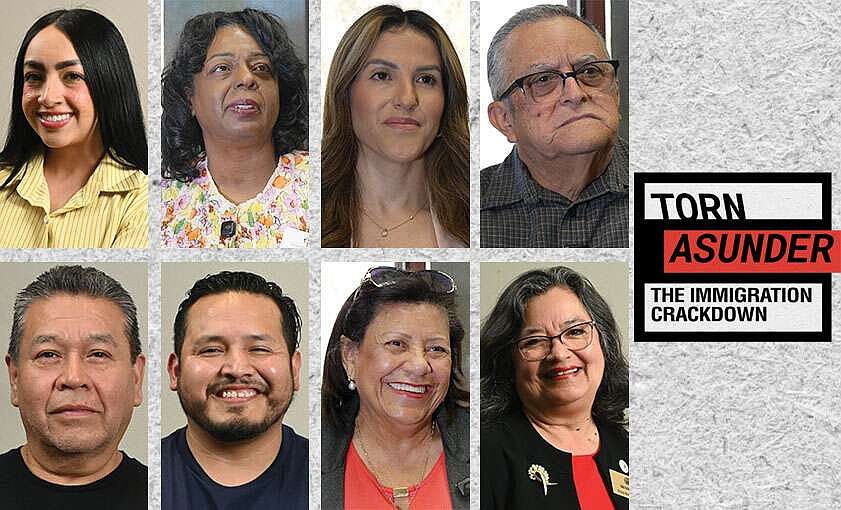
These eight people shared their opinions on the city’s history, growth and the impact of immigration enforcement efforts in the city:
STATE REP. DIANA GONZALES WORTHEN
State Rep. Diana Gonzales Worthen
State Rep. Diana Gonzales Worthen, D-Springdale, represents District 9, which consists of east Springdale, in the Arkansas House of Representatives.
The longtime educator is a Texas native, the daughter of a migrant farm worker mother and a Spanish-speaking father, with roots in San Luis Potosi, Mexico.
She has lived in Springdale since 1996, when she moved to the area with her husband and daughter and began teaching in nearby Rogers.
She described Springdale in the late 1990s as a community in a cultural mismatch phase.
“No one was ready to teach students who were learning English; nobody knew how to serve Latino immigrant families in the schools,” she said.
Worthen said she was one of the first Latino teachers in the area and the first at Rogers High School. She recalled a phone call from those early days when someone told her, “There are no educated Hispanics in Northwest Arkansas.” The person must not have thought the person on the other end of the line was in fact Hispanic, because she had no accent when speaking English and was using her married name, Worthen said.
“Actually, that’s not true,” she answered. “My full name is Diana Gonzales Worthen, and I’m working on my Ph.D.”
However, Worthen has noticed many positive changes.
“When I first got here, you didn’t have the mercados, or tiendas, or even authentic Mexican restaurants,” she said. “Over time, lots of Hispanic stores have opened, and they’re successful.”
There are Latino police officers now, as well as firefighters, doctors and nurses, she said. Springdale even has a Latino School Board member, Eddie Ramos.
Hispanic nonprofits have also played key roles in shaping Springdale’s diversity, which has become a drawing point, Worthen said.
“I’ve had families tell me that they moved from the Midwest to Springdale because they knew how diverse it was, and they wanted their kids to experience that diversity. That was important to the parents. People are moving here because of the diversity, and that’s what we should be celebrating.”
FRANCISCO JAVIER MORENO
Francisco Javier Moreno
Francisco Javier Moreno — who is originally from Tamazula, Jalisco, Mexico — arrived in Springdale in 1995 via south Texas.
He heard about Springdale from a coworker in a cannery in Wisconsin. He was told there was work aplenty and a vibrant Hispanic community in the city. The former was true; the latter, less so, he said.
[SURVEY: Enhanced Immigration Enforcement: nwaonline.com/tornasundersurvey/]
“Springdale was much smaller then, with very few Hispanics,” Moreno said. “It was quiet, pretty and full of trees.”
He said Hispanics in Springdale have been treated better than elsewhere.
“I feel like the situation here in Arkansas is normal,” he said. “I haven’t seen any alarming signs of immigration enforcement, nor any mistreatment. Compared to other states, we’re better off here. Obviously, people who are here without legal documentation may feel nervous, but in Arkansas, if you obey the law, you’ll be fine.”
TANYA EVANS
Tanya Evans
Tanya Evans is the Springdale Public Library’s multicultural librarian. Originally from Dermott, she is not Hispanic, but has spoken Spanish for most of her adult life as a teacher and librarian.
Evans has lived in Fayetteville since 1994, but knows Springdale well, having worked at Tyson and as an English teacher at Northwest Technical Institute.
In Springdale, “from time to time, I’ll hear comments like, ‘Why are there so many signs in Spanish?’ or ‘They should learn English,'” she said. “People mainly complain about the language. I’ve always thought that was sad.”
Due to her close contact with Springdale’s immigrant community, Evans said she has seen the effects of enhanced immigration enforcement operations.
“As a notary public, I have notarized documents for people who have had to designate a legal guardian for their children in the event that they are deported,” she said. “The first time I notarized one of those documents, I broke down crying, because I realized that there was a risk that these families were going to be separated, and I was sad about that possibility.”
BERENICE ALCALA
Berenice Alcala
Berenice Alcala, who recently joined the Downtown Springdale Alliance as marketing director, is also a disc jockey at the Spanish language radio station La Zeta 95.7 FM.
Born in Mexico, she has lived in Springdale since she was a year old. She said she was “the only kid in my class who spoke only Spanish at home. Part of my childhood was spent growing up in an environment where I didn’t feel represented.”
Her parents didn’t speak English, “so as a very young child I took on an interpreter role,” she said. “I witnessed incidents in which we were discriminated against for not speaking English or for our skin color.”
The situation has been improving, she said. The biggest change in her mind has been cultural and linguistic diversity.
“As Latinos, now we feel like we’re part of a big family; we feel included,” she said.
Many people and organizations have come together to build a support network for immigrants, Alcala said.
“Community support has helped us feel stronger and safer,” she said. “We’re always working hard and trying to find positive aspects, and that’s what I love about my community and about Springdale.”
SUSANA GONZALEZ
Susana Gonzalez
Susana Gonzalez has lived in Springdale for 18 years. She is originally from Epitacio Huerta, Michoacan, Mexico.
When she arrived to join her older brothers and further her education in the late 2000s, she found a peaceful, welcoming small town with a sizeable Latino community. Her first jobs in Arkansas were at Hispanic-owned stores.
“Springdale has grown a lot,” she said. Latinos have been a big part of contributing to that growth, she added.
“We can find just about everything here,” Gonzalez said. “I feel like there are more opportunities for Latinos now; there are more activities for families, updated parks and new hospitals.”
JUAN CARLOS UDABE
Juan Carlos Udabe
Juan Carlos Udabe arrived in the city in 2010. He said he fled California to keep his children out of gangs.
“You know, in California, if you have a kid, sooner or later they’re going to recruit him,” he said.
Udabe said he originally immigrated to California from Mexico in the early 1990s because of the Mexican recession. When he arrived in Springdale, he encountered difficulties, not with gangs, but with racism, he said. He recounted a story of a man driving behind him who got angry that he pulled over for an ambulance and told him the police would be coming to get him.
“As time went by, I learned to live with racism and turn the other cheek,” Udabe said.
He finds the division between Latinos over immigration enforcement to be sad.
“Some of them came over with work visas, but the rest of us, I would dare to say, 90%, came over ‘differently,’ and luckily, now we’re legal,” he said. “Hispanics are divided because the Anglo and Hispanic cultures are so different. Even if you’re a Latino who doesn’t speak Spanish, you’re never going to be fully accepted. You’ll always be seen as a Latino. If you’re Latino and you support Trump, just watch the videos of the Venezuelans dancing when he won and then crying when their son was deported.”
AYME VILLANUEVA
Ayme Villanueva
Originally from La Ceiba, Honduras, Ayme Villanueva heads Alcance, a Springdale-based nonprofit that offers educational, technological and leadership programs meant to empower community members.
Villanueva arrived in Springdale in 2010, after she and her family literally won the lottery. For U.S. resident visas, that is.
She said she hasn’t encountered any racism — quite the contrary.
“I feel blessed because everyone has welcomed me with open arms,” she said. “In fact, the first friend I made here was an American lady. She helped me navigate the school system. She introduced me to the teachers and the principal. I worked as a substitute teacher and volunteer in the school system, and most of the people who have helped and supported me are Americans.”
FRANCISCO VALENCIA JR.
Francisco Valencia Jr.
Better known as the comedian, DJ and entertainer The Frisco Kid, Francisco Valencia Jr. is a more recent arrival, moving to Springdale six years ago from Los Angeles while working for J.B. Hunt.
“At first I didn’t want to move to Arkansas, but I got here and fell in love,” he said. “I never went back to California. The first thing I noticed was the fresh air, the trees, how clean it was.”
Not everything was picture perfect, though. He was jailed for 24 hours in Bentonville while his citizenship status was being verified.
Valencia said it’s important for Springdale’s Hispanic community to raise its voice.
“We like to work hard and keep out of trouble,” he said. “It’s time to change that. We have a voice, too. We have to overcome that fear of being fired if we speak up. Things are changing, and we have to be part of that change.”
Alex Charbonnier can be reached by email at acharbonnier@laprensalibrear.com.
—————————————-
Video online
Residents share thoughts on city, immigration efforts
nwaonline.com/tornasundervideo/
Alex Charbonnier
Alexis “Alex” Charbonnier is the editor of La Prensa Libre AR, the weekly Spanish-language print and digital newspaper for Northwest Arkansas, the River Valley and Southwest Missouri.