- Thai authorities have detected dangerous levels of arsenic contamination in sediment from the Mekong River mainstream and three of its tributaries in the country’s north.
- The contamination has been widely linked to a surge in unregulated mining, including for rare earth minerals, upstream in Myanmar’s Shan state.
- Experts warn that toxic heavy metals could threaten aquatic ecosystems, fisheries and the livelihoods of millions of people who depend on the Mekong Basin.
- Regional coordination and monitoring remain limited, with the Mekong River Commission lacking authority over key upstream areas in Myanmar and China.
See All Key Ideas
BANGKOK — Thai authorities have found what they described as dangerous levels of arsenic contamination in sediment from the Mekong River and three of its tributaries in the northern provinces of Chiang Mai and Chiang Rai.
Heavy metal pollution has been reported from key tributaries of the Mekong for more than a year now, but the tests conducted in March by Thailand’s Pollution Control Department mark the first time that arsenic contamination has been detected on the mainstream of the Mekong, a vital transboundary river that supports thousands of plant and wildlife species and the livelihoods of millions of people.
The test results published in mid-April show that sediment taken from three separate monitoring stations along the Mekong mainstream contained arsenic concentrations of between 73 and 296 milligrams per kilogram of sediment. According to the Pollution Control Department, concentrations of less than 10 mg/kg are considered broadly safe for aquatic life; levels higher than 33 mg/kg are deemed dangerous.
Arsenic levels in sediment taken from various points along the Kok, Sai and Ruak rivers, key tributaries of the Mekong, all ranged from below the 33 mg/kg safe limit up to 57 mg/kg, the Pollution Control Department said via its official Facebook page, noting the contamination appears to be spreading through the river system.
Thailand’s Pollution Control Department posted results of the sediment tests to their official Facebook page on April 10, 2026. Image sourced from the Pollution Control Department’s Facebook.
Heavy metal pollution in the Mekong Basin has been widely linked to unregulated mining farther upstream in Myanmar. A rush of mining seeking to extract gold, critical minerals and rare earth elements has left a swath of destruction in northeastern Myanmar, with U.S.-based think tank the Stimson Center using satellite imagery analysis to identify 833 unregulated mines across the Mekong River Basin. Of these, 86 are thought to be rare earth mines, due to the distinctive blue tarpaulin leaching ponds. More than half of these 86 mines opened between 2024 and 2026.
More than 50 million people across the Lower Mekong River Basin rely on the river for water, fish and livelihoods, but the Mekong has also long been a biodiversity hotspot, hosting some 20,000 species of plants, along with a wide array of aquatic life such as the critically endangered Mekong giant catfish (Pangasianodon gigas) and the endangered Irrawaddy dolphin (Orcaella brevirostris). The Mekong subspecies of Irrawaddy dolphin is deemed critically endangered, with fewer than 100 individuals thought to remain. The river also supports an estimated 1,200 bird, 800 reptile and amphibian, and 430 mammal species.
In recent years, the Mekong and its beneficiaries have been strained by the proliferation of hydropower dams, along with unsustainable fishing, rampant deforestation, changing land-use and contamination from agricultural chemicals. Now, the recent boom in rare earth and critical mineral extraction risks pushing the river to the brink.
Across the region, fisheries and food security are at stake as dams continue to blight the Mekong River. Image by Gerald Flynn/Mongabay. Banner image.
Exporting the problem downstream
Rare earth elements are crucial to military, aerospace and automobile industries globally, as well as fueling the green energy transition. But they’re typically extracted using an especially ecologically destructive form of mining. The process involves injecting a liquid solution of toxic chemicals into mountaintops, liquefying the contents, draining them out, and separating the rare earth elements from the liquefied ore in leaching ponds.
The level of environmental damage caused by this form of mining, known as in situ mining, saw China, the world’s leading producer and processor of rare earths, place heavy restrictions on its domestic mines back in 2009, while quietly moving mining operations into other jurisdictions, like Myanmar, Mongolia and Malawi.
While various armed factions in Myanmar are mining critical and rare earth minerals as a means of financing the ongoing fighting, much of the rare earth mining operations in the Mekong River Basin are focused in the Kengtung, Tachileik and Monghsat districts of Shan state on the country’s eastern border with Thailand. These parts of the basin are primarily territories held by the United Wa State Army (UWSA) and the allied National Democratic Alliance Army, both of which enjoy close ties to China and agreements with Myanmar’s military guaranteeing a level of autonomy in exchange for neutrality in the ongoing conflict.
Mining across Shan state is also suspected to the source of contamination that was detected by Thailand’s Pollution Control Department in the Salween River, where tests performed in March 2026 saw an increase in arsenic levels compared to January 2026 and November 2025 results.
Satellite imagery analysis from the Stimson Center shows how rare earth mining operations shifted from Kachin state to Shan state in recent years, intensifying transboundary pollution. Image by Emilie Languedoc / Mongabay.
Thai authorities have since issued alerts to various riverine communities, including those living along the Mekong in Chiang Rai, warning them against consuming too much fish from the rivers. Some communities were urged to avoid the water altogether.
Regan Kwan, lead researcher at the Stimson Center, helped devise the think tank’s online platform monitoring mining across mainland Southeast Asia. In an email, he told Mongabay that the most recent detections of arsenic contamination in the Mekong could be related to seasonal changes, with heavy rainfall increasing the likelihood of leaching ponds at mining sites overflowing and accelerating the flow of rivers, carrying contamination farther downstream. The results, Kwan added, look concerning and serious.
“While government action should be focused on addressing immediate needs for communities who rely on the river for sustenance, income, and cultural reasons, this should raise the call for long-term and consistent water testing throughout the basin,” Kwan said. “There is now more data than a year ago when the mines on the Kok River were discovered, but it still feels like governments aren’t responding accordingly.”
He noted that there are still many unknowns regarding the basin-wide impacts of mining pollution, particularly on plant and animal life, but the lack of regional coordination isn’t helping.
Sampling at Haad Chiang Rai, a riverside park and nature area in Chiang Rai. Image courtesy of Ecological Alert and Recovery–Thailand.
Limits to authority and testing
A representative of the Mekong River Commission, which seeks to regulate activity on the transboundary river network, told Mongabay by email that arsenic contamination appears to be locally concentrated in Chiang Rai and that there’s “no indication of immediate basin-wide impacts.”
The Mekong River Commission is working to facilitate cooperation and data exchanges between governments, but doesn’t carry out independent field testing, its representative said.
“With the information currently available, there is no confirmed evidence establishing a direct link between the observed conditions in the Mekong River and mining activities in any specific country or area,” the representative said. “However, monitoring results indicate that inputs through the Kok–Sai–Ruak river network may be one pathway requiring further assessment.”
They added that the transboundary nature of the Mekong requires monitoring of the entire basin and that this monitoring is ongoing throughout the commission’s member states: Cambodia, Laos, Thailand and Vietnam. China and Myanmar remain dialogue partners over which the Mekong River Commission has no regulatory authority.
A fisherman feeds his net into the Mekong River on the Thai-Lao border by Chiang Saen. Image by Anton L. Delgado.
Mongabay contacted the Thai Pollution Control Department, the Lao Ministry of Agriculture and Environment and the Lao National Mekong Committee for comment on the issue. None had responded by the time this story was published. Cambodia’s Ministry of Environment also didn’t respond, but Heng Kong, director of the new Cambodian Agricultural Sciences Academy, told Mongabay that “We do not have budget to [test for] these heavy metals.”
Mongabay also sent questions about the import of minerals from Myanmar to China’s foreign ministry, but it hasn’t responded.
Information has remained sparse across the region, with few details offered on the consequences of exposure to heavy metals polluting river systems.
“Unlike many chemicals, metals do not degrade,” said Brian Eyler, director of the Stimson Center’s Southeast Asia program. “They persist, accumulate, and continue to cause harm long after mining stops.
“And to be sure,” he added, “the mining has not stopped in the Mekong region.”
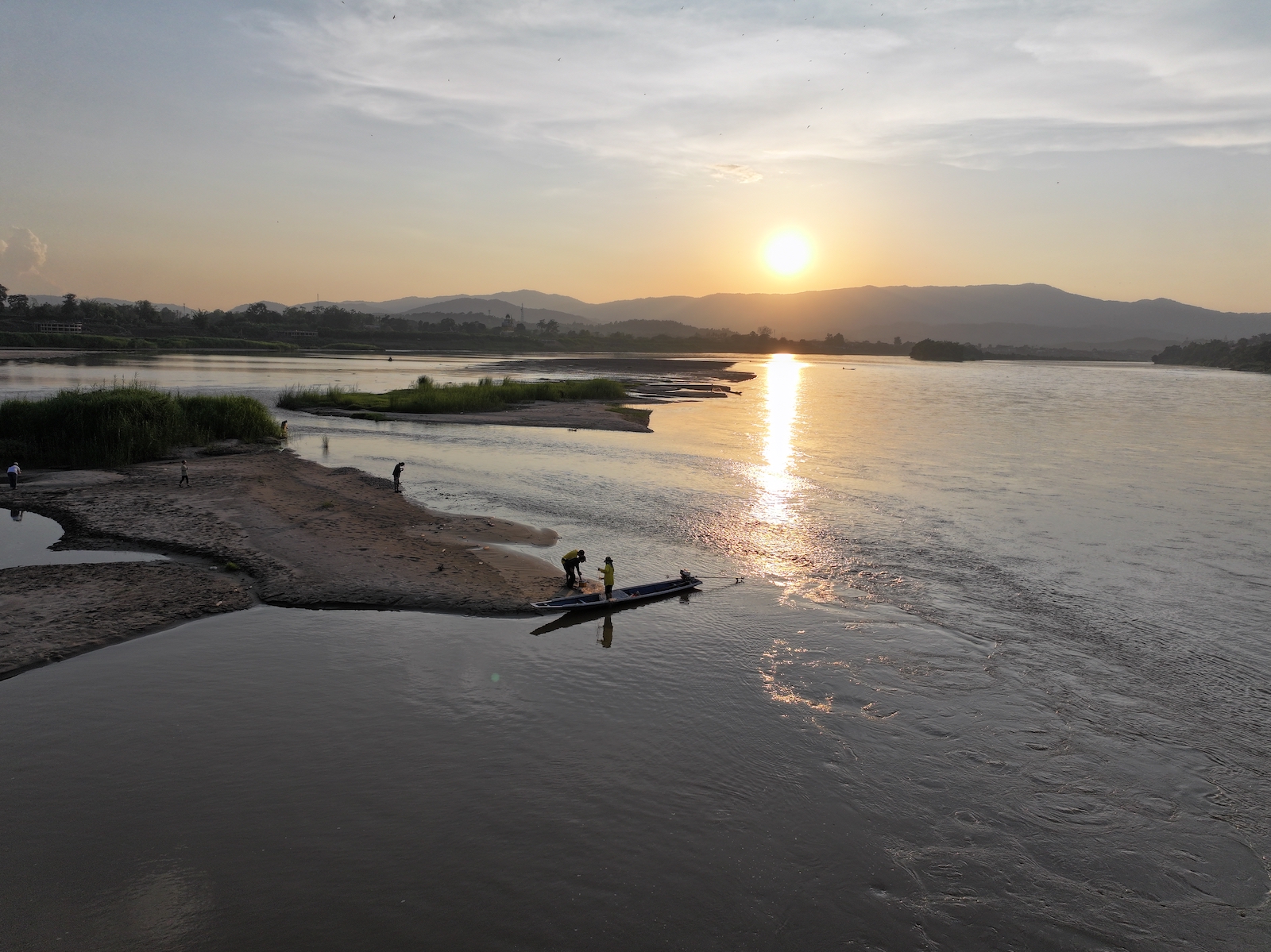
Banner image: Fishers in the Mekong River near Chiang Khong, Thailand. Elevated arsenic levels at testing sites in the Mekong indicate that contamination may be spreading into this vital waterway. Image by Stefan Lovgren.
Citations:
Klamann, L., Thiele, B., An, G. C., Kupfer, N., Kappenberg, A., Nga, N. T., … Weihermüller, L. (2026). Pesticide residues in organic vs. conventional rice systems: Management recommendations for Vietnam’s Mekong Delta. Agricultural Systems, 236, 104773. doi:10.1016/j.agsy.2026.104773
Crane, R., Mohammad, A., Jin, F., Cleall, P., & Sapsford, D. (2025). Towards environmentally compatible in situ leaching of mine waste using low concentration acids. Hydrometallurgy, 236, 106506. doi:10.1016/j.hydromet.2025.106506
Brenner, D. (2025). Rebel politics after the coup: Ethnic armed organisations and Myanmar’s Spring Revolution. Journal of Contemporary Asia, 56(2), 179-202. doi:10.1080/00472336.2025.2494109