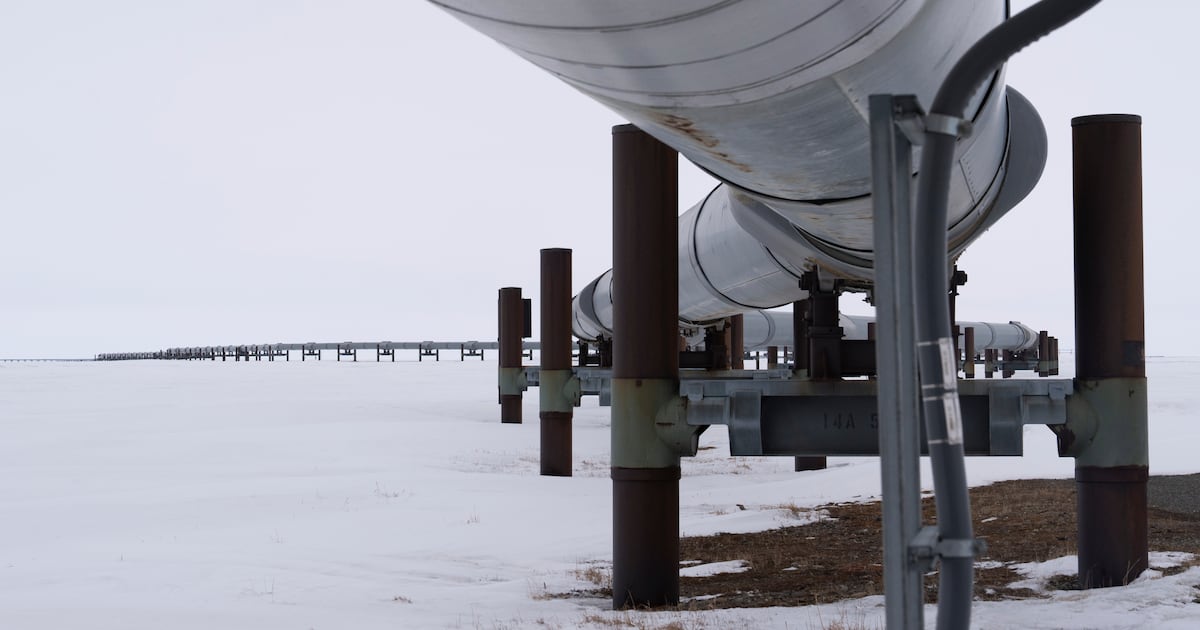
The Trans-Alaska Pipeline is seen at the Pump Station 1 on Monday, June 2, 2025, located near Deadhorse, Alaska, on the state’s prodigious North Slope. (AP Photo/Jenny Kane)
Alaskans are still paying high prices for oil.
We are paying outrageously high prices for a resource from our own ground while seeing too little benefit. This is not a resource problem. It is a system problem. And it is fixable.
When oil prices rise, Alaska should not just collect more revenue. It should capture more value and return it to Alaskans in a way that is timely, predictable and meaningful.
There is a clear path to do that. When oil prices rise above certain thresholds, the state can be structured to capture a larger share of that increase and return a portion of it to Alaskans more quickly.
This is not a new concept. Alaska has adjusted its fiscal system before in response to changing economic conditions. It can and should do it again.
First, the state can structure its production taxes so that when prices spike, the public share increases accordingly. If companies benefit from higher global prices, the state should as well.
Second, a portion of the additional revenue should be automatically reserved for immediate relief, not debated months later.
That could mean energy rebates, fuel cost offsets or direct payments tied to price increases, so people get this benefit when they are paying higher costs.
Third, relief efforts should be targeted where they are needed most. In many parts of Alaska, especially rural communities, energy costs are not just high; they are a barrier to living in your own home.
When geopolitical events like the Russian invasion of Ukraine spike prices and disrupt energy supply, those rural energy costs skyrocket, as described in a recent Alaska Beacon op-ed written by a chief scientist at the Alaska Center for Energy and Power and the president of the Alaska Federation of Natives. Any serious policy must recognize and address this reality.
To get there, we have to stop leaving our fair share of Alaska’s resource income on the table.
We also need the will to implement a forward-thinking energy policy that breaks our dependence on overpriced oil and gas.
This means eliminating outdated oil and gas tax credits that still pay out even when those companies are highly profitable, closing loopholes and special carve-outs that reduce what large producers contribute as their fair share of corporate income taxes, and creating a Department of Energy to bring Alaska’s energy operations under one roof rather than scattering them across agencies.
Alaska holds enduring advantages in global energy markets: political stability, established regulatory systems and long-term production potential. These strengths give the state leverage in how it structures its fiscal framework.
This is about more than fuel prices. It is about whether Alaska can generate stable, long-term revenue to grow an economy that will sustain its population.
In recent years, the state has faced ongoing challenges in funding education, maintaining infrastructure and retaining residents. At the same time, a significant share of the value generated from resource extraction does not remain in state.
That imbalance should concern all of us. The resource-based fiscal solutions outlined above are part of a comprehensive plan that can address that imbalance.
Alaska should not be a place where resources are extracted, profits leave and communities are left to manage the consequences.
If nothing changes, the pattern is likely to continue: Prices rise, Alaskans pay more and the long-term challenges persist.
Alaska has the resources, the position and the leverage to get our fair share and invest in its future. I have a plan to do it. No more excuses. Let’s get it done.
Tom Begich is a former Alaska state senator, a small-business owner and a candidate for governor of Alaska. He has worked with communities across the state on education, energy policy and juvenile justice.
• • •
The Anchorage Daily News welcomes a broad range of viewpoints. To submit a piece for consideration, email commentary(at)adn.com. Send submissions shorter than 200 words to letters@adn.com or click here to submit via any web browser. Read our full guidelines for letters and commentaries here.