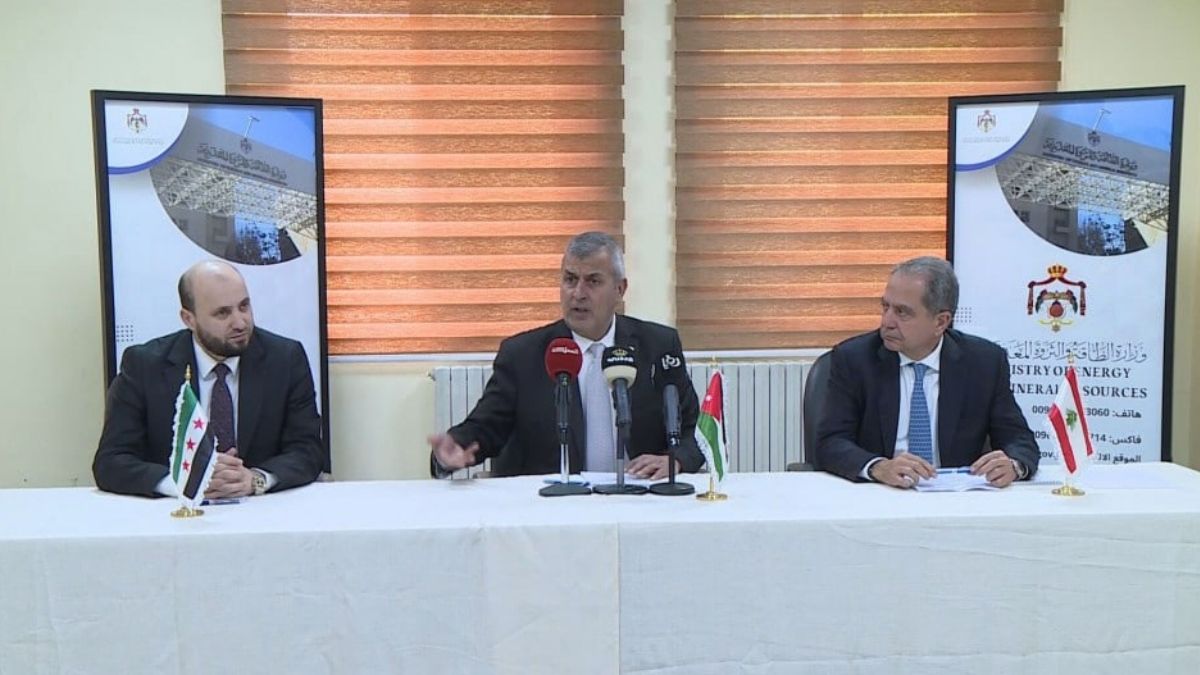
Jordanian Minister of Energy and Mineral Resources Saleh Al-Kharabsheh announced on Monday, May 4, that an agreement had been reached for cooperation on gas exchange between Syria, Jordan, and Lebanon.
Technical preparations were completed over the past period, contracts were signed, and studies were conducted to repair gas transmission networks, Al-Kharabsheh said during a press conference with his Syrian counterpart, Mohammed al-Bashir, and Lebanese counterpart, Joe Saddi, according to Jordan’s Al-Mamlaka TV.
Syrian Energy Minister Mohammed al-Bashir said Syria looks forward to continuing regional energy interconnection between Syria, Lebanon, and Jordan, revealing that four electricity interconnection lines between Syria and Lebanon are now ready.
Syria was able to rehabilitate the Arab Gas Pipeline, draw quantities of gas, improve the energy situation in Syria, and stabilize the electrical grid, according to the Syrian Arab News Agency, SANA.
Al-Bashir said there was progress in projects to transfer gas to Lebanon through Syria, contributing to strengthening electricity production and improving energy supplies in Lebanon. He noted that cooperation with Jordan in the energy sector began on the first day after liberation.
The Jordanian energy minister said the meetings discussed ways to develop gas exchange projects and benefit from existing infrastructure, as well as strengthening electricity interconnection. He added that technical teams had worked during the past period to prepare the necessary studies and assessments to rehabilitate networks.
He explained that Jordan’s role in the agreement is to use its infrastructure to import liquefied natural gas, convert it back into gas, and then pump it to Syria through the Arab Gas Pipeline.
The Lebanese minister of energy and water said the importance of electricity interconnection and natural gas projects lies in securing reliable energy sources at a lower cost.
Gas Supply From Jordan
The Syrian Petroleum Company and Jordan’s National Electric Power Company signed an agreement to supply about four million cubic meters of natural gas per day, equivalent to 140 million cubic feet, to Syria.
On January 26, the Syrian Ministry of Energy announced that the agreement aims to secure quantities of natural gas through Jordanian territory to support Syria’s electrical power system.
Jordanian Energy Minister Saleh Al-Kharabsheh said supply operations had effectively begun on January 1, with quantities ranging between 30 and 90 million cubic feet per day through the regasification vessel Energos Force, leased from the Egyptian side and docked at Aqaba Port until the end of March. He said the agreement would contribute to stabilizing Syria’s electricity system.
For his part, Syrian Energy Minister Mohammed al-Bashir said the agreement represents an important step within government efforts to strengthen supplies of fuel needed by the electricity sector and improve the reliability of electricity feed, especially given the challenges the energy sector faced in past years.
Al-Bashir noted that the agreement contributes to diversifying gas sources and raising the operating efficiency of generation plants, which will positively reflect on the level of services provided to citizens.
The media office at the Ministry of Energy told Enab Baladi that Jordan has a regasification station at Aqaba Port and that there is no single source for the gas arriving there, explaining that it is a global station that receives gas from all countries of the world.
The media office said at the time that the first shipment was from Egypt, and that later shipments could come from other sources.
Gas Is Not Jordanian
Abdul Hamid Salat, director of media at the Syrian Ministry of Energy, said in remarks to the Attaqa platform that the gas supplied to Syria is not Jordanian, but comes through a regasification vessel at Aqaba Port, in a quantity of nearly four million cubic meters per day.
He added that the annual value of the gas export agreement from Jordan to Syria is estimated at $800 million.
Salat confirmed in the same remarks that the Syrian government bears the full cost, unlike previous experiences that relied on foreign grants to support the electricity sector. The agreement stipulates purchase for full access.
Raydan: Gas Exported to Syria Is Israeli
Researcher Noam Raydan said during the US Syrian Energy Conference held in Washington on March 26, organized by the Atlantic Council and the US-Syrian Business Council, “Until now, we still hear that Syria gets gas from Jordan, and this is inaccurate.” Why? “Because Jordan does not export gas. It is not one of the major exporters. So where does the gas come from? From Israel.”
Raydan, a researcher specializing in energy and shipping industries in the Middle East, particularly Iraq and Lebanon, said the Arab Gas Pipeline remains very important, “but we must always remember that it no longer operates the way it used to. In 2008, Egypt was able to export gas to Lebanon through Syria. Today, that is no longer the case.”
“What is happening now?” Raydan continued. If Egypt wanted to supply Syria and Lebanon with gas, that gas would not come from Egypt, because Egypt itself is also not currently a major gas exporter and relies heavily on liquefied natural gas. It is likely to face more problems because of what is happening in the Strait of Hormuz, so there are many challenges.
Electricity interconnection projects between Jordan and Syria date back to 2001, before stopping in 2012 because of political conditions. The three countries also signed several agreements in 2022 to activate the import of electricity and gas to Lebanon through Syrian territory, but the project faced challenges related to financing conditions.