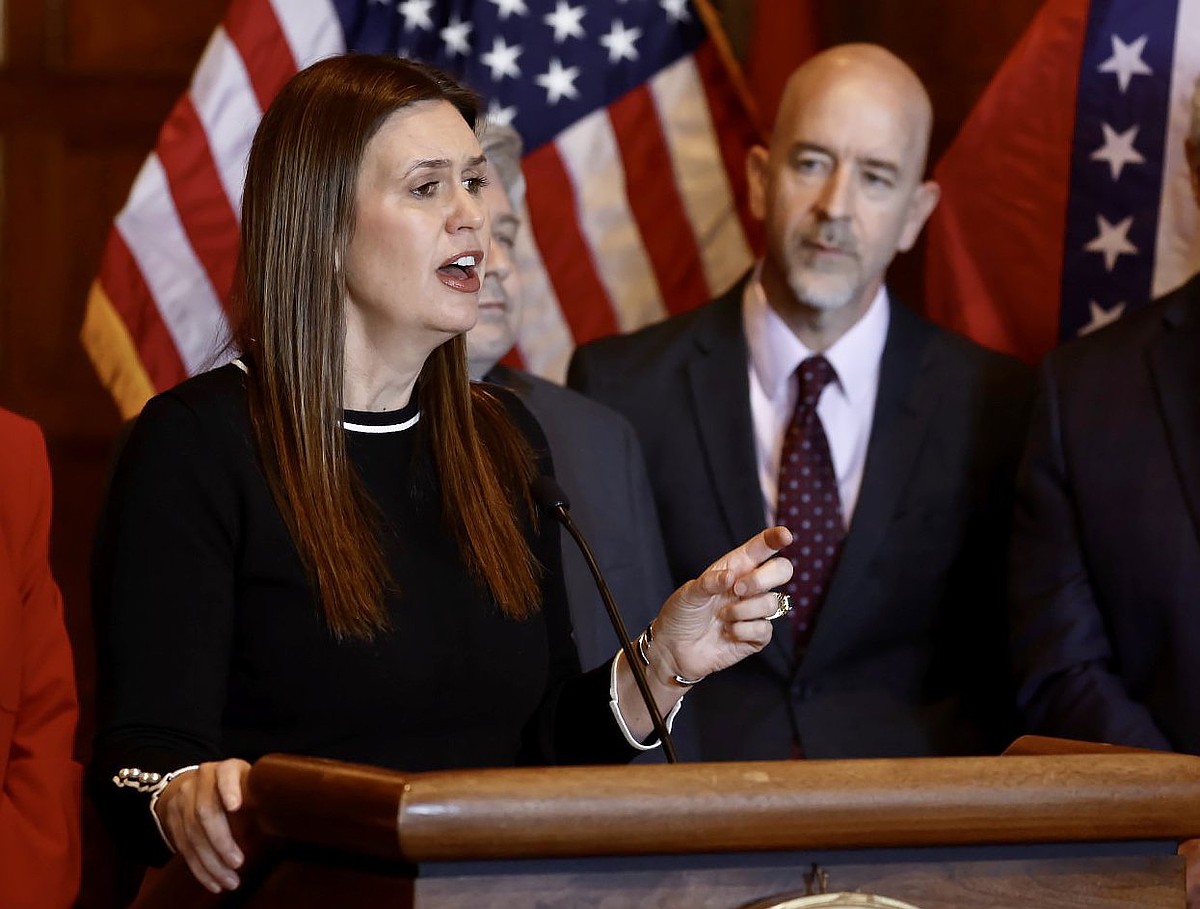
An attorney said Monday he may seek to depose Arkansas Gov. Sarah Huckabee Sanders in a lawsuit that challenges the constitutionality of the state’s Educational Freedom Account program.
Little Rock-based attorney Richard H. Mays, who represents the plaintiffs, told Pulaski County Circuit Judge Tim Fox during a motion hearing that he may need to take a deposition from the governor to ask questions about the scope of the LEARNS Act. Sanders championed the passage of LEARNS, the 2023 law that created the Educational Freedom Account program and made other sweeping changes to K-12 education in Arkansas.
However, Mays added that he is in talks with Arkansas Attorney General Tim Griffin’s office about first deposing an Arkansas Department of Education official.
“There’s a rule that when you’re going to depose a high-level government official or corporate official that you need to have exhausted your opportunity to get the same information from a lower-level person who may not be quite as busy,” Mays said in an interview after Monday’s hearing.
Jordan Broyles and Laura Purvis, two attorneys in Griffin’s office, told Fox they would talk further with Mays about the depositions.
Asked later about the possibility of the governor facing a deposition, Jeff LeMaster, a spokesman for Griffin’s office, said the case was still in the early stages of planning for discovery.
“Speculating on who might or might not get deposed would be premature,” he said.
The Educational Freedom Account program significantly expanded state taxpayer funding of private school tuition and other costs, as well as some homeschool expenses. Over 44,000 students are receiving an Educational Freedom Account in the current 2025-26 school year, the first year the school choice program is open to all K-12 students. Most participating students received a $6,864 award in 2025-26, and the Arkansas Legislature has dedicated roughly $309.4 million to the program in the current year.
The plaintiffs in the lawsuit, which was filed in June 2024, are Gwen Faulkenberry, Special Renee Sanders, Anika Whitfield and Kimberly Crutchfield. Their lawsuit seeks to end the Educational Freedom Account program and force recipients to repay the funds.
Faulkenberry, who lives in the Ozark School District, has been a columnist for the Arkansas Democrat-Gazette since 2021.
The defendants are Gov. Sarah Huckabee Sanders, state Department of Education Secretary Jacob Oliva and members of the state Board of Education, represented by the attorney general’s office.
The four plaintiffs also filed a federal lawsuit in the Eastern District of Arkansas last summer, which seeks to halt the Educational Freedom Account program on the grounds that it violates the U.S. Constitution by allowing public funds to be used to support private religious schools.
The two lawsuits in federal court and state court are moving forward simultaneously.
Monday’s motion hearing was Fox’s first in the lawsuit. Previously, then-Pulaski County Circuit Judge Morgan “Chip” Welch oversaw the case, but he left the circuit court bench in 2025.
Fox said the hearing was primarily about the next steps in the case, and “how to get the case ready for trial.” He described the lawsuit as a “public interest case” that needs to be “fully tried.”
Attorneys on both sides of the lawsuit said they had no intention of seeking a jury trial and expect the trial to be conducted solely by Fox.
During the hearing, Fox also granted a motion by attorney Thomas M. Fisher of Indianapolis, who is affiliated with EdChoice Legal Advocates, for admission pro hac vice. He has not yet ruled on a similar motion by another EdChoice attorney, Bryan Cleveland.
Fisher and Cleveland represent three mothers whose families use the Educational Freedom Account program and who are intervening in the lawsuit as defendants alongside state officials. Welch initially denied a motion by the three mothers — Erika Lara, Katie Parrish and Nikita Glendenning — to intervene in the case, but the Arkansas Supreme Court reversed Welch’s decision in December.
Arkansas’ school choice program is expected to grow in the upcoming school year, both in terms of participating students and state spending.
Roughly 49,000 applications for the accounts have been submitted for the 2026-27 school year so far, according to the Education Department.
Most families with Educational Freedom Accounts are slated to get $7,208 in the 2026-27 school year. Former recipients of the Succeed Scholarship — a smaller school choice program for students with disabilities that was absorbed into the Educational Freedom Account program — will receive $8,162. They currently receive $7,627.
The state Legislature has allocated $309.4 million in general revenue to the Educational Freedom Account program for the 2026-27 school year, along with another $70 million in one-time state reserve funds.
Mays contends the state unconstitutionally spent taxpayer money to fund the program, violating provisions of the Arkansas Constitution that restrict the use of public school funds. The attorney general’s office argues the state’s funding of Educational Freedom Accounts is separate from its funding of public schools.
With support from the ADG Community Journalism Project, LEARNS reporter Josh Snyder covers the impact of the law on the K-12 education system across the state, and its effect on teachers, students, parents and communities. The Arkansas Democrat-Gazette maintains full editorial control over this article and all other coverage.
Josh Snyder
[email protected]
Josh Snyder reports on how the state LEARNS Act has changed public education, including on the local level. His position is funded by the ADG Community Journalism Project. A Phoenix native and graduate of the Clinton School of Public Service, Josh has worked for the Arkansas Democrat-Gazette since 2018.