By Dr. Abdulkadir Osman Farah
“Alculumaa Warithatul Anbiyaa” (Scholars remain the heirs of- hikmah- from Prophets)
“Life is a deep divine secret, inevitably inescapable in moments of loss” (The legendary intellectual poet, Mohamed Ibrahim Warsame (Hadraawi))
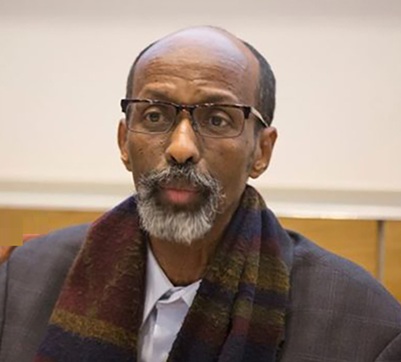
Somalis—and the world—have recently lost a towering Somali scholar and intellectual: Professor Ali Jimale Ahmed. He was a parent, spouse, grandparent, teacher, scholar, intellectual, mentor, poet, polyglot, cosmopolitan, and a man of faith and more. A man who carried immense respect for life and deep love for humanity. Deeply missed, especially those who knew him, who read, listened to, and learned from him over decades.
The loss of such a figure feels like the sudden removal of a mountain, a wall, or a shelter—something that once protected people from the approaching storms of irrationality, injustice, and ignorance in an often superficial and self-absorbed world. His passing also marks, symbolically, the closing of a blessed window through which students and admirers drew the fresh air of refined analysis, knowledge, and wisdom.
The Professor was ehel-xigto/xidid—inseparable vertical and horizontal ties of kinship—a friend, and a colleague. For students, he was an academic mentor, especially among Somalis who became socio-politically conscious during their secondary education in the early to mid-1980s. Ali Jimale elevated our approach to reading and writing. He became a role model for committed schoolchildren in Xamar (Mogadishu) and across the country: a model of how to see critically and reflect on Somali society, and on the world beyond Somalia.
Although schools at the time provided basic education about the country and society, staying ahead required seeking knowledge of the wider world from multiple sources. Somalis of the 1970s and early 1980s grew up in a more relaxed cultural environment than those of later decades. People accessed socio-cultural performances directly and through Radio Mogadishu. Such exposure enriched by movies from East and West, as well as regular artistic performances at the Somali National Theatre. Together, these cultural platforms helped equip generations with cultural competence and insight.
However, reading beyond school lessons remained limited—at least for those of us from modest backgrounds. At the time, Somalis had access to only few libraries, with books in foreign languages, often foreign-owned (for example, in embassies) and, for strategic and diplomatic reasons, often offering restricted access. As a result, schoolchildren and students pursued any opportunity to find something to read in whatever language they could reach—Arabic, English, Italian, French or otherwise. One memorable commercial outlet was Samatar Bookshop—one of the few places where people could buy foreign newspapers and magazines, many of which arrived late because of censorship and other constraints. Students, of course, could rarely afford them. Occasionally, they had the chance to borrow issues from older siblings or their networks, who somehow secured these precious materials. Out of sheer curiosity, young students would also stand outside such bookshops just to read the headlines and cover pages, studying the images and the text.
Through Ali Jimale’s work at Heegan newspaper—a weekly English-language publication—some of these curious students found an opportunity to engage directly with articles written in English. Secondary school students were even astonished when the Professor invited them to submit brief pieces to the newspaper he edited. The remarkable offer, however, came with a condition: candidates should refrain from spending excessive time on sports and entertainment. They will have to read carefully, think deeply, and prepare seriously. At the time, none of those offered this unique opportunity submitted a work.
For students, Ali Jimale also indirectly introduced other Somali authors and intellectuals, including the globally renown and award-winning writer Nuruddin Farah. (Nuruddin was Ali Jimale’s intermediate-school teacher.) Among the books students accessed was From a Crooked Rib, Farah’s first published novel. Although young readers did not fully understand the book, it was a revelation and helped train people in the practice of reading literature by Somalis written in a foreign language. After that elevation, there was no going back from reading books and discussing literature. Such shift of socialization left students isolated from peers more absorbed in physical relaxing activities. Classmates even joked: “Buuk akhris dhibkiis ma rabo, ma waxaad rabtaa in ay bidaar iga soo baxdo.”
Professor Ali Jimale went on to become not only a scholar but also a public servant, serving as an associate educator and English-language speechwriter at the Somali Presidency (Madaxtooyada). He provided linguistic and analytical support for senior public officials, including the President. Consequently, he worked long hours, commuting on foot and by caasi (the mini public Toyota Coaster). Later, he acquired a simple old Fiat 850—borrowed from someone—an expression of modesty compared with what officials of similar or higher status might have done at the time. For Somalis, this was a deeply challenging decade, which the late traditional intellectual Abdi Muhummed Amin described as “Land Cruiser gado, soo bari galley” (illegally acquire a Land Cruiser- while begging donors for maize).
Ali Jimale could have easily pursued private gain and material wealth, had he wished. Instead, he chose privacy, principled public engagement, and simplicity. He prioritized a different, more enduring privilege: the pursuit of education and wisdom. He was not someone who sought others; rather, others often sought him. In his youth, visionary senior officials recognized his diligence and brilliance and recruited him. He repeatedly spoke of the late Yusuf Ibrahim Aburas, Mogadishu’s mayor in the 1970s, who famously improved urban infrastructure with city buses arriving and departing on time. Aburas helped brilliant students access opportunities they otherwise could not have reached.
It was a noble practice that Ali Jimale himself sustained by voluntarily mentoring and empowering younger generations. In the United States—where he lived in exile from the early 1980s—students (partly with Somali background) often dismissed by other professors reached out to him. They also contacted his former university teacher Professor Hussein Tanzania- because of their kindness and willingness to help students cope with, and overcome, the challenges they faced.
Over the years, people also learned from Ali Jimale how to navigate the destructive dynamics of Somali clan politics. He repeatedly emphasized: “We need not ignore either the positive or the negative aspects of clan/kinship affiliation. We need to confront clan dynamics by thinking about and scrutinizing them—going through them and coming out on the other side more enlightened and empowered.”
As a forward-thinking intellectual, the collapse of the military regime—and the Somali state—did not surprise the Professor. He analyzed the trajectory and warned that Somalis could end up in such a situation if it were not wisely averted. The avoidable fragmentation of society and state deeply and psychologically shook him, particularly the immense displacement and suffering across the nation. In response to the disaster, and together with other scholars, he contributed to numerous conferences aimed at building bridges and helping relief both society and country.
Among Professor Ali Jimale’s sincerest wishes included the dream of again teaching and conducting research at Somali National University, his alma mater, Unfortunately, such wish did not fully materialize. He however contributed to numerous online sessions in which he supervised students from Somali universities and across the world. Most recently, he delivered a historic and deeply insightful lecture at the 15th Somali Studies Conference on Wednesday, the 18th of December 2024, in Mogadishu. It was an occasion in which Somali Studies, after 35 years, symbolically, returned to its institutional home in the Somali Capital. He was thrilled, especially as he addressed emerging young academics and scholars. He strongly urged them to focus on how Somalis can draw on their wealth, heritage, and cultural resources to contribute not only to Somali society, but also to the advancement of knowledge and development globally. He insisted that this requires “in indhaha si fiican loo furo/fiiqo, maskaxdana si feejigan loo xaar xaaro.” He was confident that today’s younger, transnational generation could live up to such an enormous task of development and human flourishing.
For closer Somali scholars, he was an indispensable guide and academic mentor—someone you could reach at any time of the day. He was among the few leading Somali academics who would respond thoughtfully and promptly to inquiries. He would begin by pointing out what was strong and valuable in what you had said or written, then add suggestions to consider as you refined the work.
Ali Jimale respected and loved all Somalis, regardless of kinship ties or regional affiliation. In 2017, he participated in a book and cultural fair in Hargeysa, where young journalists asked: “What do you think about the [northern region]?” He responded wisely: “I have nothing against this remarkable [region].” It was a balanced and insightful answer at a time when Somali unity and prosperity remain under intense scrutiny from diverse domestic and foreign adversaries.
The continuing suffering of Somali women, mothers, and children deeply troubled the Professor. For him, building a robust society begins with the inclusion and empowerment of those who are most excluded and vulnerable. No nation can thrive while oppressing or neglecting such indispensable members. Societies rise—or fall—depending on how the powerful treat the vulnerable. In that sense, the condition of the vulnerable reveals how a society copes with its challenges and how it may advance compared with others.
Once, the Professor recalled a historic but traumatizing visit that he and other prominent scholars—including his university teacher, the late Professor Hussein Tanzania—made to war-torn Mogadishu to observe and report on prevailing conditions. The visit was chaotic and confusing, and it diminished his hope for an immediate recovery from the civil war. At one-point, years later, Somali politicians approached urging him to become Prime Minister of the troubled nation. After careful reflection, he responded that he was willing to help his homeland recover on the condition of non-interference and non-subjugation by external powers.
Ali Jimale physically left us, yet in ways remain with us. The late Palestinian poet and award-winning intellectual Mahmoud Darwish once wrote: “Kam rajulun maat, walaakin xayun yamshi baynanaa?” (How men who left us- yet live and walk among us?). His long-term work and legacy continue through, among others, his scholar daughter, Halima Ahmed—together with her siblings—and through the thousands of students around the world whom he educated and empowered. These younger generations carry forward a torch of liberation, fairness, and enlightenment. In conclusion, I share the deeply moving words of Halimo Ahmed, commemorating her beloved, thoughtful, and merciful father. May Allah bless and reward his soul (Allah-yarxamhu).
“Above all, he will be remembered as a good and principled man—fair, humble, and private—who stood firmly against injustice. He deeply loved his people and his land, his faith, and his family, and lived with purpose and integrity. He believed that a life grounded in faith, righteous deeds, truth, and patience, as described in Surah Al-Asr, was a life well lived—one that he lived. He often reminded his children: ‘Wherever we go, we strive to be the very best of who we are.’ He was a gift from Allah, and to Allah he has returned.”
Dr. Abdulkadir Osman Farah
Email: osmanfaraha@gmail.com
————-
Dr Abdulkadir is a vvisiting Research Professor, Somali National University ; Associate Aalborg University, Denmark-Migrant Solidarity and Hospitality in Global Perspective; Research and Innovation Associate, Tshwane University of Technology, Pretoria, South Africa.