Guest contributor
Mon Zin
President Win Myint is now free. Myanmar is not.
The images of his release have brought a wave of relief. After five years of unjust detention, seeing him reunited with his family is undeniably human and deeply moving.
But relief, in Myanmar today, rarely arrives alone. It arrives with confusion.
Because while one prison door has opened, more than 22,000 others remain firmly shut. Among them is Aung San Suu Kyi, still under detention, still tightly controlled and still denied independence.
The question is not simply what this release means. It is what it is meant to make people feel.
The answer lies less in the act itself than in its timing and framing.
The release of President Win Myint comes at a moment of carefully staged political theatre.
The same military general that removed an elected government now sits in parliament under the title of “President,” and has proceeded to pardon the imprisonment of the very president it unlawfully detained.
It is a move that is as symbolic as it is strategic.
The jailer recast as arbiter of mercy. The usurper assumes the language of constitutional authority.
What appears humane is embedded within a structure that remains fundamentally illegitimate.
This is not simply a political contradiction. It is a constitutional one.
President Win Myint was the sitting head of state, elected by Parliament in 2018. His term was interrupted before a newly elected legislature could convene following the 2020 general election.
No lawful transition took place. No successor was elected.
His detention was not the removal of a past officeholder, but the interruption of an ongoing presidency. His subsequent pardon is therefore not a routine exercise of authority, but a striking inversion of it.
This inversion is central to the military’s broader narrative manoeuvre.
Selective prisoner releases are not intended to resolve the crisis. They are designed to reshape its perception, to recast repression as reconciliation, and control as transition.
The latest developments make this strategy even clearer.
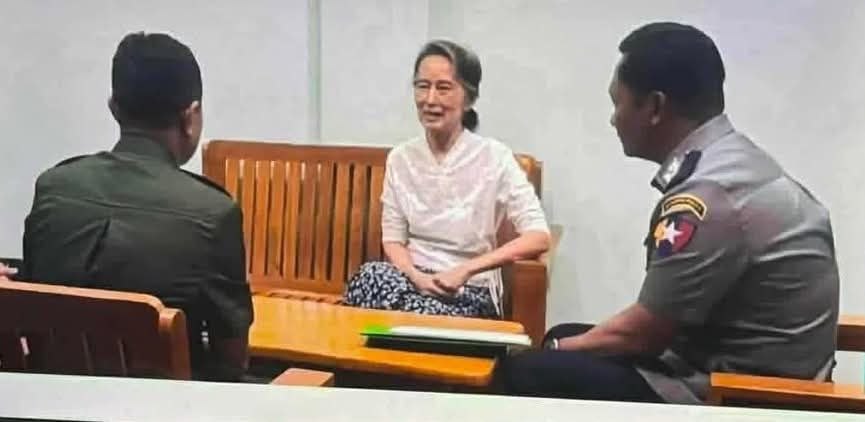
The military has announced that Aung San Suu Kyi will be moved to house arrest at an undisclosed “designated residence”, accompanied by the release of a carefully managed photograph, the first image of her in years.
Yet key questions remain unanswered.
Her location has not been disclosed. There is no independent access to her. Even the image itself has been questioned, with her own son indicating it may have been taken years ago.
This is not transparency. It is controlled visibility.
This recalibration is unfolding alongside regional pressure. Increased engagement between China and ethnic armed organisations along Myanmar’s eastern border, framed around stability, border security, and the protection of economic corridors, has coincided with the junta’s 100-day ultimatum for “peace talks.”
This is not an open invitation. It is a managed timeline. One designed to create the appearance of dialogue without substance.
International response reflects an awareness of this dynamic.
Governments such as Australia and the United Kingdom have acknowledged the release, while avoiding language that would frame it as progress.
Instead they reiterate calls for the release of all political prisoners, including Aung San Suu Kyi.
Even language has become contested terrain.
The European Union and Canada continue to refer to Win Myint as President, reaffirming democratic legitimacy.
The United States uses “former president”. Meanwhile, Australia and the United Kingdom adopt more neutral language, referring simply to Win Myint.
These are not stylistic differences. They reflect competing priorities; asserting legitimacy, preserving flexibility, and managing engagement.
At the core lies a familiar tension in international practice: the distinction between legitimacy and recognition.
Power may be exercised. It does not follow that it is lawful. The result is a carefully managed ambiguity.
This ambiguity now extends beyond diplomacy and increasingly visible in media framing as well.
In the aftermath of the release, some reporting has begun to describe Win Myint as a former president, while referring to Min Aung Hlaing as the country’s current head of state.
This framing mirrors the very narrative the military seeks to establish, that a constitutional transition has taken place.
It has not.
In a context where constitutional order was violently interrupted, language does not merely describe reality.
It shapes perception.
For many, the image of President Win Myint smiling again evokes memories of a political era that feels both distant and unfinished. It creates a sense, however fleeting, that something may be shifting.
But this is precisely where the danger lies. Because hope, when carefully engineered, can also disorient.
It can blur the distinction between symbolic gestures and structural change. It can soften the perception of a regime that continues to detain more than 22,000 political prisoners, restrict information and carry out violence against civilians.
It can also fracture the resistance itself.
In this sense, the release of President Win Myint is not an endpoint. It is the beginning of a new psychological phase.
One in which the struggle is much about perception as it is about power. Yet there is one point that remains beyond ambiguity.
Aung San Suu Kyi remains under strict control, without independent access.
If the Myanmar military can present President Win Myint to the public, it can also provide proof that she is alive and well.
Anything less raises legitimate concern.
And beyond her, more than 22,000 individuals remain behind bars, many young, many unnamed, many unseen, all part of the same unfinished story.
Their continued detention is not mitigated by the release of one man. It makes the contrast unavoidable.
The release of President Win Myint should be acknowledged. It should be welcomed on humanitarian grounds.
But it should not be mistaken for progress. Because the measure of change is not who has been freed. It is who remains.
Mon Zin is a Myanmar-born finance professional and community advocate in Australia focusing on geopolitical and humanitarian developments relating to Myanmar.
DVB publishes a diversity of opinions that does not reflect DVB editorial policy. We’d like to hear what you think about this or any of our stories: [email protected]