-
May 02, 2026
-
Global New Light of Myanmar
-
79
Foreign visitors show keen interest in the history of Buddha images and mural-adorned pagodas, underscoring the need for knowledgeable interpreters, while Myanmar’s unique ancient cultural heritage — widely appreciated yet rare globally — remains both a source of national pride and an important field of study and preservation for future generations.
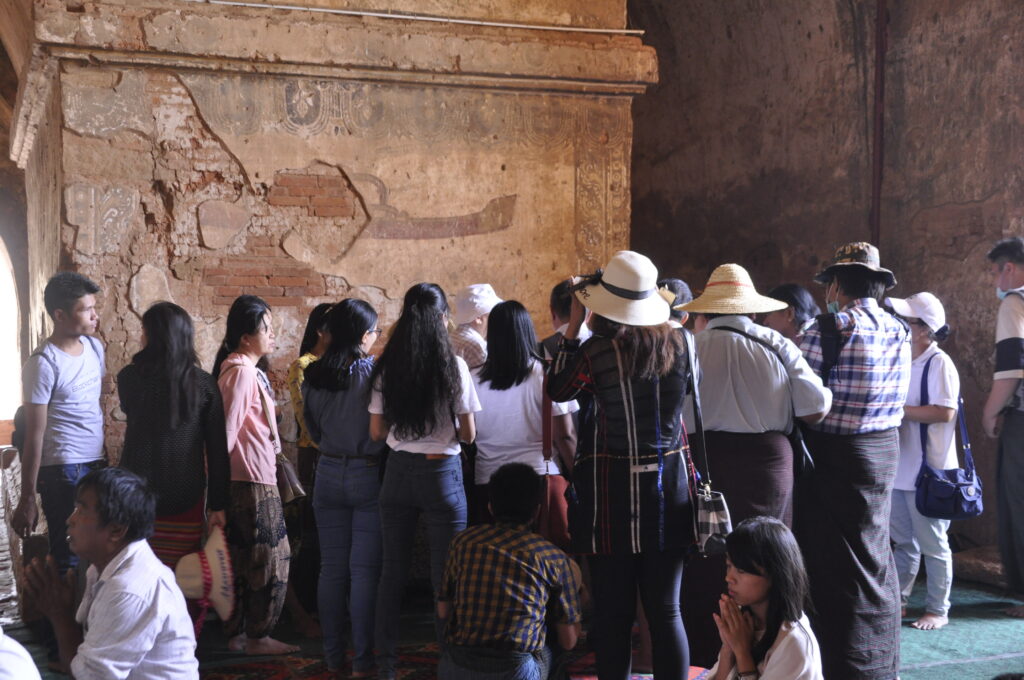
University students and researchers are seen closely studying mural paintings in the pagodas and temples of the Bagan Ancient Cultural Heritage Zone. Photo: Zwe marn
During the reign of the Bagan kings in the 11th century AD, mural paintings were created in pagodas, temples, Buddha images, and caves. Currently, university students and researchers are able to conduct practical studies on mural paintings and ancient works in these pagodas and temples. According to the Directorate of Hotels and Tourism (Bagan Branch), the preservation of Myanmar’s ancient heritage is a source of national pride.
Mural paintings can be found in 416 Bagan pagodas, including Myinkaba Gubyaukgyi Pagoda, Lawkahteikpan, and Thanbula Pagoda.
“In the Bagan region, Buddha images and pagodas with mural paintings are visited by both domestic and foreign tourists, as well as university and private school students. The peak tourist season is in December. University students often come for fieldwork and research papers. In particular, they frequently ask about the differences in painting styles between the early and late Bagan periods, how pigments were produced, how brushes were used, and why painting techniques changed in stupas with mural paintings.
“Foreign visitors are more interested in the history of Buddha images and pagodas with mural paintings. Therefore, there is a special need for interpreters who are knowledgeable in history. Foreign visitors appreciate Myanmar’s ancient cultural heritage, which is not found in many other countries, and it is a source of national pride that it can be studied and researched by local students. In addition, preserving this ancient heritage is also a matter of national pride,” said Assistant Director Daw San San Myint of the Directorate of Hotels and Tourism (Bagan Branch).
During the Bagan era, mural paintings were created on the walls and ceilings of pagodas, temples, and caves. Durable pigments were developed and applied to the walls. Even when the surface layer has faded over time, the underlying paintings can still be seen today. Researchers have also recognized and praised the techniques used to prepare pigments during both the early and late Bagan periods. — Thitsa (MNA)/MKKS