- A new project in Guatemala’s Maya Biosphere Reserve will install bioacoustics devices that can “listen” for illegal activity, using AI models trained to identify chainsaws, gunshots and other sounds associated with environmental crime.
- The project is part of the $100 million AI for Climate and Nature Grand Challenge, run by the Bezos Earth Fund for innovative uses of artificial intelligence for tackling biodiversity loss, climate change and food insecurity.
- The devices will be installed in parts of the reserve threatened by cattle ranching and illegal human settlements, accounting for thousands of hectares of annual forest loss in recent years.
- If successful, bioacoustics technology could be combined with camera traps, drone monitoring, satellite data and human observation to create a more efficient and data-driven conservation strategy, members of the project said.
See All Key Ideas
FLORES, Guatemala — This March, rangers on patrol in the Maya Forest came across the feathers of hunted birds and paths that had been cleared through the trees. These led them to a 2-hectare (5-acre) opening in the forest where squatters likely planned to settle and then expand.
The people who’d cleared the forest were nowhere to be found. The deforestation had occurred around eight days before, the rangers guessed. Even with camera traps and other technology, there’d been almost no way to detect it in real time.
Rapid response has long been a challenge for conservationists in the Maya Biosphere Reserve, which spans 2.2 million hectares (5.3 million acres) across northern Guatemala. The reserve is a patchwork of national parks, logging concessions and biological corridors, some of them under pressure from cattle ranching and illegal logging.
“If we’re going out regularly to a site every two or three months, and something happens a day after the last visit, then two or three months will go by with no information,” said Rony García Anleu, director of biological research at the Guatemala office of the Wildlife Conservation Society (WCS).
A new project in the reserve aims to decrease ranger response times with bioacoustics devices that can “listen” for illegal activity, using AI models trained to identify sounds associated with logging, hunting and other crimes.
It’s part of the $100 million AI for Climate and Nature Grand Challenge, run by the Bezos Earth Fund for innovative uses of artificial intelligence for tackling biodiversity loss, climate change and food insecurity.
The project will also have a second component in the Pantanal wetland with WCS Brazil.
WCS, the Lab of Ornithology at Cornell University in the U.S., Chemnitz University of Technology in Germany, and Brazil’s Federal University of Mato Grosso do Sul submitted the proposal together. The group was one of 15 winners of the challenge, each given as much as $2 million.
“They’re basically giving us ears in the forest to detect and address threats in a much quicker and much more efficient manner,” said Jeremy Radachowsky, WCS director for Mesoamerica and the Caribbean.
WCS has already been using acoustic devices in the Maya Biosphere Reserve for around three years, but that technology is simpler and less effective. The devices collect only a few hours of sound per day, and require a ranger to physically travel to the location of each device — sometimes days away from the nearest station — and bring back the memory cards for review.
Researchers at Cornell are providing much more sophisticated devices, which are scheduled to be tested this year and installed early next year. They include a machine-learning model that can be trained to recognize the sounds of gunshots, chainsaws, engines and other human activity. Small data packages comprising short sound snippets and metadata — including location, date, time and other basic pieces of information — are sent via satellite to an online repository accessible by researchers and rangers.
The model can also learn species sounds. The team plans to include some biological sounds, such as the vocalizations of scarlet macaws (Ara macao), but will focus on environmental crime, several members said.
“You transmit the information so we can look at it and say, ‘Yeah, this was a gunshot. We should go out there and get ready and [look into] that.’ It’s a sensible approach,” said Holger Klinck, director of Cornell University’s K. Lisa Yang Center for Conservation Bioacoustics.
Klinck has built a career around bioacoustics technology, having spent years using underwater drones and other devices to monitor marine mammals in offshore areas where the U.S. Navy was conducting training activities.
Underwater sound travels efficiently and marine mammals tend to “chatter” to communicate, often with distinct and isolated acoustic signatures, Klinck said. In some cases, underwater projects require just one recording device. But terrestrial soundscapes can be much more challenging. In a high-biodiversity forest, there are multiple, overlapping animal sounds occurring at different frequencies, as well as the sounds of wind, chainsaws and engines. Many of those sounds can mask quieter species.
Others are extremely similar to each other, such as branches snapping and gunshots.
A jaguar in the Maya Biosphere Reserve. Image courtesy of WCS
“We’re talking about areas that have some of the highest levels of biodiversity on the planet, so there’s a lot going on,” said Laura Figueroa, a professor of environmental conservation at the University of Massachusetts Amherst in the U.S., who isn’t associated with the project but uses bioacoustics for conservation ecology and entomology.
She added, “You have inadvertent sounds that are produced when organisms fly. You have bats trying to echolocate to find their prey. There’s just so much happening both at big scales and with small invertebrates that are also making sounds.”
To ensure accurate detections, the team will train the AI model before installing the devices. The process involves feeding it recordings of engines, chainsaws, firearms and other sounds so that it can “learn” how to differentiate their subtle acoustic signatures.
The algorithm should be able to handle between 50 and 100 sounds, Klinck said.
If the detection system isn’t accurate enough, it risks losing the trust of conservationists working on the ground. Too many false positives, and rangers will start to ignore alerts or think they’re not worth investigating in the field, he said.
The project can mitigate that risk by involving the rangers more in the verification process, Klinck said. They’ll have the actual audio clip, spectrogram and “confidence score” for decision-making, rather than just a general alert about a certain sound being detected.
A spectrogram is a visual representation of a sound, with time on the x-axis and frequency on the y-axis, with a color code depicting how loud the sound was. The spectrogram of a chainsaw looks entirely different from that of a bird call.
A WCS ranger checking monitoring technology in Laguna del Tigre National Park. Image by Maxwell Radwin
If rangers can listen to the sound themselves and compare the shape of different spectrograms, they should feel more confident in visiting the site of new alerts, Klinck said.
“We want to loop in the people that act on the data,” he said. “We want to include them in the process, actually having them trust in the actions they’re taking.”
The project will be implemented in several national parks and forest concessions around the reserve, some of them under pressure from cattle ranching, logging and illegal human settlements.
The team expects some of the devices to be stolen or damaged by people who notice them in the trees, even if they’re well-hidden. In the past, Klinck said, people have even shot at the devices, not knowing what they are.
Others might be damaged by cattle, which are notoriously curious, or succumb to harsh weather conditions.
But the biggest challenge might still be logistical, several people working on the project told Mongabay.
The devices provide near-real-time monitoring, Klinck stressed — not immediate alerts. Due to power constraints, recordings are only transmitted periodically. Depending on the devices’ configuration, that means minutes, hours or days could go by before rangers receive certain alerts, and longer still for them to travel to the area.
A ranger vehicle stuck in the mud in Laguna del Tigre National Park in January. Image by Maxwell Radwin.
Even if an alert arrives in minutes, some of the devices will be installed in distant parts of the rainforest that can take days to reach, especially during the rainy season, between June and October.
During an initial brainstorming meeting with Cornell team members and WCS in January, two pickup trucks got stuck in the mud and needed to be winched out. One of them also got a flat tire. Quickly reaching the locations of some of the alerts just won’t always be possible, several members of the project said.
“Even if we receive it in real time, we’re not going to arrive in real time, we’re not going to teleport,” García said.
The team is still trying to figure out the best way to use the new bioacoustics information it will be collecting. At the brainstorming meeting in January, members discussed who should receive the alerts, what should trigger a field response, and when it would be safe to carry one out.
One consensus at the meeting was that bioacoustics are more useful with a “data fusion” approach, combining sound-based alerts with data from camera traps, drone monitoring, satellite imagery and human observation.
For the time being, the combination of so much technology will require lots of trial and error, several people involved in the project said. But eventually, they expect a more efficient and data-driven conservation strategy to emerge.
“The future is in data fusion, no doubt about it,” Klinck said. “We need to work together more closely. We need to integrate these data streams and hopefully get the most complete picture of what’s going on in the environment that we can.”
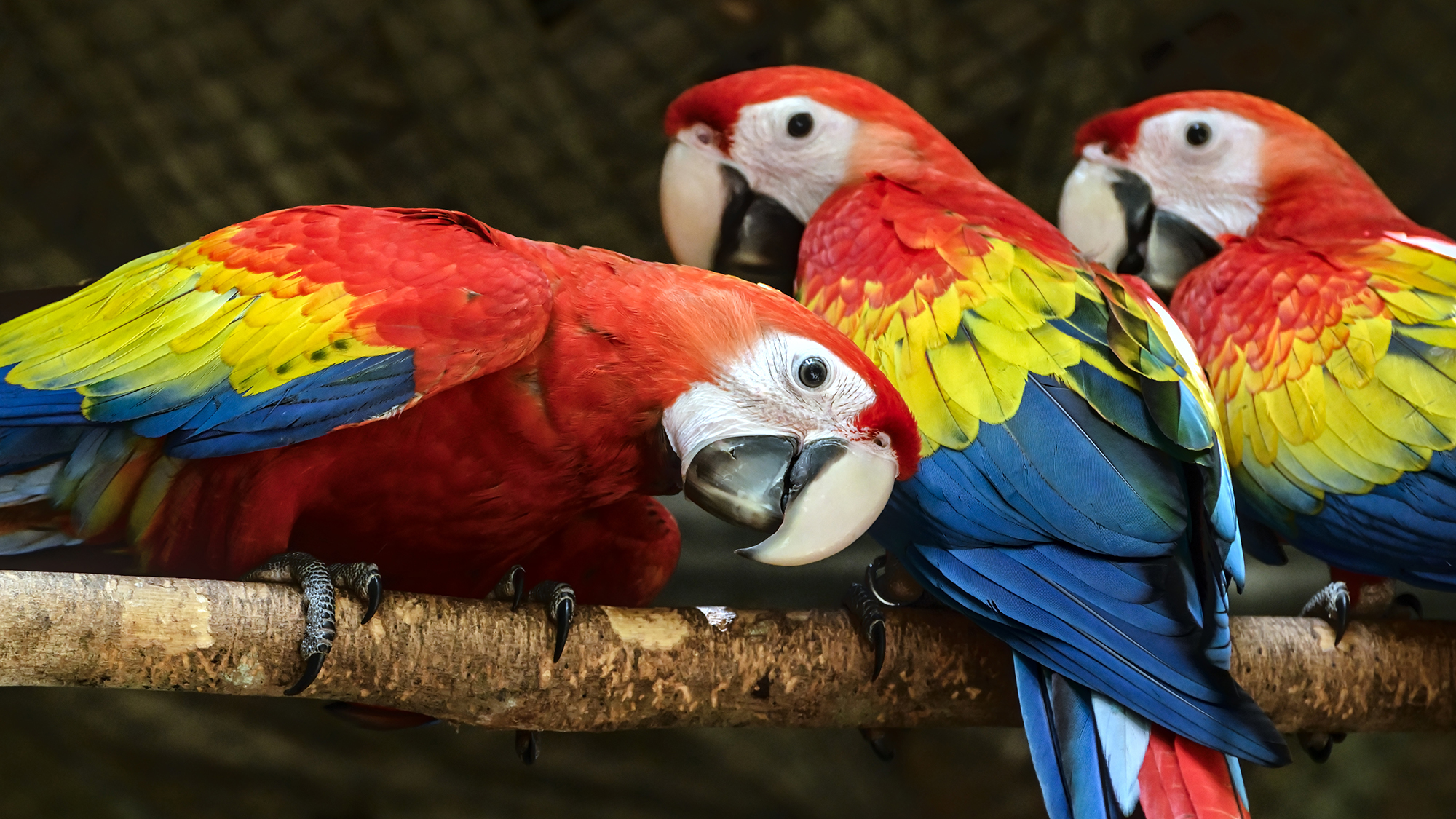
Banner image: Scarlet macaws in Guatemala. Image courtesy of Rony Rodríguez.
See related from this reporter:
Guatemala closes oil field, increases security in Maya Biosphere Reserve
FEEDBACK: Use this form to send a message to the author of this post. If you want to post a public comment, you can do that at the bottom of the page.