Some coral reef ecosystems famously have “cleaning stations,” where fish line up to be cleaned by other species of fish and shrimp. Entomologist Mark Moffet recently published observations of what appears to be a similar relationship in ants.
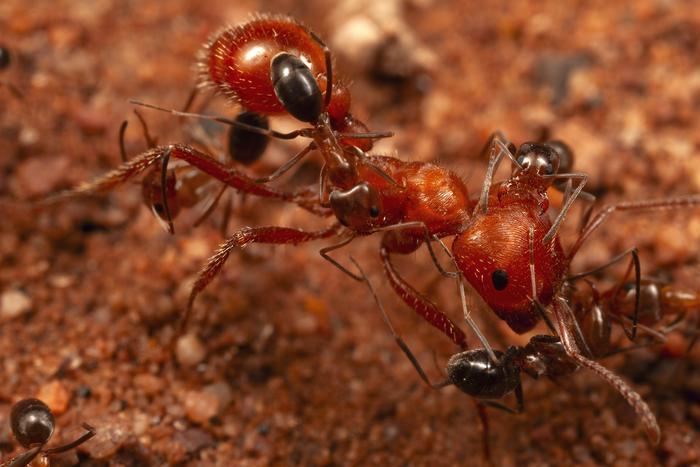
In the Chiricahua Mountains of the U.S. state of Arizona, Moffet, from the National Museum of Natural History, was watching harvester ants (Pogonomyrmex barbatus) collecting seeds when he noticed something odd. He saw several harvester ant workers frozen in place. When he zoomed in with his camera, Moffet saw the harvester ants covered with cone ants (Dorymyrmex spp.).
At first Moffet assumed he was seeing aggression between the species. On closer inspection however, he observed that the small cone ants were licking and nibbling the larger harvester ant workers, not fighting with them. Moffet observed the cone ants inspecting the harvester ants’ open mandibles, which could easily crush the smaller cone ants.
Moffet observed at least 90 individual harvester ant workers being tended this way and concluded that they might be getting cleaned by the cone ants. He even watched harvester ants approach the nests of cone ants and wait for cone ants to attend to them, which reminded him of reef fish lining up for a cleaning by cleaner fish species.
The big question is: What is each species getting out of the arrangement? Moffet consulted colleagues and came up with several possible explanations. Perhaps the ants exchange microbes, which create a healthier microbiome for both species. Or maybe they swap pheromones, to keep harvester ants from attacking cone ants later on. Maybe the cone ants impart an antifungal substance they’re known to produce.
Another possibility is that the cone ants get a free meal. “The Pogonomyrmex are called ‘harvester ants’ because they harvest seeds and store them in underground larders,” Moffet told Mongabay by email. “Seeds are high in calories and a carbohydrate-rich dust from them are likely all over the ant’s body surfaces — an energy rich snack that would be invisible to the eye.”
In return for that snack, the cone ants may be helping the harvester ants stay free from disease by eating seed dust that could potentially contain harmful microbes.
The cleaner ant system might be an example of mutualism — a symbiotic relationship that benefits both species — but this hypothesis needs more research. “I want to go back and take a further look. But proving that this is a mutualism would take quite a bit of time — what we need is an interested PhD student!” Moffet wrote.
Daniel Kronauer, an ant biologist at Rockefeller University in the U.S., who wasn’t involved with the cleaner ant research, told The New York Times that “It’s a pretty unique observation” that could lead to new directions in research.
Banner image: Dorymyrmex ants clean workers of a different ant species. Image by Moffet, 2026 (CC BY 4.0).