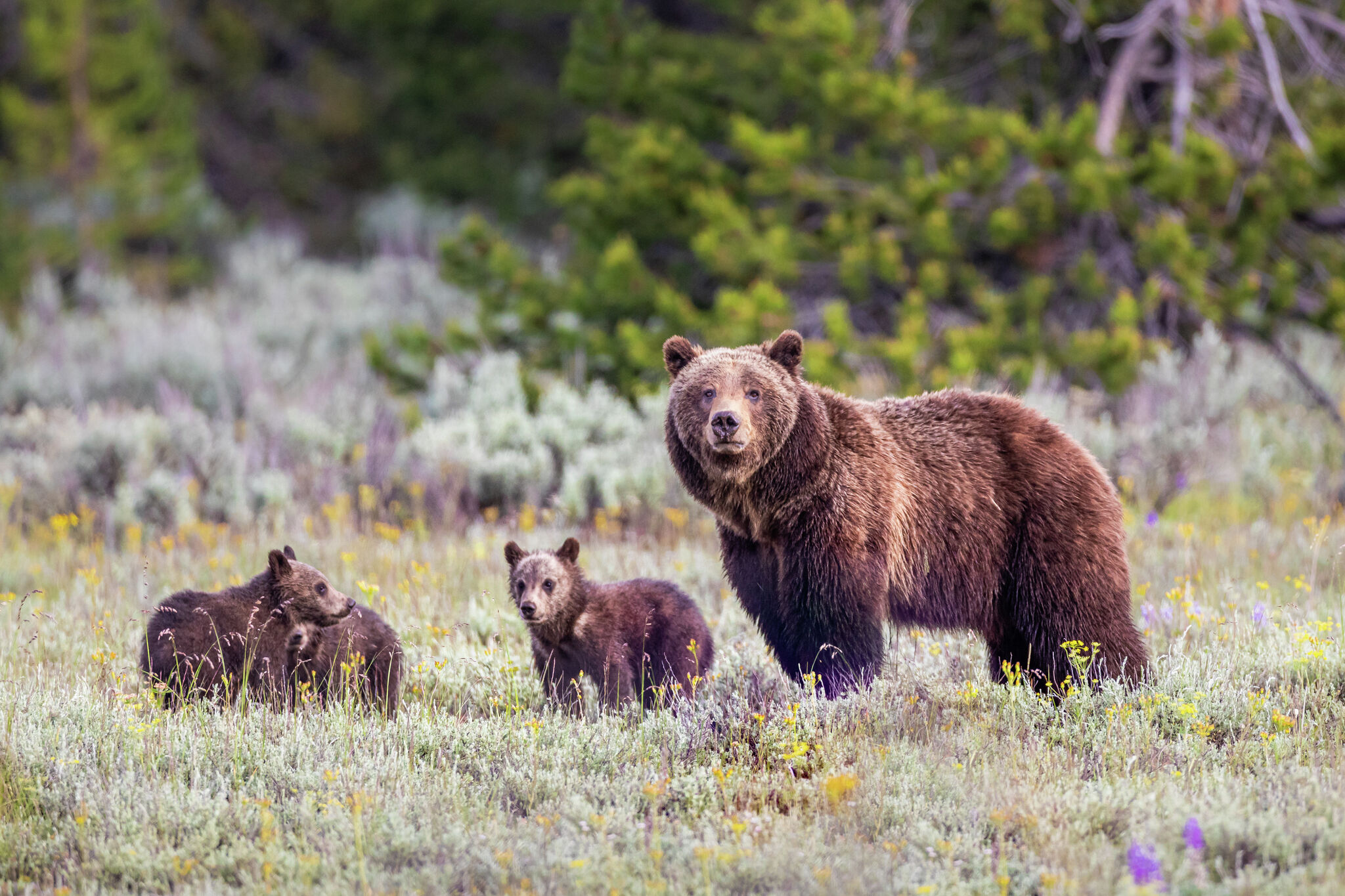
FILE: Grand Teton National Park’s famous bear, Grizzly 399, along with three cubs, in the fields near Pilgrim Creek, Wyo.
Troy Harrison/Getty Images
A bill aimed at crafting a plan to reintroduce grizzly bears to California’s ecosystems is making its way through the Legislature, over a century after the state’s official animal was last seen in the wild.
Senate Bill 1305’s success would be the first step in a yearslong process to potentially bring the bears back to California, requiring the Department of Fish and Wildlife to craft a roadmap and feasibility study related to a grizzly reintroduction effort. The bill was introduced by Democratic state Sen. Laura Richardson of San Pedro in February and is sponsored by the Tejon and Yurok tribes, to whom grizzly bears hold a deep cultural, spiritual and historical significance.
Article continues below this ad
“It’s important for people to realize that the grizzly bear isn’t just a symbol on a flag — it was a real animal that shaped California’s ecosystems and holds deep meaning for Tribal Nations across the state,” Tejon Tribe Chairman Octavio Escobedo III said in an April 2025 news release published by the Center for Biological Diversity.
The release came on the heels of a 200-page feasibility study conducted by researchers at UC Santa Barbara and the University of Washington and published by the California Grizzly Alliance. The study concluded that a recovery program in California could result in a renewed, sustainable grizzly population, though the effort would likely come with a host of political, financial and social challenges.
Those challenges have already started to present themselves: The effort has been met with ample criticism from politicians and California residents, especially the state’s ranchers, who are facing a rise in livestock deaths related to the recent resurgence of gray wolf packs.
“California is already struggling to take care of the apex predators that we have now, and what’s happened with the wolves has woken people up to the fact that we don’t have enough prey for the predators that we have, and we don’t have the staff for CDFW to manage them,” said Rick Roberti, a Sierra Valley rancher and president of the California Cattlemen’s Association. “And wolves are nothing compared to the grizzly.”
Article continues below this ad
He added that ranchers in his area are still contending with wolf-related losses, which skyrocketed since the animals began to cross into the state from Oregon and Washington.
Conservationists, however, contend that most worries related to the possibility of a renewed grizzly population in California are unfounded.
“The fears articulated about bringing grizzlies back, and all the chaos and carnage that they fear will ensue, is completely overblown,” Brendan Cummings, conservation director at the Center for Biological Diversity, told SFGATE. “They’re big and fierce animals, but at the end of the day, they’re mostly vegetarian, minding their own business, looking for food and other things in life. And we’re an annoyance at most, and they’ll do everything in their power to avoid us.”
If a grizzly reintroduction were to take place in California, it would likely be “the most studied and carefully managed and scrutinized species reintroduction ever done in the United States,” Cummings added. A small number of bears would be placed in carefully chosen areas with ample access to food and a low likelihood of encounters with humans or cattle, he said, and each bear would be tagged and tracked using GPS collars.
Article continues below this ad
“It’s a remarkable state with millions of acres of protected habitat,” Cummings said. “There are a lot of people in California, but no one’s proposing to reintroduce grizzlies into Downtown LA.”
While an official feasibility study has not yet been conducted, Cummings said that the California Grizzly Alliance study identified three areas within the state that would likely produce fruitful results for reintroduced grizzlies: the southern Sierra Nevada, roughly from the Sequoia and Kings Canyon area to Yosemite; the remote, coastal ranges of Northern California, near Redwood National and State Parks; and the Sespe Wilderness area of Los Padres National Forest in northern Ventura County. The reintroduced bears would likely be recruited from regions with active grizzly populations, including the Northern Rockies and British Columbia.
The Grizzly Alliance study highlights many questions related to the biological and ecological feasibility of bringing grizzlies back to the state, Cummings said, but political and social concerns related to a reintroduction effort are far from being rectified. In California’s rural 1st State Senate District, Republican Sen. Megan Dahle of Bieber has been vocal in recent weeks about her opposition to SB 1305 and the larger push for a grizzly reintroduction. The study identified the mountains of western Siskiyou County, which lie in Dahle’s district, as a potential area for grizzly reintroduction.
“Over the past decade, legally protected gray wolves have spread all over northeastern California’s mountains and absolutely ravaged ranchers’ herds whenever a pack discovers a taste for calves,” Dahle said in an emailed statement. “Because of endangered species protections, ranchers are unable to do almost anything useful to prevent these attacks. At the same time, new limits on hunting bears and depredation permits for bears and mountain lions leave our rural communities with more predators while making it more difficult for residents to protect their animals and property. Throwing grizzly bears into the mix on top of this is asking far too much of the rural residents who will actually have to live with the consequences.”
Article continues below this ad
At the start of the Gold Rush, California’s grizzly bears numbered around 10,000. Settlers decimated the population over the following decades, and the animals were completely extinct in the state by 1924.
SB 1305 was recently approved by the Natural Resources and Water Committee and is scheduled for a hearing with the Senate Appropriations Committee in May. If the bill makes it through the Senate and is signed by the governor, the Department of Fish and Wildlife would be required to present a roadmap for potential grizzly reintroduction by 2030, Cummings said.
“Hopefully, the roadmap would answer all these questions and show us that we can and should work together to bring our state animal back to the state and turn the California flag, rather than a memorial to the grizzly bear, into a symbol of recovery and restoration,” Cummings said.
Article continues below this ad