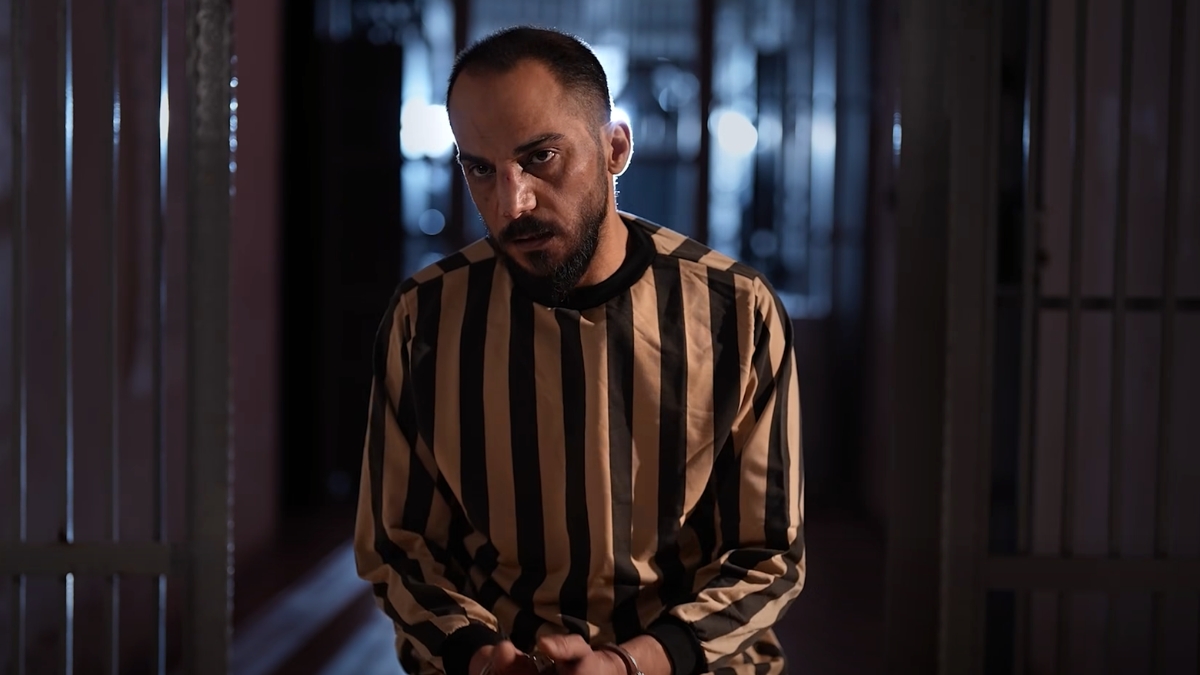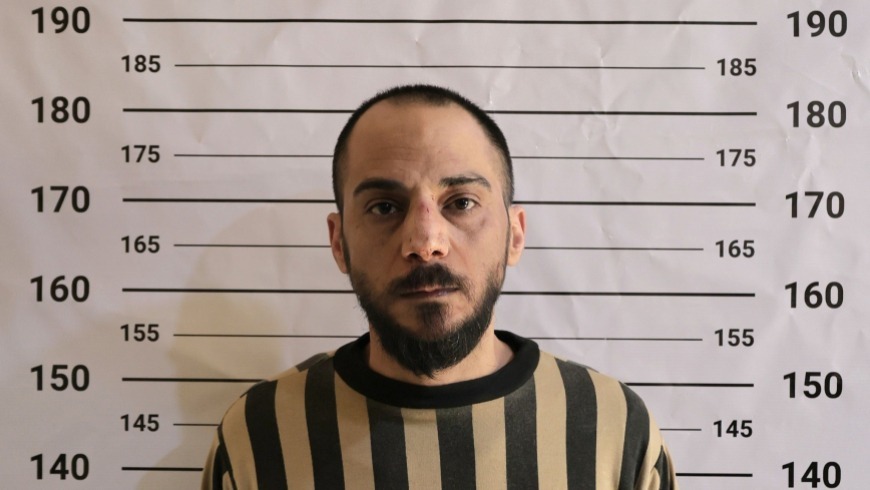
Newly released recorded confessions from Syria’s Ministry of Interior have revived public attention to the Tadamon massacre in Damascus, coming just two days after the arrest of Amjad Youssef — a former warrant officer in Branch 227 and the main suspect in one of the most chilling mass executions documented during the war.
In the footage, Youssef admits to participating in the killing of roughly 40 people who, he claims, were brought to the execution site on accusations of supporting “terrorism.” He insists he acted without orders from superiors and carried out the killings on his own initiative. But that claim raises more questions than it answers, especially given documents and allegations pointing to the involvement of higher-ranking officers who oversaw the Tadamon sector and the men operating within it.
Born in 1986 in the village of Nabaa al-Tayeb in the al-Ghab Plain of Hama province, Youssef says the executions were carried out alongside a man identified as Najib al-Halabi, a member of the National Defence Forces militia. According to his account, the victims were led to a pit dug in advance with an excavator. Some were shot before being thrown in; others were shot after falling into the pit.
He adds that the bodies were later burned using rubber tires to obscure their identities and suppress the smell of decomposition. The remains, he says, were buried by al-Halabi two days later. Youssef also claims the killings were filmed by another man at the scene, whose name he says he does not know.
The massacre took place on April 16, 2013, when civilians were reportedly detained, blindfolded, bound, and taken to a pit in the Tadamon neighborhood of southern Damascus, where they were summarily executed. A video of the killings — published by The Guardian in a 2022 investigation — became one of the most disturbing pieces of evidence of the violence carried out by elements of the former regime against civilians.
According to the Ministry of Interior, Youssef was arrested in a security operation in rural Hama. Brigadier General Mulham al-Shantout, head of internal security in the province, said the operation followed extensive planning, including aerial surveillance and the deployment of multiple checkpoints to ensure the arrest could be made without complications. Security forces raided Youssef’s home and found him in his bedroom, where he was detained without resistance and transferred to the relevant authorities for questioning.
Other security sources say the operation followed roughly two weeks of surveillance, during which Youssef’s movements and contacts with his family were closely monitored. They add that he avoided appearing publicly in his village and that only a small circle of trusted individuals knew where he was hiding. According to those sources, several other suspected perpetrators — including officers — were also arrested during a raid on a house in Nabaa al-Tayeb.
In a related development, Syrian authorities detained several of Youssef’s relatives, including his father, along with others suspected of helping conceal him while he was in hiding.
Washington welcomes the arrest
Youssef’s arrest drew a notable reaction from Washington. Thomas Barrack, the U.S. envoy to Syria, welcomed the news, describing Youssef — whom he called the “butcher of Tadamon” — as a symbol of impunity. He said the arrest marked a significant step toward accountability and part of what he described as a “new model of justice” emerging in post-Assad Syria, one grounded in the rule of law, national reconciliation, and equal justice regardless of past affiliations.
Yet Youssef’s attempt to portray the massacre as the result of an individual decision sits uneasily beside broader allegations about the structure of Branch 227 and the chain of command that operated in Tadamon and al-Zahira. Materials attributed to military documents identify Colonel Jamal Adel Ismail — an officer in the same branch — as Youssef’s direct superior and the field commander responsible for the sector.
Those documents suggest Ismail’s role extended far beyond routine administration. He is described as the officer who supervised the men involved in killings and torture and as someone who provided cover for abuses. In 2013, when Youssef was reportedly caught violently assaulting a conscript, Ismail — then a major — allegedly intervened to defend him before an investigative committee, despite the head of Military Intelligence reportedly describing the men’s conduct as that of “monsters.”
The same materials link Ismail to a broader pattern of violations, including kidnappings, executions, looting, and the operation of secret detention sites in homes across the Tadamon area. They also reference a 2022 audio leak attributed to him, in which he allegedly justified killing civilians in the street on the grounds that it was cheaper than imprisoning and feeding them.
A Confession Short of the Truth
These allegations give the Youssef case a significance that extends well beyond the prosecution of a direct perpetrator. His confession, grim as it is, cannot by itself explain how a civilian neighborhood became a site of execution, burning, and enforced disappearance. The larger question concerns the command structure that enabled the crime — the explicit or implicit orders that turned killing into field practice, and the security apparatus that rewarded officers accused of grave abuses with promotions and medals rather than holding them accountable.
The new Syrian authorities are presenting Youssef’s arrest as a milestone on the path toward transitional justice. The real test, however, lies in what comes next: the transparency of the investigation, the identification of all those involved, the protection of witnesses and victims’ families, and the ability to connect individual criminal responsibility to the broader issue of institutional accountability.
For many Syrians, the Tadamon massacre was never the crime of one man. It was a distilled image of an entire machinery of violence. If the new state hopes to turn this moment into the beginning of genuine justice, bringing the so-called butcher of Tadamon before the courts will not be enough. The full truth must be pursued — from the man who pulled the trigger to the officer who commanded the sector, from the branch that enabled the crime to the system that made brutality part of its daily vocabulary.
A confession is not justice
Some Syrian critics fear that Amjad Youssef’s arrest and filmed confession may be used to project an image of accountability while leaving the wider machinery of Assad-era crimes largely untouched.
In a sharply worded Facebook post titled A Confession Is Not Justice, Suad Khibiyeh argued that the arrest of the former intelligence officer accused of carrying out the Tadamon massacre, though significant, cannot substitute for a serious transitional justice strategy. She warned against reducing justice to a symbolic scene: one perpetrator, one video, one confession, while the chain of command and the senior architects of Syria’s crimes remain beyond reach.
Khibiyeh said Youssef should not be treated as an isolated criminal, noting that he operated within an intelligence branch, under a security hierarchy, and in a system where killing, torture, disappearance, and humiliation were tools of rule. The central question, she argued, is why Syria’s transitional authorities have not yet built a coherent legal framework to pursue Bashar al-Assad, senior intelligence officials, and top military commanders.
She said the authorities could have created a special war crimes prosecutor’s office and a national court for international crimes, issued domestic arrest warrants, sought Interpol red notices, and submitted formal extradition requests to countries hosting suspects. Internationally, she argued, Syria could have accepted the jurisdiction of the International Criminal Court retroactively, pursued a special tribunal or hybrid court for Syria, and supported universal jurisdiction cases in Europe through judicial cooperation and the sharing of evidence.
Khibiyeh dismissed the argument that justice is impossible because Russia is unlikely to hand over Assad, saying accountability begins with indictments, warrants, evidence, and sustained legal pressure, not with the immediate surrender of suspects.
For her, the Tadamon case is a test. It can either mark the beginning of a serious architecture of accountability, or remain a spectacle that suggests justice is moving forward while the most powerful perpetrators remain untouched. The victims, she wrote, do not need another performance; they need a state willing to move beyond confessions, name the chain of command, indict the architects, and confront the system that produced the crimes.
This article was translated and edited by The Syrian Observer. The Syrian Observer has not verified the content of this story. Responsibility for the information and views set out in this article lies entirely with the author.