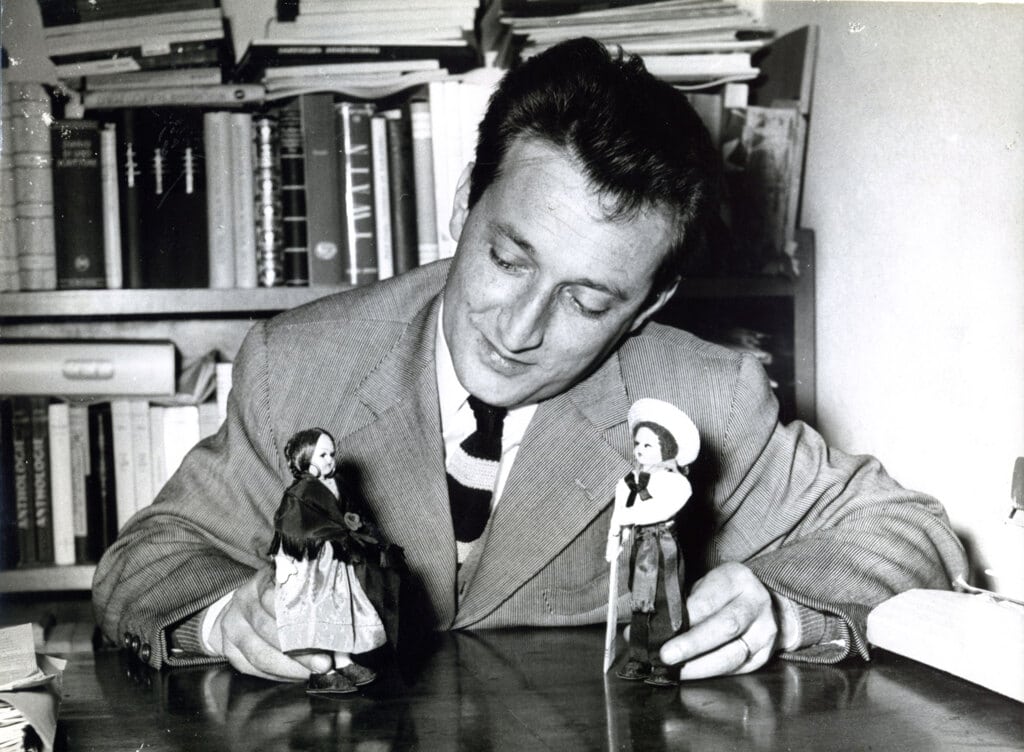
The creator of beloved vegetable rebel Cipollino, Gianni Rodari, winner of children’s literature’s highest honour, passed away on 14 April 1980.
Forty-five years ago, Italy lost the writer widely regarded as the greatest children’s author the country has ever produced. Gianni Rodari died in Rome on 14 April 1980, having been hospitalised on 10 April to undergo surgery on his left leg following an occlusion of a vein. He died four days later.
He was 59. Behind him lay a body of work that had been translated into dozens of languages, a Hans Christian Andersen Medal — the Nobel Prize of children’s literature — and a cast of vegetable characters beloved by generations of Italian children.
From Lake Orta to the classroom
Rodari was born on 23 October 1920 in Omegna, a small town on Lake Orta in the province of Verbano-Cusio-Ossola in northern Italy. His father, a baker, died when Rodari was only eight. He and his two brothers, Cesare and Mario, were subsequently raised by their mother in her native village in the province of Varese.
After three years at the seminary in Seveso, Rodari received his teacher’s diploma at the age of seventeen and began to teach elementary classes in rural schools around the Varese district.
War, trauma and a political awakening
The Second World War brought upheaval. Rodari was deferred from military service due to ill health, but his precarious financial situation led him to apply for work at the Casa del Fascio, where he was forced to join the National Fascist Party.
The experience left its mark but it was personal grief that proved the more decisive catalyst. Traumatised by the loss of his two best friends and his favourite brother Cesare’s incarceration in a German concentration camp, Rodari joined the Italian Communist Party in 1944 and participated in the Italian resistance movement.
He began writing for children in 1948 while working as a journalist for the Communist newspaper L’Unità. In 1950, the Party installed him as editor of the new weekly children’s magazine Il Pioniere in Rome.
The birth of Cipollino
In 1951, Rodari published his first two books: Il Libro delle Filastrocche and Il Romanzo di Cipollino. The latter introduced the character that would make him famous across Italy and far beyond.
Cipollino — Little Onion — is no passive hero. He fights the unjust treatment of his fellow vegetable townspeople by the fruit royalty: Prince Lemon, the overly proud Tomato, and their ilk. The themes are unmistakably political: the struggle of ordinary people against powerful rulers, the value of solidarity, and the sustaining force of friendship in the face of adversity. Yet Rodari never preached. The stories charmed as much as they challenged.
The tale proved popular enough for a ballet to be staged in the Soviet Union in 1973, composed by Karen Khachaturian.
International recognition
In 1970, Rodari received the Hans Christian Andersen Medal — the highest recognition available to a writer or illustrator of children’s books — gaining him a wide international reputation as the best modern children’s writer in Italian.
His notes from a series of school meetings with teachers, librarians, parents and students were collected in The Grammar of Fantasy (1973), which became an immediate reference point for those working in reading education and children’s literature.
A life cut short
In 1953, Rodari had married Maria Teresa Feretti, who four years later gave birth to their daughter, Paola. He began travelling to the Soviet Union regularly from 1952 onwards.
In 1979, after another trip to the Soviet Union, his health declined and his productivity diminished. He did not recover, dying in Rome the following spring.
He was buried in the city he had made his home, leaving behind a body of work that Italian children still encounter in classrooms and living rooms today. The Little Onion, armed with wit and solidarity, can still outlast any prince.