Cannon Street has become a joy — it’s just not for us. It’s mostly for them.
Once the heart of the city’s black business community, Cannon has been transformed into a tourist’s dream of how to live like a Charlestonian, if only for a few days. It’s a case study in the power of the city’s exacting preservation regulations on one hand and the destructive costs of the Airbnb economy on the other.
In a city where residents are starving for housing, investors can’t build swank accommodations fast enough for visitors from Off — 7.8 million last year and ever increasing. Where not so long ago developers might have renovated houses or built apartments for sale or for long-term rentals, they have remade Cannon, financed by a fire hose of cash flows from short-term rentals. Spring Street isn’t far behind.
Steve Bailey
Grace Beahm Alford gbeahm@postandcourier.com
“The real estate values in Charleston now really don’t support long-term rentals at a small scale,” Steve Ramos, an exceptional local architect and a partner in The Charlee, a gorgeous new vacation apartment building and adjacent townhouses on Cannon, told the Post and Courier’s Teri Errico Griffis.
Cannon and Spring are Exhibits A and B.
The Cannonborough/Eliottborough neighborhood is uniquely zoned on the peninsula to allow commercial short-term rentals rather than owner-occupied properties. Values have exploded. That’s what happens when an apartment that might rent for $2,000 or $3,000 a month can suddenly fetch $500 a day or more. The economics of short-term rentals are simply overwhelming.
The result: Cannon and Spring look great, never better. But beautiful buildings do not make a neighborhood — long-term residents do, people who know one another, neighbors who call the place home. They are fast being replaced by a constant churn of visitors who check in on a Thursday and check out on a Sunday.
The 19th century homes on crape-myrtle-lined streets have undergone top-of-the-line restorations and are being marketed with names like Historic Smalls Alley, Casa Zoe or the Palm Club. Other dilapidated homes are under renovation — getting ready to join the party.
The Charlee, a new vacation apartment building, is only one of many projects helped by the unique zoning for Elliottborough and Cannonborough neighborhoods.
Robert Behre/Staff
Now come The Charlee and the Cannon Exchange Building, three-story brick bookends on Cannon that fit seamlessly into the texture of downtown Charleston. In July, a four-bed unit at The Charlee will cost you about $750 a night. Make that $1,300 a night at the five-bed Cannon Exchange Building. Such is the price of admission these days for deluxe Cannon Street.
Everywhere you look Preservation Society of Charleston plaques tell the stories of the European immigrants and African American cops, brick masons and tailors who once lived there. The society’s prestigious Carolopolis markers are outnumbered only by those for Stay Duvet, the short-term rental company.
Except for the buildings, though, the past is long past. You see bridal parties leaving and (immigrant) cleaning crews moving in behind them.
Cannon and Spring were once home to generations of black businesses such as the Hotel James, Robinson’s Luncheonette and the Blue Willow Tea Room. But integration gave black people choices, and gentrification wiped out most of them. Dorothy’s Home for Funerals remains on Cannon and the Tiny Tassel, an excellent boutique run by Mimi Striplin and her mom, Keiko, on Spring. Highly recommended.
My favorite touch: the sign over Spring Street designating this the “Dr. Martin Luther King Jr. Memorial District.” Erecting historical markers to celebrate black people after the black people are mostly gone is a Charleston tradition.
What makes Charleston so attractive to us and to them is it’s a living city, not a museum like St. Augustine. The locals aren’t yet completely extinct on Cannon and Spring, particularly along the narrow side streets such as Sires and Felix. Look carefully, and you can even find a few units of public housing on Cannon.
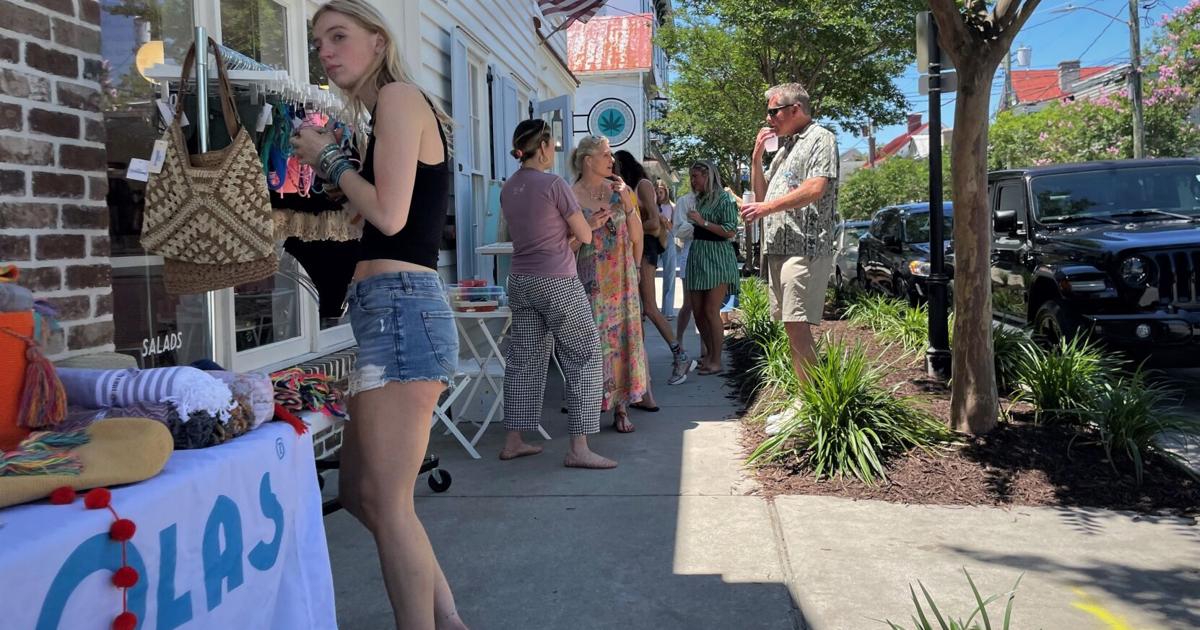
If we locals can’t afford to live there, we can still enjoy the shops and great singular restaurants such as Kultura, Malagon and Southbound. The Veggie Bin is as friendly as ever, and you can still get a cold keg at Charlie’s on Spring, a good thing. Banners remind our out-of-town guests to “Shop & Dine Local.”
In another time, in another place, the end of rent control might have raised rents but also sparked an investment boom that improved the quality and availability of housing for local residents. Today, in a tourist town like Charleston, we don’t have rent control, but deregulating the housing market to allow short-term rentals — or its second cousin, the furnished 30-day rental, a widely exploited loophole around the peninsula — also improves the housing stock. For visitors, not locals.
Short-term rentals aren’t going away. Too many people are making too much money. But what the Airbnb economy giveth, it also taketh away. Here in our special yet fragile hometown, in particular, we are not better for it.
Steve Bailey is a regular contributor to The Post and Courier Opinion section. He can be reached at sjbailey1060@yahoo.com.