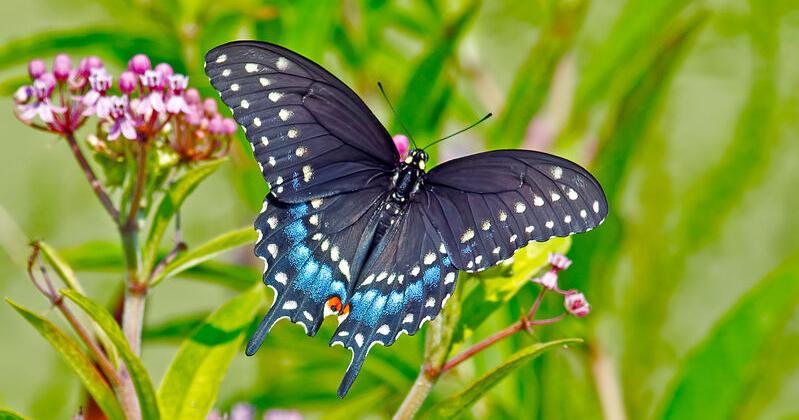
The time of year is here for butterflies to start preparing for the fall migration.
Pollinator plants — ranging from orange lantana to passion flower, coneflower to tickseed and milkweed — are all food sources for butterflies this time of year as they forage, searching for nature’s good nectar to help build them up physically before wintertime.
Butterflies go through four stages in their lifecycle
Stage 4 of the life cycle is when butterflies emerge from a chrysalis with wet wings that need to be dried so they can prepare for flight.
Glen Payne/Provided
-
Stage 1 is the female laying tiny round eggs on host-specific plants that will become food for the next phase after about three weeks.
-
Stage 2 is the caterpillar stage, known scientifically as the larva. A tiny caterpillar’s main job is to eat, growing to 100 times larger than its original size. During this growth phase, it molts three to four times, shedding its outer layers, repairing its body, becoming larger and making wings.
-
Stage 3 is when the butterfly enters the chrysalis stage, attaching to twigs or branches so that it can completely reorganize itself inside of the hard encasement. The butterfly chrysalis will form new legs, an abdomen and a completely new wing formation as the reorganization comes full-circle. This stage can take months to complete for certain species of butterflies.
-
Stage 4 is the adult stage when butterflies emerge with wet wings that need to be dried to stiffen and prepare for flight. Adult butterflies search for nectar to drink from host plants, mate, lay eggs and start the entire cycle over again. The life expectancy for most adult butterflies is a few weeks with some species being able to live for several months.
Swallowtails
Swallowtail butterflies are found on every continent except Antarctica and have 550 species in their family. They are some of the largest butterflies size-wise found in the United States.
Spicebush swallowtails are unique in that once they reach the adult stage, unlike other butterflies, they fly low to the ground and continue to flutter their wings rather than pin them back in the upright position or lay them flat out and stop moving them about.
And, of course, they can be found feasting on their favorite plant of spicebush. Sassafras tree leaves, typically found along the edge of wood lines growing as understory trees with unique ghost-shaped leaves, are another favorite food of the swallowtails.
As a defense mechanism, giant swallowtails have an organ gland like daddy longlegs and millipedes that appears as an inverted forked tongue that can be inverted or extended to produce a butter-scented odor to keep foraging predators such as ants away while in their second stage.
The flight patterns of swallowtail butterflies include powerful wing-flapping followed by graceful breeze-gliding. They have been observed displaying a bouncing or hopping pattern, moving from flower to flower in search of nutrition. Fluttering of their wings is often suspended for a fraction of a second when sipping nectar from some of their favorite plants — which include parsley, dill and sweet citrus flowers.
Fritillaries
Gulf fritillaries can be found feasting on orange lantana.
Glen Payne/Provided
In addition, fritillary butterflies — typically orange and black resembling monarch butterflies — may be observed in the cooler fall temperatures feasting on orange and yellow lantana, as well as yellow and white tickseed flowers.
The name fritillary was derived from the checkerboard appearance of colors on their wings. Gulf fritillaries arrive in the Lowcountry in May and can be found fluttering by looking for passionflowers to feast upon along the Southeast coast.
So take a break, stand up from your chair, stretch and walk out into nature. When you catch some wings fluttering, you’ll know more about these extraordinary creatures in your garden.
“We are like butterflies who flutter for a day and think it is forever” — Carl Sagan, “Cosmos.”