Source: Split second from tragedy: 40 000-litre petrol tanker spills fear on the highway – herald
Sikhumbuzo Moyo, s.moyo@chronicle.co.zw
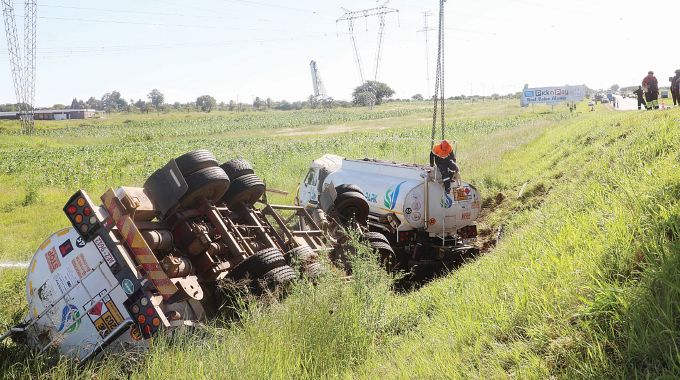
A swift, co-ordinated response by Bulawayo’s emergency teams spared motorists and nearby communities from what could have spiralled into catastrophe yesterday, after a fuel tanker carrying 40 000 litres of petrol overturned at the 428km peg along the Harare-Bulawayo Highway, turning a routine stretch of tarmac into a nerve tightening scene of danger and urgency.
The tanker, travelling from Harare to Bulawayo, left the roadway after the driver tried to avoid a head on collision with an overtaking truck – a split second decision that ended with tonnes of steel on its side and highly flammable fuel threatening to spill into the open air. The driver, 42 year old Ephraim Banda of Norton, escaped with minor injuries and was pulled from the wreckage before being rushed to United Bulawayo Hospitals (UBH) for treatment, as the highway’s usual roar of engines gave way to sirens, shouted instructions and the uneasy hush that follows a near miss with disaster.
Bulawayo Chief Fire Officer Mr Mhlangano Moyo said emergency crews moved with speed and precision, sealing off the danger, containing leaking fuel and shutting down the conditions that could have sparked an inferno.
“After securing life, we managed to close the leaking fuel and mobilised other stakeholders, including EMA, Zera, ZETDC, the Zimbabwe Republic Police, and the Ministry of Local Government and Public Works, which oversees the Civil Protection Unit,” said Mr Moyo.
What followed was a carefully choreographed rescue operation where every action mattered: cranes were brought in to help upright the overturned tanker, while fuel was decanted under strict control to reduce the volatile load.
Firefighters, never letting the risk drift from view, continuously doused the vehicle with foam liquid — a protective blanket against the smallest spark — as the air carried the sharp, unmistakable bite of petrol and the highway itself felt like a match waiting for friction.
Mr Moyo stressed that moments like these are sobering reminders of how fragile safety can be on busy roads, especially where heavy duty vehicles carry dangerous cargo. He said strict compliance with road regulations for fuel tankers is essential, and that well trained, well equipped responders remain the thin line between a frightening incident and a full blown tragedy.
Director for Bulawayo Metropolitan and chairperson of the local Civil Protection Committee, Mrs Tsvagai Fikile Marovatsanga, said the operation moved beyond the crash scene and into the surrounding community almost immediately, with residents being alerted to the threat and urged to keep their distance.
“We called a man named Enoch, who is in charge of this area, to alert the residents to stay safe,” she said.
Residents at the scene described the moment the tanker went over as one that jolted them into panic — the kind of fear that arrives without warning and lingers long after the noise fades. Mr Hloniphani Nkomo said the driver had earlier parked on the opposite side of the railway flyover but was cautioned that the spot was risky.
“He started moving slowly when suddenly the vehicle veered off the road and overturned,” he said.
Another eyewitness, Mr George Ncube, recalled a powerful smell of petrol that seemed to hang in the air from far beyond the crash site, stirring dread of an explosion and a chain reaction that could have swallowed everything nearby.
“I just prayed that nothing would ignite. Within minutes, two fire tenders and an ambulance arrived,” he said.
Bulawayo provincial police spokesperson Inspector Nomalanga Msebele confirmed that the driver lost control on the embankment and the tanker landed on its right side, a position that can turn a single vehicle accident into an emergency measured in seconds, not minutes.
The Harare-Bulawayo highway remains a vital artery linking the capital with the second largest city, a fast moving corridor used heavily by passenger buses, commercial trucks and fuel tankers — a road where speed, fatigue and impatience can collide as easily as metal on metal, and where a single mistake can ripple across lanes, lives and livelihoods.
Fuel tanker accidents are particularly perilous because the cargo is not merely heavy, but volatile — the kind of danger that can leap from spillage to flame in an instant, threatening chain reaction collisions, fires and explosions, and leaving communities counting their luck when swift action and calm professionalism keep the worst from happening.