Almost 300 flood rescues in 24 hours, NSW emergency services minister says
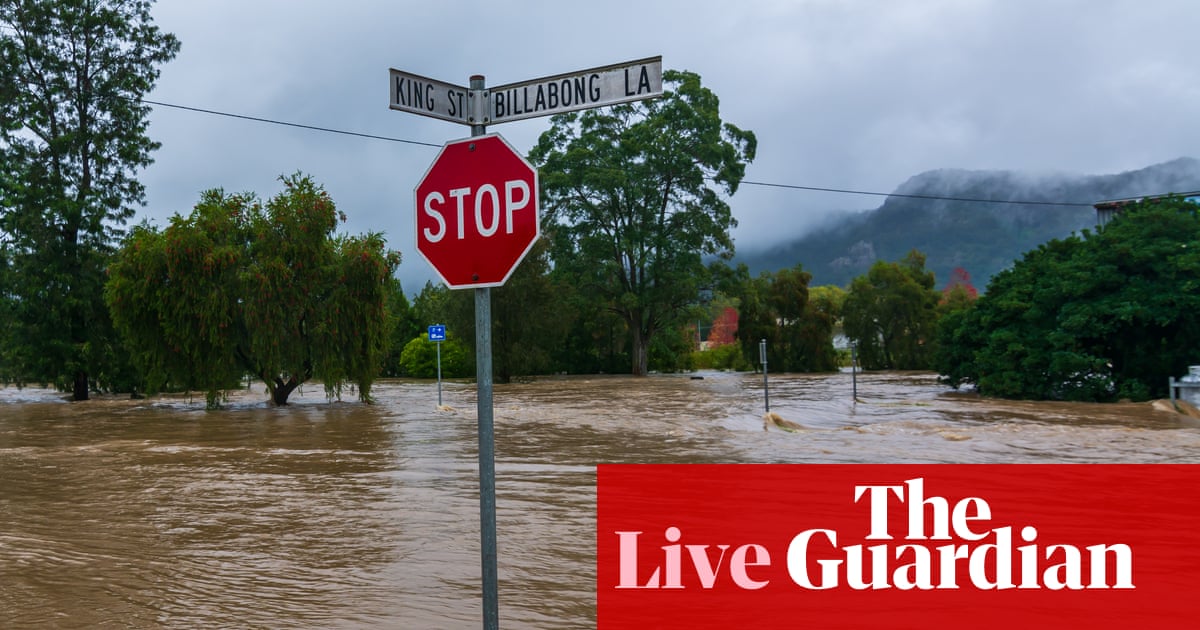
There have been 284 flood rescues amid wet conditions pummelling the NSW Hunter and mid-north coast regions in the last 24 hours, the emergency services minister, Jihad Dib says.
Since midnight, there have been 150 rescues.
Dib is speaking live:
We have seen an enormous amount of rainfall over the Hunter and mid north coast area.
Falls have reached up to 280mm in some areas. Conditions are expected to persist into the rest of the day, with 150 to 200mm of rainfall predicted in the mid-north coast. Rain is also moving further north, affecting southern parts of Coffs Harbour.
More than 1,600 SES volunteers are on the ground, with 20 multiagency flood rescue teams.
What we’re seeing is a clear example of throwing every single thing we have at this event.
Share
Updated at 23.38 EDT
Key events
Show key events only
Please turn on JavaScript to use this feature
Josh Taylor
Less than a year after hiking its prices, Telstra has announced it will again raise prices for mobile and internet plans, with most rising between $3 and $5 per month.
The prices will affect most plans, Telstra said on Tuesday, except the lowest priced ($50) starter mobile and starter NBN ($65) plans from 1 July. Prepaid pricing, as well as home phone, satellite and 5G home internet prices would remain the same.
Telstra said it was making this change “to help us invest more to improve our network performance and experience” with $800m allocated for mobile network investment in the next four years.
Some of the higher tier internet plans are reducing in cost, with the 1Gbps NBN plan dropping from $150 per month to $139, and the 100Mbps small business plan dropping from $140 to $125.
Last year Telstra announced it would move away from its annual pricing review linked to CPI, and this is the second price increase in a year on most plans since that announcement.
Communications consumer body ACCAN has said the price increases come as Australians are facing cost-of-living pressures, and connectivity is not a luxury but a requirement for work, education, healthcare and safety.
Chief executive Carol Bennett said:
The fact is that these price increases are approaching 10% on some plans. This is a real additional cost on households, and many will feel the difference.
ShareLuca Ittimani
Labor’s national secretary: governments must convince voters of the value of reform
Jumping back to Labor’s campaign boss at the National Press Club, Paul Erickson says the Albanese government will have to work to engage voters if it pursues further reform in its second term.
Erickson, Labor’s national secretary, told reporters Labor had found voters were looking to their political leaders for solutions and progress.
They’re looking for a plan to make them better off, and they’re looking for a plan that takes the country in the direction that we need to go in. I hate to break it to you, but I haven’t seen too many detailed discussions of productivity in a focus group. But that does not take away from the importance of the task.
On top of election commitments to Medicare, housing construction and free Tafe, the government has sought recommendations on future economic reforms and faced calls to go beyond its existing promises.
Erickson told the National Press Club the government would be ready to take on reform, given it had tailored its election efforts around offering voters progress.
Our strategy was to have the best answer on who could make you better off over the next three years and drive the campaign towards that question …
About reform, you just have to bring people with you. You have to make the case for why it’s important, for what the benefits will be, and that’s something I think that has been a hallmark of the government.
Share
Updated at 00.23 EDT
Benita Kolovos
Victoria public sector operating costs represent more than a third of government spend
Treasurer Jaclyn Symes says public sector operating costs are one of the “driving issues” for the budget, representing more than a third of the government’s expenditure.
She admits previous attempts to cut the public sector have failed, which is why there’s now a formal review.
[Top bureaucrat Helen Silver’s] been doing a lot of hard work in identifying a range of areas that government could look to consolidate. She’s looking at duplication. She’s looking at entity reform. This isn’t about just becoming smaller. It’s about becoming better. It’s about making sure that we are focused on the main priorities of Victorians.
Symes suggests family violence and mental health programs might be on the chopping block. She says:
What we tend to do as a government, and what I’ve experienced, is we do really good things. We have new initiatives to respond to community needs … obvious examples of that is responding to family violence and mental health. We have had royal commissions into both. So we’ve directed so much investment into areas that matter, while not necessarily making the decisions to stop others. And that’s not to say that some of those smaller programs, and some of those programs have been around for a long time aren’t good, they’re probably not as good as some of the others that we later invested in.
Share
Updated at 00.19 EDT
Benita Kolovos
Victoria treasurer defends cutting funds for ‘nice to have’ initiatives in favour of frontline services
The Victorian treasurer, Jaclyn Symes, is speaking at the annual post-budget lunch hosted by the Melbourne Press Club and Victorian Chamber of Commerce.
Regarding her plans to cut the public sector, Symes says the many initiatives the government funds are “nice to haves” but they have “diluted our focus”. She goes on:
That’s why I am focused on restructuring the public service so we can focus on and deliver the frontline services and essential services that Victorians need, like healthcare, education and child protection. This is why I’ve commissioned an independent review of Victoria’s public service, led by Helen Silver, to ensure spending is aligned with the needs and priorities of Victorians. This is also about ensuring that the public sector is delivering excellence. It’s not about letting go of numbers of people. It’s about making sure that the people that we have … they’re not distracted by the busy work.
Share
Updated at 00.04 EDT
NSW’s Manning River at Taree experiences record flooding as waters continue to rise
Unprecedented flooding has inundated the Manning River at Taree, surpassing its 1929 record of six metres early this morning, and waters are still rising. In 24 hours, NSW SES have responded to 892 call outs, including 130 flood rescues, with most in Taree, Wingham and Glenthorne
Watch the video:
NSW floods: record deluge at Manning River in Taree as more heavy rain predicted – videoShare
Updated at 23.50 EDT
NSW SES issues more flood evacuation warnings
NSW SES is urging people in Belmore Right Bank, Kinchela Left Bank, Smithtown and Gladstone to “evacuate now due to dangerous major flooding”.
Share
Updated at 23.46 EDT
Luca Ittimani
Labor national secretary: ‘progressive’ Australians voted tactically to keep Coalition out of power
Labor believes more people wanted to vote for the party than was reflected in its historically low primary vote, its campaign boss has said.
Labor and ‘progressives’ voted for the candidate best placed to defeat a Coalition opponent, says the party’s national secretary. Photograph: Bianca De Marchi/AAP
Paul Erickson, the Labor party national secretary, said the party had won a higher primary vote – the share of people numbering Labor first on their ballot – in the Senate than in the House of Representatives, which he said showed progressive Australians were voting tactically:
There’s about 14 electorates around the country where the Senate primary vote is more than 10 points higher than in the house, and it’s largely, we think, because of Labor supporters and people of a progressive mindset who are voting tactically [for] the candidate best placed locally to defeat the Coalition.
So, that 34.6% primary [vote] in the House, I don’t think that it actually is an accurate reflection of the proportion of the Australian population that would have cast a vote for Labor if they had to in their own electorate, if that was what they needed to do to elect a Labor government.
Share
Updated at 23.45 EDT
Luca Ittimani
Paul Erickson says Labor must stay focused on ‘the voters who elected us’ amid coalition drama
Paul Erickson, Labor’s election campaign boss, has said the party will not get wrapped up in the split between the Liberals and Nationals.
Erickson said he was confident the government would focus on its commitments, not on parliamentary drama:
We need to stay very grounded, and just stay focused on delivering the agenda that we were elected on. … There’ll be all sorts of drama and events happening in other parties and around the parliament but we need to stay focused on the voters who elected us.
Speaking at the National Press Club, Erickson told reporters Labor had focused on engaging with voters in the campaign while Peter Dutton’s Coalition campaign had repeated the mistake of Bill Shorten’s 2019 loss by becoming “hostage” to its own predictions:
I like to think back to the 2019 election, where I think one of the mistakes we made was to spend too much time predicting different outcomes and then ultimately becoming hostage to the predictions that we’ve made … That is an error that they appear to have made in this campaign by front running so much, briefing out about what was happening in different parts of the country, where our focus was more on just talking to the voters in those places.
Share
Updated at 23.36 EDT
Labor’s national secretary says lessons learnt from No vote campaign in voice referendum
The architect of Labor’s election win has said the party learnt from the online efforts of No vote campaigners in the voice referendum for its 2025 efforts on social media.
The Labor party’s national secretary and campaign boss, Paul Erickson, told the National Press Club his team “paid close attention” to the effectiveness of online activism during the vote over an Indigenous voice to parliament.
[We] did quite a bit of work following it, to understand how the No camp had organised their digital campaigning and brought in some people to help us understand whether there were any lessons about how you organise yourself when you campaign online.
Erickson said Labor aimed to engage with an accelerating pace of change in the media landscape:
We took the view that we needed to engage with all comers. .. In that fragmented media environment, you can’t pass up any opportunity to try to connect with people and get your message across.
The national secretary of the Labor party, Paul Erickson. Photograph: Lukas Coch/AAPShare
Updated at 23.34 EDT
Natasha May
AMA warns regulations don’t stop health insurers pursuing conflict of interest
The AMA said Bupa is not the only insurer pursuing this type of “aggressive agenda”, with Medibank also moving to own or have a share in more and more health services.
However, the peak body warns there is little that can be done to stop insurers as the current health legislation allows private health insurers to set up, take over and own health service delivery businesses.
McMullen said:
The conflict of interest in an insurer both funding and delivering care is incredibly obvious – and while these insurers will use spin to explain away these concerns, it is vital the new government moves quickly to address this, including through the establishment of a private health system authority to oversee the sector.
Patients should be very worried when private health insurers are setting up an environment where they are potentially able to access more information than ever before about a patient’s health and interfere with decisions that should be made by a patient after talking with their doctor in the safety of a private consultation.
Share
Updated at 23.09 EDT
Natasha May
AMA says Bupa expansion a ‘red flag’ for private health system
The peak medical body is warning Bupa’s expansion of its health services is a “major red flag” for Australia’s private health system, risking health funds having too much say over clinical decisions when they are both funding and delivering care.
The health insurer plans to funnel up to 30% of the cases that it manages through its own Bupa-controlled facilities, announcing this week the creation of 60 of its own mental health clinics and a further 130 medical centres. Bupa already owns 22 medical centres as well as 180 dental clinics and 50 optical stores.
The president of the Australian Medical Association (AMA), Dr Danielle McMullen, said health insurer’s agenda raises serious questions about conflicts of interest:
We are concerned Australia is hurtling towards a US-style system of vertically integrated managed care, where health funds have too much say over the clinical care that patients receive.
It is crucial that we avoid a scenario where profits are put before patients, like we have seen happen in the US with disastrous results. Clinical decisions must remain in the hands of doctors and their patients — not influenced by insurers or corporate ownership – so that care is guided by need, not by financial incentives.
The Bupa Health Services managing director, Liz Curran, said in the announcement of these new facilities Bupa supported full clinical autonomy for all medical practitioners which is fundamental to delivering optimal health outcomes.
Nick Stone, the chief executive for Bupa Asia Pacific, said “declining levels of mental health and difficulties accessing care are amongst the most pressing health challenges of our time, so the time is right for us to offer complementary in-person and virtual services, to help provide Australians with more choice in how they manage their mental wellbeing”.
A woman walks past a Bupa Health Insurance branch in Sydney. Photograph: Mick Tsikas/AAPShare
Updated at 23.15 EDT
Luca Ittimani
Housing shortage to worsen as new builds fall short of Albanese government target, agency predicts
Australia will miss the Albanese government’s target for 1.2m new homes by nearly a quarter, increasing homelessness and overcrowding, the independent housing agency has warned.
Housing shortages will be compounded by the target shortfall of 262,000 new builds plus 113,000 predicted demolitions over the period from financial years 2025 to 2029, according to the government’s National Housing Supply and Affordability Council’s annual report, out today.
The combined effect of the shortfall and demolitions is expected to see the shortage between Australia’s needs and new builds worsen by mid-2029, with the 825,000 expected net new homes well behind the increased underlying demand from 904,000 extra households.
Australians would mostly deal with the worsening shortfall by staying in homes of larger numbers, risking overcrowding, or by piling into the already overheated rental market, though some would be unable to afford conventional housing at all, analysts at the council wrote. The report read:
Some of this unmet demand will be absorbed by a lower [rental] vacancy rate. Some will result in a greater reliance on suboptimal types of shelter … such as caravan parks, hotels and emergency shelters. A portion will contribute to the growing homeless population.
All states and territories were forecast to fall short of their target commitments, with New South Wales likely to build only two-third of its share. Without new policy action, the housing shortage would not be overcome, the report suggested:
Australia has one of the least responsive housing supply systems in the world.
It is unlikely that unexpectedly favourable conditions alone could enable the housing accord target.
Share
Updated at 23.08 EDT
Daisy Dumas
Chris Minns says fare-free day ‘the least we can do’
Chris Minns is still addressing media about the Sydney train network. He went on to say that a fare-free day on Monday was “the least we can do”.
I don’t expect it to make up for the chaos of the last 24 hours or commuters’ unhappiness with the system over a prolonged period of time, but it’s a little bit that we can do to show that we understand that there’s been major disruptions.
He said that a “short and sharp” independent outside review could look at maintenance, punctuality and communications from Transport for NSW.
He said that the disruptions would continue to affect the network for the remainder of the day and urged commuters to leave work early, if possible, to avoid peak hour travel when more heavy rain is forecast.
He said he didn’t “want to see scenes of thousands or hundreds or thousands of people waiting to get access to a train this afternoon, when the heavens have opened up and it’s incredibly difficult and potentially dangerous to get on public transport”.
I regret that that message is going out, but it’s one we would like you to consider as you attempt your afternoon, your afternoon journey home.
The transport minister, John Graham, thanked commuters for their patience.
“We understand that their patience is wearing thin,” he said.
Commuters at Strathfield station this morning. Photograph: Steven Markham/AAPShare
Updated at 23.08 EDT
Daisy Dumas
Premier says NSW government on ‘short leash’ with commuters after train chaos
Chris Minns admits that the New South Wales government is on a “very short leash” with commuters after Tuesday’s massive train network outage continued to wreak travel havoc in the city and statewide.
Speaking with reporters at midday, the premier said that the government needed to “make sure that people have got confidence” in the Sydney trains network.
He said:
That’s not happening. The consistency in the network is not there. Punctuality is not there. We know that we have to turn around, and we’re on a very short leash from the commuters of New South Wales who are demanding answers as to why they can’t get reliability on the public transport network.
He said there were “specific technical reasons” for the shutdown and “the commuting public would have been understanding of those circumstances if there hadn’t been a persistent lack of reliability on the public transport network over a long period of time.
In fact, I think their patience has worn thin and I want them to know that the government has heard that message absolutely loud and clear.
He was joined by the transport minister, John Graham, and the Sydney Trains chief executive, Matt Longland.
More to come.
The NSW premier, Chris Minns. Photograph: Dan Himbrechts/AAPShare
Updated at 22.50 EDT
Krishani Dhanji
Australia and EU closer to free-trade deal
Australia and the EU are inching closer towards a free-trade agreement that stalled under the last parliament.
The trade minister, Don Farrell, held a second meeting with EU commissioner for trade and economic security, Maros Šefčovič, last night, after Anthony Albanese met with the EU president, Ursula von der Leyen, in Rome on Sunday.
The two trade representatives discussed the ongoing sticking points, and the need to diversify trade, following Donald Trump’s tariffs.
Farrell said in a statement it was “great” to meet with Šefčovič and that “it’s more important than ever to advance free and fair trade”.
A trade deal with the European Union has the potential to deliver great opportunities for Australian businesses and jobs.
Better access to the EU, means better access to a market of around 450 million people and a GDP of US$20tn.
The government is seeking to improve access for Australian beef, lamb, sugar and dairy into the EU, and is holding firm against the EU on naming rights, on products such as prosecco and feta.
Share
Updated at 23.30 EDT
No natural disaster declaration for mid-north coast and Hunter regions as yet
There has not been a natural disaster declaration for the mid-north coast and Hunter regions, the NSW emergency services minister, Jihad Dib, says:
A natural disaster declaration will usually occur after the response phase. We’re still in the response phase. We have had conversations with local government at the minister for recovery. The focus has to be right now on the response and then we can go through and do an assessment. The commonwealth has been made aware and the reconstruction authority … but at this stage there has not been declaration and we need to focus on the response at this point.
Nelsons Plains farmers herd their remaining cattle on to high ground near their home. Photograph: Dean Sewell/Oculi Photos/The GuardianShare
Updated at 23.19 EDT
The NSW SES commissioner, Mike Wassing, says flood rescues have involved medical episodes and livestock rescues:
It is a significant number of flood rescues. We have highly trained flood rescue technicians that are volunteers that are also staff both in SES as well as fire rescue, multiple services, then all the support capabilities making sure those people are looked after when they are evacuated.
We are seeing rescues ranging from last night, we had large numbers of rescues, flood waters on the Pacific Highway, 24 in one location, also a number of animal rescues, acknowledging a lot of these areas have either livestock or horses or other large animals, so some flood rescues have been associated with that. Some associated with medical episode, getting paramedics in and patients out. But our primary focus is very much on people that are in the area that commenced yesterday and I focus for those people stuck in flood waters especially in homes that in many cases have been inundated and where most rescues this morning and into the rest of the day are primarily focused.
Share
Updated at 22.18 EDT
Nine helicopters active in Taree, Glenthorne and Coffs Harbour
NSW SES have nine helicopters are active in Taree, Glenthorne and Coffs Harbour areas.
The NSW SES commissioner, Mike Wassing, joins the emergency services minister live. Wassing says:
There have been situations overnight where we were not able to access people by air or through water. But these are highly trained volunteers and staff doing their best and continue to reach out to any calls of support and rescue. We are prioritising those rescue operations. We have people on roofs, are in contact with most and we are prioritising and containing to prioritise the greatest requirements of those rescue operations and will continue to do so.
Share
Updated at 22.16 EDT
The emergency services minister, Jihad Dib, says rain is falling hard in the mid-north coast and Hunter regions, and is not moving away:
I want to thank not only the SES volunteers at other agencies. The ADF responded to a request and provided assistance on its way in addition to that. We have a situation where the rain has been falling quite heavily and hard and it has not been moving away. Part of that is because the ground is saturated and the rivers are swollen.
We have been clear in terms of giving information to communities and getting that information out quickly and I would remind people the best source of information is the SES, so look at the website, their Facebook page, official SES ones, the Bureau of Meteorology and our Hazards Near Me app.
Share
Updated at 23.27 EDT